
Will ATMs Disappear? Debit Card Usage Drops by 44% in Two Years—What Is the Real Reason?
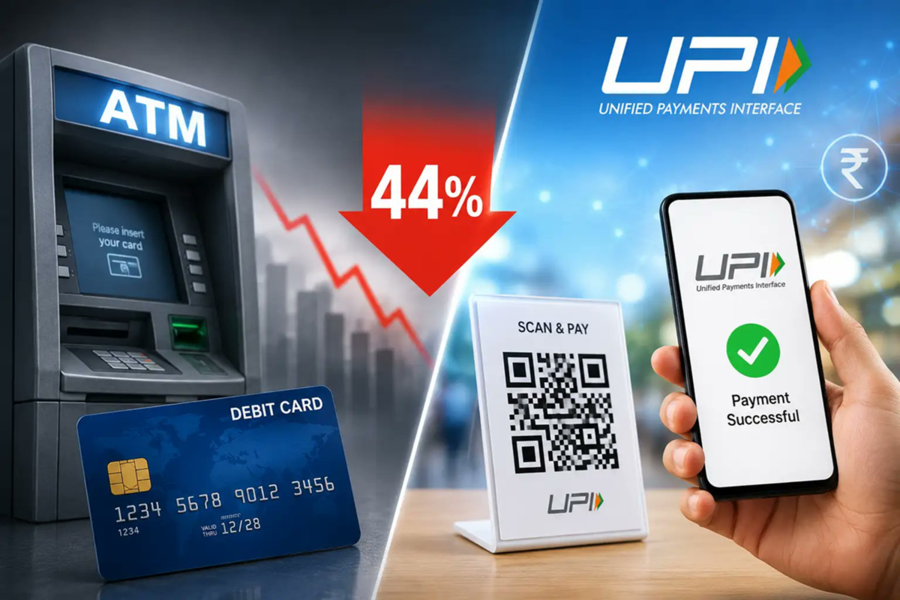
For decades, debit cards have been the most trusted means of withdrawing money for Indians. ATM withdrawals have been convenient. However, according to new RBI data, the number of debit card users has declined. The new data shows that debit card usage has declined by 44 percent in just the last two years.
How much of a decline in two years?
The number of ATM withdrawals has declined sharply. According to the central bank's FY2026 annual report, debit card transactions are projected to decline from 22,86 million in 2023-24 to 16,12 million in 2024-25 and 12,802 million in 2025-26. This data indicates a decline of approximately 44 percent in the last two years.
Why has debit card usage declined?
The decline is due to the increased use of the Unified Payments Interface (UPI). Data shows that UPI transactions increased from 13,11,295 lakh to 24,16,169 lakh in the financial year 2023-24, an increase of approximately 84 percent. People now use UPI for everything from purchasing small items like groceries, vegetables, and other essential items to paying electricity and water bills, and it has become the default payment method. This has reduced the need to swipe or tap debit cards.
In addition, many banks now offer cardless cash withdrawals through mobile banking apps and UPI-enabled platforms, eliminating the need to carry a physical debit card.
Credit card usage has also increased.
Debit cards are typically issued as a default with savings accounts and are issued without any application, whereas this is not the case with credit cards. Reports suggest that people are increasingly using credit cards over debit cards. In April 2026, the volume of credit card transactions increased by approximately 23 percent on a year-on-year basis, while the transaction value rose by 7 percent during the same period.
Disclaimer: This content has been sourced and edited from Dainik Jagran. While we have made modifications for clarity and presentation, the original content belongs to its respective authors and website. We do not claim ownership of the content.
