
What are the disadvantages of not registering a marriage? You will not get relief or access to facilities for these tasks..
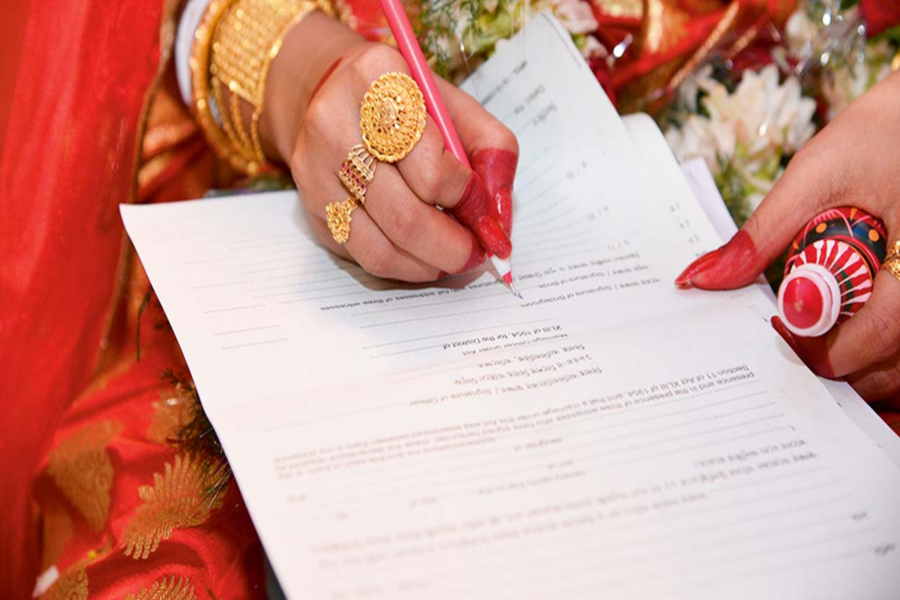
In India, marriage is considered not merely a social and religious bond but also a legal relationship. Often, even after all wedding rituals are concluded, people do not deem marriage registration essential and keep postponing it. However, in changing times, marriage registration has evolved from a mere formality into a key that unlocks various rights and benefits. Failure to register a marriage can lead to difficulties in future legal, financial, and administrative matters. In many instances, proving the marital relationship may require additional documentation and a lengthy, cumbersome process.
In the 2006 case of *Seema vs. Ashwani Kumar*, the Supreme Court directed all states to make marriage registration mandatory. Without registration, there is no official or legal proof of the marital relationship. Should any matrimonial dispute, property issue, or question regarding rights arise in the future, proving the marriage might necessitate reliance on various other documents and witnesses. However, the absence of registration does not invalidate the marriage; registration does not make a marriage 'valid' *per se*, but rather makes it easier to prove.
A marriage certificate may be required if a couple plans to travel abroad, seek employment, or take up permanent residence in another country. This document plays a crucial role in processes such as adding a spouse's name to a passport, obtaining a spouse visa, or relocating abroad with one's family. Many countries list the marriage certificate as a mandatory document for issuing family or dependent visas. Consequently, a lack of registration can make these procedures lengthy and complex.
**Potential Issues with Joint Bank Accounts and Investments**
After marriage, many couples open joint bank accounts or include each other in financial plans. In such cases, banks may request a marriage certificate as proof of the marital relationship. Furthermore, difficulties may arise when adding a spouse or designating them as a nominee for fixed deposits, investment schemes, and other financial services. Many couples also avail of joint loans for purposes such as purchasing a home or starting a business. Banks and financial institutions often require a marriage certificate as proof of the marital relationship. If the marriage is not registered, the process for obtaining a joint home loan or other loans may require additional documentation and could take longer to get approved.
**Insurance claims and nominee procedures can be complex**
A marriage certificate is often required to designate a spouse as a nominee for life insurance, health insurance, and other policies. In the event of an insurance claim, the lack of marriage registration might necessitate additional legal documents to prove the relationship, potentially delaying the settlement of claims. The marriage certificate is considered a crucial document in matters concerning property and inheritance. If a property is held in the name of one spouse and disputes regarding succession or ownership arise later, the absence of marriage registration can complicate matters.
**You may miss out on these facilities**
Opening a joint bank account may require additional documentation if the marriage is not registered.
Including a spouse in fixed deposits, investment schemes, and other financial services may prove difficult.
In many cases, the process of designating a spouse as a nominee can be lengthy and complex.
Proof of relationship may be requested when applying for joint home loans, business loans, or other joint credit facilities.
The absence of a marriage certificate can delay the loan approval process.
Additional legal documents may need to be submitted to prove the relationship at the time of an insurance claim.
Proving the marital relationship can be difficult in disputes related to property, inheritance, and succession.
**Obstacles in accessing government schemes and family benefits**
A marriage certificate is often required to avail of various government schemes, employee benefits, and family entitlements. Frequently, if a marriage is not registered and the husband passes away, a 'Succession Certificate' must be obtained for the transfer of bank accounts or property—a process that is both lengthy and expensive. A marriage certificate effectively eliminates the need for this procedure. This document may be essential for government employees regarding family pension, medical facilities, and dependent benefits. In India, marriage registration is typically conducted under the marriage laws applicable to the respective religion or the Special Marriage Act, 1954. In most states, the process can be completed using identity proof, proof of address, wedding photographs, and witnesses.
While people once considered social and religious customs sufficient proof of marriage, the marriage certificate has now become an essential document. Marriage registration should be completed as soon as possible after the wedding. It is not merely a procedural formality but a crucial step to avoid potential legal, financial, and administrative complications in the future.
