
The entire landscape of international flights has been upended by the conflict in Iran; will those traveling abroad now stand to gain or lose?
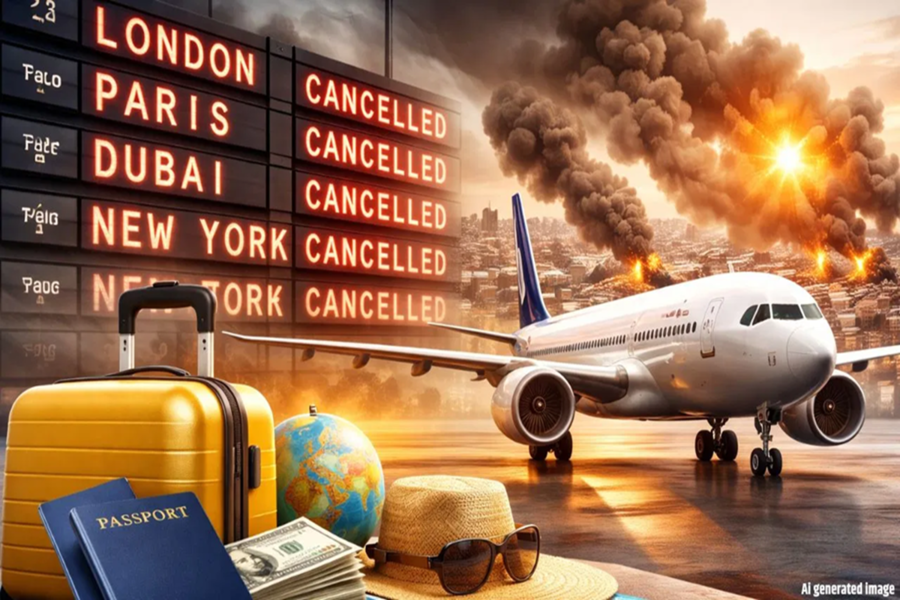
For international travelers, the landscape of the skies is changing rapidly these days. For passengers who have spent years traversing the globe via the magnificent airports of cities like Dubai and Doha, air travel is no longer what it used to be. The conflict unfolding in the Gulf region has completely upended the entire equation of the global aviation industry. Airlines once renowned for their excellent networks and affordable fares have suddenly found themselves on the back foot.
**How Foreign Airlines Seized Opportunity Amidst Crisis**
Major Middle Eastern aviation giants—such as Emirates, Qatar Airways, and Etihad—have historically held a dominant position on routes connecting Europe, Africa, and Asia. However, this business model has been shaken by airspace closures and flight cancellations resulting from the conflict. In light of this, Western carriers like Lufthansa, British Airways, and Air France-KLM have launched an aggressive campaign to fill this void. These airlines have swiftly redeployed their wide-body aircraft toward destinations such as India, Thailand, and Singapore. They aim to attract travelers who are now seeking alternative routes. However, such a shift does not happen overnight, as establishing new routes requires months of extensive planning and crew mobilization.
**Will Your Airfare Prices Rise?**
As a traveler, it is only natural to wonder how this ongoing turbulence in the skies will impact your wallet. In reality, the conflict poses a looming threat of a massive surge in global jet fuel prices. The greatest challenge facing airlines like Lufthansa and British Airways is determining how to manage these escalating costs. If these carriers choose not to absorb the burden of rising fuel costs themselves, it implies that airfares could become significantly more expensive in the near future. While American Airlines may have increased its long-haul flights by 11 to 12 percent, shares of several major European airlines have plummeted by 13 to 27 percent due to fears of a fuel crisis.
**Asian Airlines' Masterstroke**
Due to the ongoing war between Russia and Ukraine, Western airlines were already unable to utilize Russian airspace. Now, with the closure of Iranian and Iraqi airspace, flight operations have become even more complicated. Aircraft are now compelled to navigate through narrow corridors over Georgia and Central Asia. Amidst this entire upheaval, Turkish Airlines and various Asian carriers have capitalized on the situation. India's Air India, Singapore Airlines, and Hong Kong's Cathay Pacific have significantly ramped up their flights toward Europe. According to Bloomberg data, Turkish Airlines has seen its market share grow during this crisis period, while Qatar Airways has suffered significant losses.
**The Real 'Price War' Will Begin in the Skies Once the Fighting Ceases**
It would be premature to assume that the dominance of Gulf-based airlines has ended forever. Aviation experts believe that as soon as conditions normalize, these Middle Eastern giants will return to the market with renewed aggression. To reclaim their lost passenger traffic and market share, they are likely to offer travelers highly enticing and affordable fares. Western airlines have only a limited window of opportunity to generate profits. Airlines like Emirates—which has expanded its empire manifold within just a few decades—will not cede their ground easily.
Disclaimer: This content has been sourced and edited from TV9. While we have made modifications for clarity and presentation, the original content belongs to its respective authors and website. We do not claim ownership of the content.
