
SIP vs STP: Which Investment Strategy Gives Better Returns for Investors?

Many investors planning to grow their wealth through mutual funds often face a common dilemma: Should they invest through a Systematic Investment Plan (SIP) or choose a Systematic Transfer Plan (STP)? At first glance, both methods appear similar since the investment eventually moves into equity funds in instalments. However, a deeper look reveals significant differences in how each strategy works — and the results can vary as well.
Here’s a detailed comparison to help you understand which approach suits you best.
SIP Works Best for Those with a Regular Income
A Systematic Investment Plan (SIP) is ideal for individuals who receive a fixed monthly income, such as salaried employees. Through SIP, investors commit a specific amount each month into a mutual fund scheme. Over time, these small instalments accumulate into a sizeable corpus.
Raghavendra Nath, Managing Director at Ladderup Asset Managers, explains, “SIPs work very well for anyone who earns regularly and can invest a small portion every month. It eliminates the need to time the market and helps build long-term wealth in a disciplined manner.”
SIP not only brings consistency to your investment journey but also reduces risk through rupee-cost averaging, especially during market fluctuations.
STP Is Suitable When You Have a Lump-Sum Amount
An STP (Systematic Transfer Plan) is a better choice for investors who already have a large sum of money available. Instead of putting the entire amount into equities at once, the money is first parked in a liquid fund. From there, fixed amounts are transferred at regular intervals to an equity fund.
Aditya Agarwal, Co-Founder at Wealthy.in, says, “If an investor has the full amount available from the beginning, STP often delivers better outcomes because the money earns returns inside a liquid fund before being moved into equities.”
This strategy not only reduces the risk of market volatility but also ensures that your idle funds are earning returns in the meantime.
How SIP and STP Differ in Investment Approach
The primary difference lies in where the remaining money stays before it enters equities:
-
In SIP, the investor keeps the leftover amount in a savings account, which usually offers around 3% annual interest.
-
In STP, the money stays in a liquid fund, which typically yields around 6% per year, nearly double that of savings accounts.
Over a long period, this seemingly small interest-rate difference can have a significant impact on total returns.
Example: How Returns Change in SIP vs STP
Consider this scenario:
-
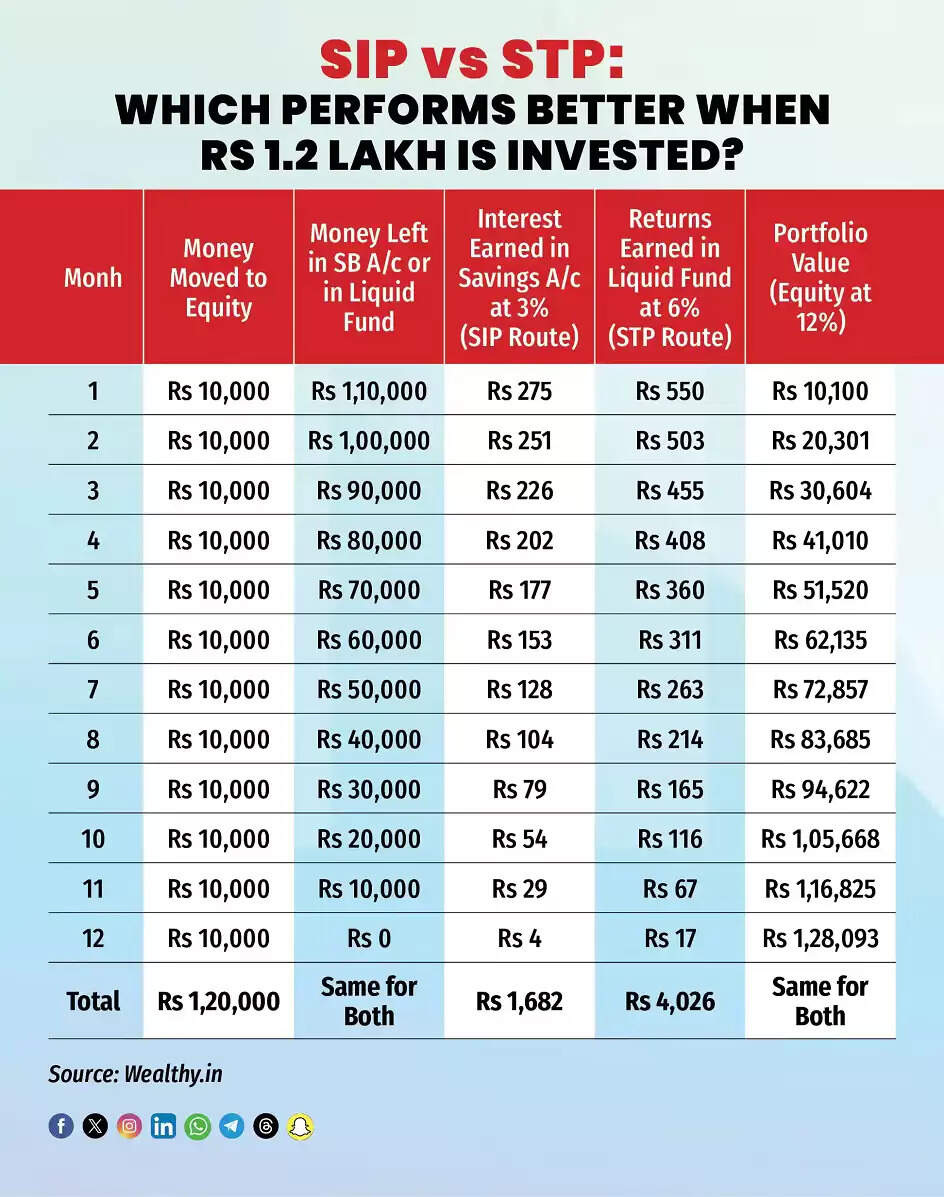
Investor A uses SIP and invests ₹10,000 every month into an equity fund. The remaining money stays in a savings account earning 3% interest.
-
Investor B puts ₹1.2 lakh into a liquid fund and sets up a 12-month STP to transfer ₹10,000 each month into the same equity fund.
Now compare the interest earned:
-
Savings account (3%) → approx. ₹1,682 interest
-
Liquid fund (6%) → approx. ₹4,026 interest
This clearly shows that the additional return from the liquid fund boosts the overall gains in STP.
However, it is important to note that STP does not always guarantee superior returns.
STP Benefits Depend on Market Timing
While STP offers time diversification, its effectiveness depends heavily on the period of transfer. Karan Agarwal, CIO at Elevare, gives a cautionary example: if an investor’s lump-sum amount had been invested through STP and the transfer period ended in December 2007, they would have missed the opportunity to invest more during the 2008 market crash — a time when equity markets fell sharply due to the global financial crisis.
Therefore, STP can work well in stable or rising markets, but it may not always capture opportunities in sudden downturns.
So, Which Strategy Should You Choose?
The choice depends entirely on your financial situation:
✔ Choose SIP If:
-
You earn a steady monthly income
-
You prefer disciplined, long-term investing
-
You want to avoid timing the market
✔ Choose STP If:
-
You have a lump-sum amount from a bonus, property sale, inheritance, or savings
-
You want to gradually enter equities while earning additional returns on parked funds
-
You want to reduce the risk of investing a large amount at once
Both SIP and STP are effective investment tools, but they work best in different scenarios. Understanding your income pattern, risk appetite, and financial goals will help you choose the right method.
