
SIP vs EMI vs FD: Which will make you the wealthiest in the next 20 years? Find out which option will be the most profitable..
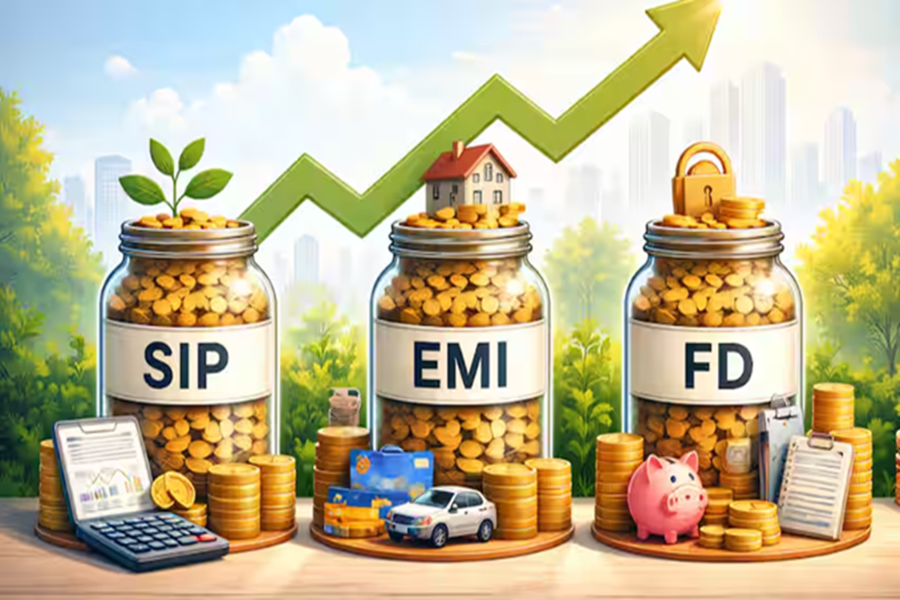
Saving money and then becoming rich – these are actually two different things. In fact, we Indians have always been told to save money and invest in Fixed Deposits (FDs). But in today's era of high inflation, will these old methods work in the future? The truth is, there are now many excellent investment options available in the market that are helping people become wealthy. That's why today, everyone faces three major paths: one that builds wealth slowly (SIP), another that offers a guarantee (FD), and a third that provides the pleasure of fulfilling needs initially but leaves you with an empty pocket later (EMI).
So, if you invest a portion of your earnings in any of these three options today, what will your life be like in 20 years? Let's pick up the calculator without further ado and analyze all three in simple terms to see what would be right for the future.
1. FD (Fixed Deposit): Security is there, but will you become rich?
FDs are considered synonymous with trust in our country. We all go to the bank, deposit money, and sleep peacefully.
Calculation: Let's say you start an FD of ₹10,000 per month. Currently, you are getting an interest rate of 7%.
After 20 years: Your total deposit will be approximately ₹24 lakhs, and at maturity, you will receive around ₹52 lakhs.
Value with inflation: While a fund of ₹52 lakhs sounds very large, considering inflation over 20 years, the value of this money might only be equivalent to ₹15-20 lakhs in today's terms. This means that an FD only saves money; it doesn't increase its value in line with inflation.
2. EMI: Pleasure first, then punishment?
EMIs are not a path to becoming rich, but rather a path to appearing rich. We easily buy things on EMI to fulfill every need. But when you pay an EMI for something, you are spending your future earnings today. Calculation: If you pay an EMI of ₹10,000 for a personal loan or a luxury car for 20 years (through various loans).
After 20 years: Let's assume you've paid ₹24 lakhs from your own pocket, plus an additional ₹15-20 lakhs in interest to the bank.
Result: This means that after 20 years, you'll only be left with an old item whose value has probably depreciated to zero. EMIs don't make you rich; they make the bank rich and diminish your future net worth.
3. SIP: Small Investment, Big Impact
SIP stands for discipline. Essentially, it leverages the fluctuations of the stock market to give your money the power of compounding.
Calculation: So, if you invest ₹10,000 monthly in a good mutual fund through an SIP, and we consider an average return of 12% (which many funds have delivered over the past 20 years).
After 20 years: Your total investment will still be ₹24 lakhs, but the amount you'll receive will astound you – approximately ₹1 crore. That's a fund of ₹1 crore in 20 years!
The Magic: If the return is 15% (which is possible), this amount will exceed ₹1.5 crore. This is the real path to wealth.
Disclaimer: This content has been sourced and edited from NDTV India. While we have made modifications for clarity and presentation, the original content belongs to its respective authors and website. We do not claim ownership of the content.
