
SIP Investment Strategy Explained: How to Allocate Funds Across Large, Mid, and Small Caps
Starting a Systematic Investment Plan (SIP) is one of the most popular ways to build wealth over time. However, many investors often struggle with one key question—how to divide money between large-cap, mid-cap, and small-cap funds. Understanding this balance is crucial for managing both risk and returns effectively.
Understanding the Three Fund Categories
1. Large-Cap Funds: Stability First
Large-cap funds invest in well-established companies with strong market presence. These companies are usually industry leaders and offer relatively stable returns.
- Lower risk compared to other categories
- Suitable for beginners and conservative investors
- Provides steady, long-term growth
2. Mid-Cap Funds: Growth with Moderate Risk
Mid-cap funds focus on companies that are in the growth phase. These businesses have the potential to become future leaders but come with higher volatility.
- Higher return potential than large caps
- Moderate risk involved
- Ideal for investors seeking balanced growth
3. Small-Cap Funds: High Risk, High Reward
Small-cap funds invest in smaller companies with strong growth potential. However, they are highly volatile and can fluctuate significantly in the short term.
- Maximum growth potential
- High risk and market fluctuations
- Suitable for experienced investors
How Should You Allocate Your SIP?
Experts suggest that the best approach is diversification, meaning spreading your investment across all three categories instead of putting all your money into one.
A commonly followed strategy could be:
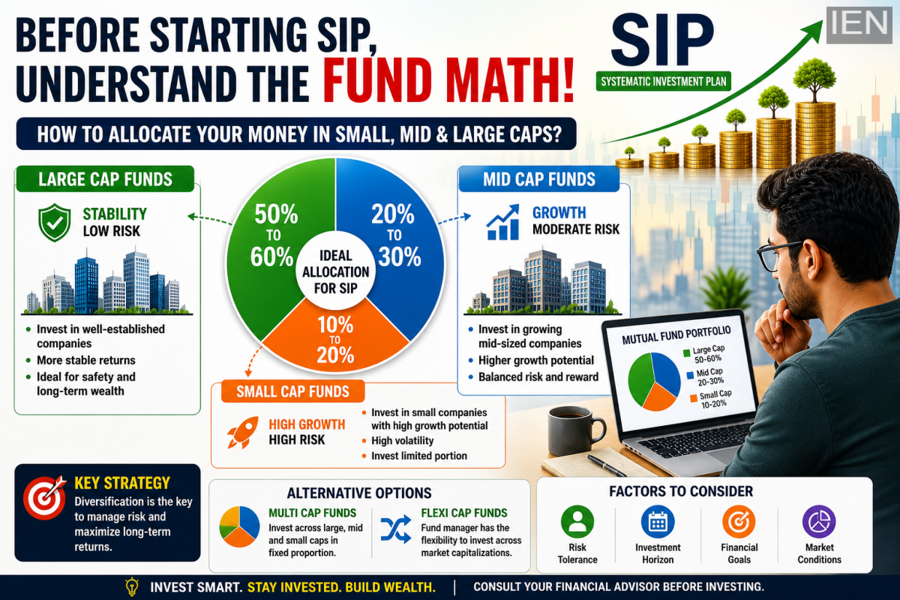
- 50–60% in Large-Cap Funds (for stability)
- 20–30% in Mid-Cap Funds (for growth)
- 10–20% in Small-Cap Funds (for higher returns potential)
This balanced allocation helps reduce overall risk while still allowing your portfolio to grow.
Alternative Options: Multi-Cap and Flexi-Cap Funds
If selecting individual categories feels confusing, you can consider:
- Multi-cap funds: Invest across large, mid, and small caps in fixed proportions
- Flexi-cap funds: Allow fund managers to adjust allocation dynamically based on market conditions
These options simplify investment decisions while maintaining diversification.
Key Factors to Consider Before Investing
Before finalizing your SIP strategy, keep these points in mind:
- Your risk tolerance
- Investment time horizon
- Financial goals (short-term vs long-term)
- Market conditions
A younger investor with a long-term horizon may take more exposure to mid and small caps, while conservative investors may prefer large-cap dominance.
Why Diversification Matters
Putting all your money in one category increases risk. Diversification ensures that even if one segment underperforms, others can balance your returns.
It also helps smooth out market volatility and improves long-term wealth creation potential.
Final Thoughts
Building a successful SIP portfolio is not about chasing the highest returns but about maintaining the right balance between risk and reward. By allocating your investments wisely across large, mid, and small-cap funds, you can create a stable yet growth-oriented portfolio.
For beginners, starting with a diversified approach or opting for flexi-cap funds can be a smart and hassle-free way to begin the investment journey.
