
SIP: How to Become a Millionaire by Saving Just ₹2,000 Every Month? Understand This Magical SIP Formula..
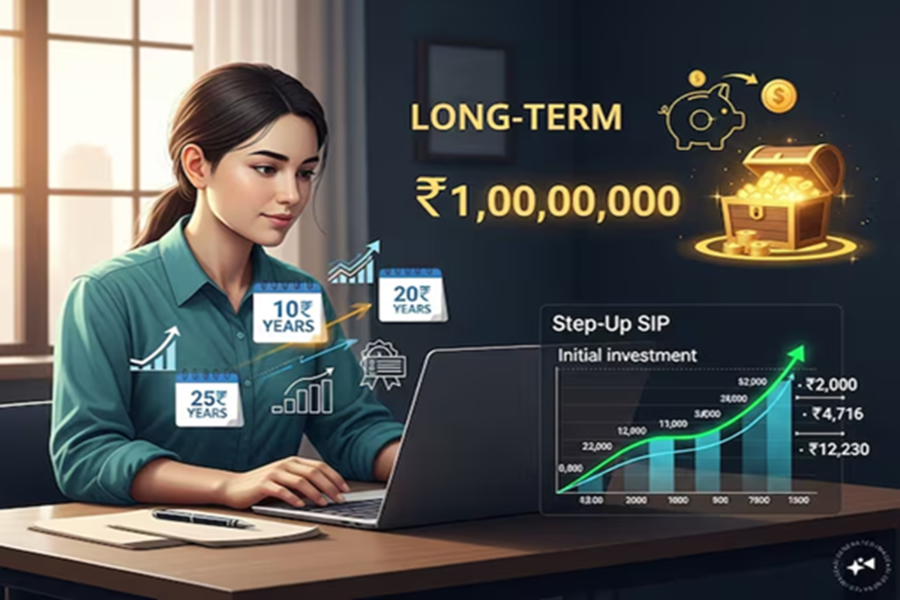
People often harbor the misconception that becoming a millionaire requires investing a massive sum of money. However, the reality is that you can build a substantial fund even through modest savings. To achieve this, you must not merely save; you must also adopt a "smart investment strategy." As the saying goes, "Growing money correctly is even more important than simply saving it." You can accomplish this through a "Step-Up SIP." If you embrace this strategy and invest with discipline, saving just ₹2,000 every month could eventually make you a millionaire.
A Step-Up SIP is a modern investment method designed to keep pace with your rising income. If, for instance, your salary increases every year, your investment should ideally grow in the same proportion. In a standard SIP, you deposit a fixed amount every month; however, with a Step-Up SIP, you opt to increase your investment amount by a specific percentage (such as 10% or 15%) each year.
How Does the Step-Up Work?
Let's understand this with an example. Suppose you start investing with ₹2,000 and choose a 10% annual step-up. In the first year, you will contribute ₹2,000 every month. In the second year, this amount will automatically increase to ₹2,200, and in the third year, to ₹2,420. This seemingly minor adjustment can make a world of difference to your final investment corpus over the long term.
How Will Your Money Grow?
If you start a SIP of ₹2,000 today and increase it by 10% annually, your investment journey—assuming an average annual return of 15%—would unfold as follows:
The First 10 Years: During the first decade, your monthly SIP contribution will gradually rise to reach ₹4,716. Over this period, the value of your investment will grow to approximately ₹9.35 lakhs. This marks the phase where you witness your hard-earned money steadily accumulating. The 20-Year Journey: As time progresses, the power of compounding begins to manifest its full effect. By the completion of 20 years, your monthly SIP contribution will have reached ₹12,230, and your fund value will have surged past the ₹64 lakh mark.
The 24th–25th Year: At this juncture, the entire dynamic of the game shifts completely. By the end of the 24th year, your investment magically crosses the ₹1 crore milestone.
Market fluctuations are an inherent part of investing. The success of your investment plan also hinges on the average rate of return you generate:
15% Returns: If you invest in equity mutual funds (specifically mid-cap or small-cap funds) and achieve a return of 15%, you will become a crorepati (multi-millionaire) within 24 years.
12% Returns: If the market remains somewhat subdued and the average return stands at 12%, it will take you 28 years to reach the ₹1 crore mark with the same investment amount.
Benefits of a Step-Up SIP
A Strong Shield Against Inflation: As time passes, inflation erodes the purchasing power of money. A Step-Up SIP ensures that your investment continues to grow at a pace that outstrips rising inflation.
Discipline and Convenience: You do not need to manually initiate a new SIP every time you receive a job promotion or experience an increase in business profits. It operates on a simple "Set it and forget it" model.
Accelerated Goal Achievement: Compared to a standard SIP, a Step-Up strategy allows you to achieve your financial goals—such as retirement planning or purchasing a home—5 to 7 years sooner.
Who Is a Step-Up SIP Best Suited For?
This formula is a boon for salaried individuals who can reasonably anticipate an annual increment in their income. Furthermore, it is an excellent option for young professionals who may not be able to make substantial investments at the very beginning of their careers but aspire to increase their investment capacity in the future.
Disclaimer: This content has been sourced and edited from News18 Hindi. While we have made modifications for clarity and presentation, the original content belongs to its respective authors and website. We do not claim ownership of the content.
