
SCSS vs. Post Office MIS: Which scheme offers higher regular income after retirement? Understand the detailed calculations..
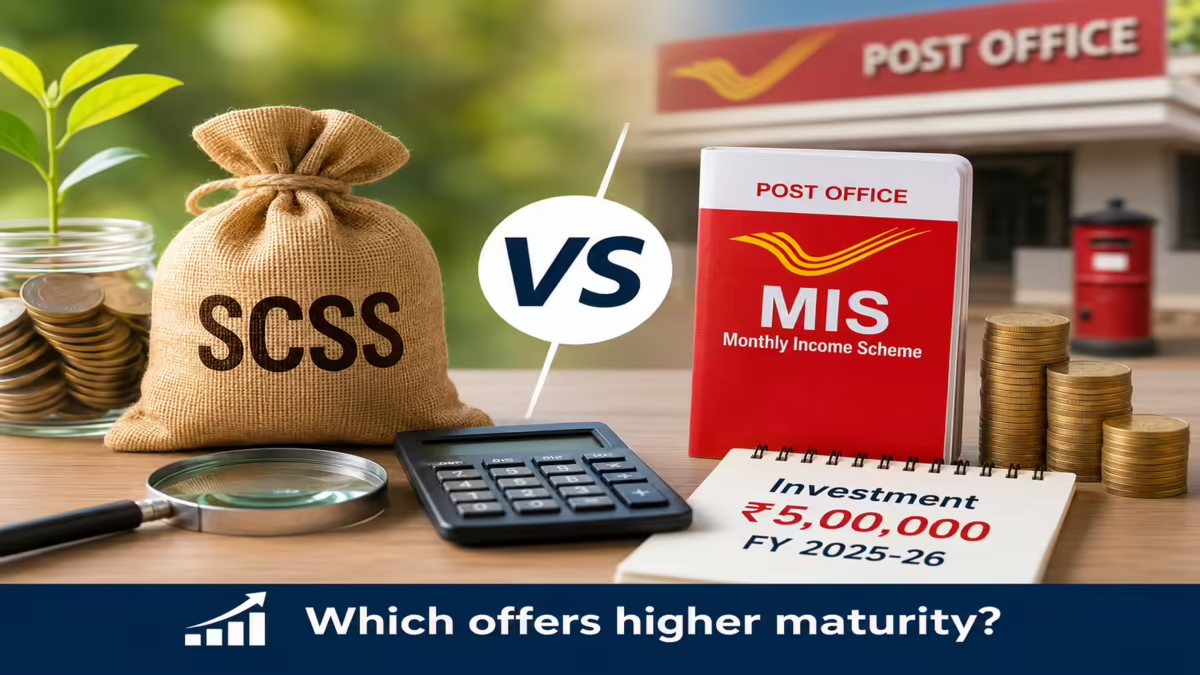
Senior Citizens Savings Scheme vs. Post Office MIS: After retirement, everyone's top priority is a secure and fixed regular income. In this context, two of the Post Office's most popular government schemes—the Senior Citizens Savings Scheme (SCSS) and the Post Office Monthly Income Scheme (POMIS)—emerge as the preferred choices for investors.
While both schemes are secure and backed by a full government guarantee, they differ significantly in terms of interest rates, investment limits, payout methods, and tax rules. Let’s explore which scheme might be better suited for your retirement.
Who can invest?
SCSS: This scheme is primarily designed for senior citizens aged 60 years or older. However, employees opting for Voluntary Retirement (VRS) or retiring from government service can open an account before the age of 60, subject to certain conditions.
Post Office MIS: There is no age restriction for this scheme. Apart from senior citizens, any Indian citizen over the age of 18 can open an account.
Interest rates and payout method
SCSS: For the July–September 2026 quarter, the SCSS offers an annual interest rate of 8.2%. Interest under this scheme is paid quarterly on the first working day of April, July, October, and January.
Post Office MIS: POMIS offers an annual interest rate of 7.4%. A key feature is that interest is paid monthly directly into your bank or post office account, making it highly convenient for managing household expenses.
What is the maximum investment limit?
SCSS: An individual can invest up to a maximum of ₹30 lakh.
Post Office MIS: A maximum of ₹9 lakh can be deposited in a single account, while a joint account allows for a maximum deposit of ₹15 lakh.
Calculation: What kind of returns can you expect? Let’s use calculations to understand how much you would earn from each scheme based on the maximum investment limit:
Case 1: SCSS (Investment of ₹30 lakh @ 8.2%)
Total investment: ₹30,00,000
Annual interest: ₹2,46,000
Quarterly earnings: ₹61,500
Monthly average: Approx. ₹20,500 per month
Case 2: Post Office MIS – Joint Account (Investment of ₹15 lakh @ 7.4%)
Total investment: ₹15,00,000
Annual interest: ₹1,11,000
Monthly earnings: ₹9,250
Case 3: Post Office MIS – Single Account (Investment of ₹9 lakh @ 7.4%)
Total investment: ₹9,00,000
Annual interest: ₹66,600
Monthly earnings: ₹5,550
Lock-in period and tax rules
Both schemes have a maturity period of 5 years. However, premature withdrawal is permitted subject to certain deductions and conditions. The interest earned from both schemes is fully taxable according to the investor's tax slab. TDS may also be deducted by the bank or post office if the interest exceeds the prescribed limit. (For SCSS, a tax deduction benefit of up to ₹1.5 lakh under Section 80C is available on the initial investment).
Which scheme is best for you?
Choose SCSS: If you have a substantial retirement corpus, are over 60 years of age, and wish to receive a significant lump sum every quarter along with higher returns (8.2%).
Choose Post Office MIS: If you require a fixed monthly income to cover regular household and kitchen expenses.
Smart Strategy: Experts believe that a combination of both schemes is the best approach for the post-retirement period. You can earn higher returns by investing a large portion of your funds in the SCSS, while maintaining monthly cash flow by allocating a part to the MIS.
Disclaimer: This content has been sourced and edited from Money Control. While we have made modifications for clarity and presentation, the original content belongs to its respective authors and website. We do not claim ownership of the content.
