
Scored only 51 in Math but had big ambitions: Pawan Chandana built India's first private space rocket.
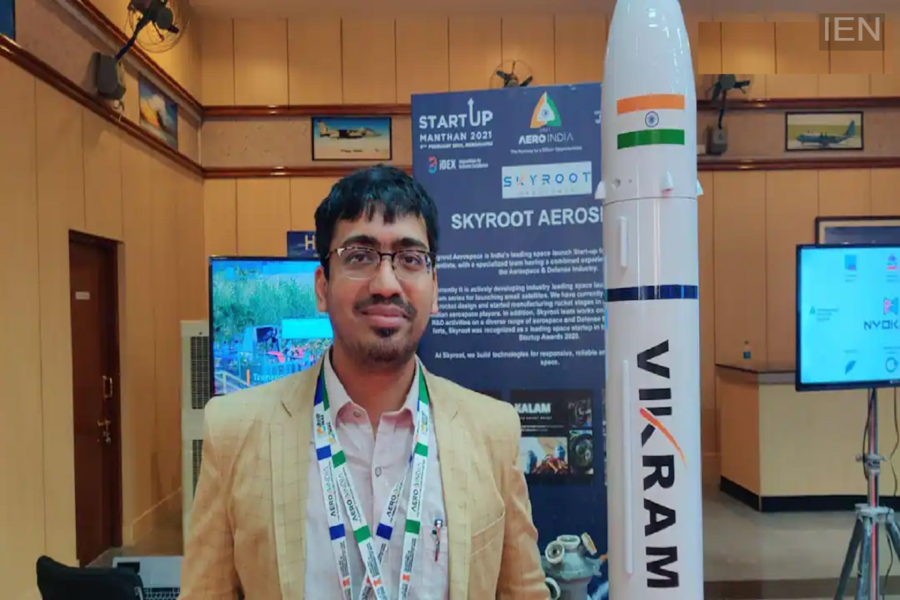
Raised in Hyderabad, Pawan Chandana comes from an ordinary middle-class family. He had an interest in understanding machines and technology from childhood. However, mathematics was not his strong suit during his academic years.
Pawan Chandana Success Story: After scoring just 51 marks in mathematics in a school exam, hardly anyone would have imagined that this student would go on to become a prominent figure in India's private space sector. Yet, Pawan Kumar Chandana has proven that success is not defined merely by marks. Today, the Vikram-1 rocket—developed by his company, Skyroot Aerospace—has become India's first privately developed rocket to reach space. This achievement is considered a significant milestone not only for the company but also for India's private space sector.
Weak in Math, but deeply interested in machines
Raised in Hyderabad, Pawan Chandana comes from an ordinary middle-class family. He had an interest in understanding machines and technology from childhood. However, mathematics was not his strong suit during his studies, and he once scored only 51 marks in an exam. Despite this, he never stopped learning. His father, in particular, encouraged him during difficult times, helping him maintain his self-confidence. Over time, mathematics and science—subjects that once seemed challenging—became the strongest foundation of his career.
Cleared IIT on the first attempt, then got an opportunity at ISRO
Nearly two decades ago, Pawan Chandana cleared the IIT entrance exam on his very first attempt and enrolled at IIT Kharagpur. After completing his engineering studies, he secured an opportunity to work at ISRO through campus placement. Although the salary at ISRO was lower than that of private companies, the most important thing for Chandana was the chance to be part of the nation's space program.
Worked on the GSLV Mk-3 Project
During his six-year tenure at ISRO, Pawan Chandana worked on several critical projects related to the development of India's most powerful launch vehicle, the GSLV Mk-3, at the Vikram Sarabhai Space Centre in Thiruvananthapuram. He also received an innovation award from the organization for his contributions. It was during this time that the idea struck him: the private sector in India could also play a significant role in the field of rocket manufacturing.
Left ISRO to Found Skyroot Aerospace
In June 2018, Pawan Chandana co-founded Skyroot Aerospace in Hyderabad alongside his colleague and former ISRO scientist, Naga Bharath Daka. At that time, launching a private space startup in India was no easy task; investors were not entirely convinced about the sector's potential. In the early stages, Binny Bansal—Flipkart co-founder and IIT Kharagpur alumnus—invested $1.5 million in the company. While the pace of funding slowed during the COVID-19 pandemic, Greenko later provided financial support, accelerating the company's journey.
Achieving Major Successes
In July 2020, Skyroot became the first private company in India to successfully test a rocket engine. The engine was named 'Raman-1' in honor of Nobel laureate C.V. Raman. Subsequently, after the Government of India opened the space sector to private players, Skyroot became the first private company to sign an agreement with ISRO. The company later secured substantial funding—amounting to $51 million—which was ranked among the largest investments in India's deep-tech sector at the time.
The Journey from Vikram-S to Vikram-1
On November 18, 2022, Skyroot launched the 'Vikram-S,' India's first privately developed suborbital rocket. This launch marked a new beginning for the country's private space industry. Following this, the company continued to work steadily on its launch vehicles and technology. Recently, Vikram-1 made history by reaching space as India's first privately developed space rocket. This is being hailed as a major achievement for India's private space sector.
