
Rooftop Solar vs Fixed Deposit: How Your Terrace Could Earn More Than a Bank FD
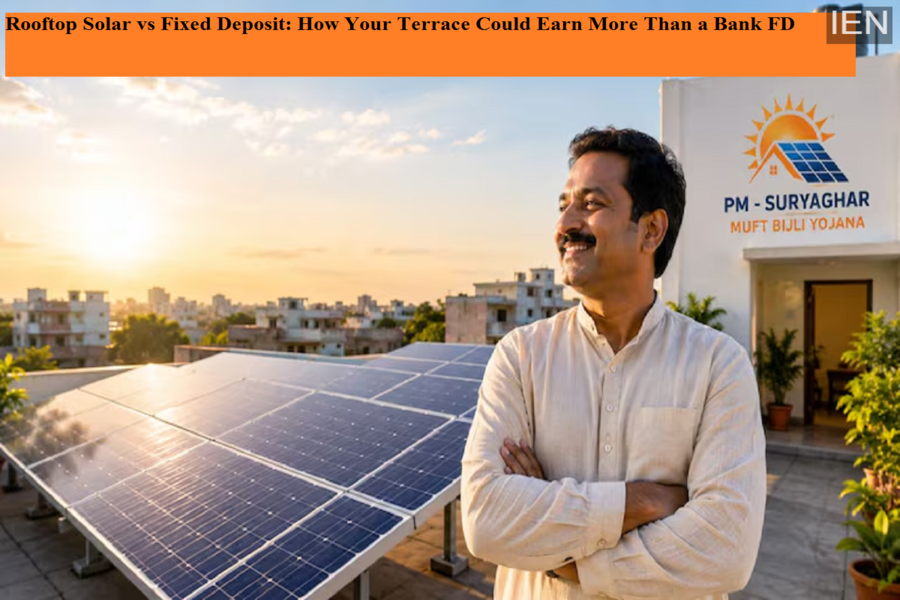
For decades, bank fixed deposits (FDs) have been the preferred investment option for millions of Indian households seeking safety and predictable returns. However, with interest rates offering limited real returns after taxes and inflation, many homeowners are beginning to explore alternative ways to grow their money.
One such option is rooftop solar. Thanks to generous government subsidies, rising electricity tariffs, and long-term savings, installing a solar power system on your home's roof is increasingly being viewed as an investment rather than just an energy-saving solution.
Financial calculations suggest that a residential rooftop solar system can potentially generate returns significantly higher than those offered by traditional fixed deposits.
Why Rooftop Solar Is Becoming a Popular Investment
A rooftop solar installation allows homeowners to generate their own electricity using sunlight. This reduces dependence on grid power and cuts monthly electricity bills.
Unlike many financial products, the return from a solar system comes in the form of direct savings. Every unit of electricity generated by the system reduces the amount of power purchased from the electricity distribution company.
When these savings are calculated over the life of the system, the returns can be surprisingly attractive.
Comparing Bank FD Returns and Solar Savings
Most leading public and private sector banks currently offer fixed deposit interest rates in the range of approximately 6.5% to 7.5% annually. After accounting for taxes, the effective return often becomes even lower.
A rooftop solar system, on the other hand, can deliver annual savings that translate into an estimated return of 15% to 25%, depending on electricity consumption patterns and local power tariffs.
This makes solar energy one of the few low-risk investments capable of generating double-digit returns over a long period.
How Much Can a 3 kW Solar System Save?
A typical 3-kilowatt rooftop solar system is among the most popular choices for Indian households.
After government subsidies, the installation cost generally falls between ₹1.2 lakh and ₹1.4 lakh.
Such a system can generate approximately 360 to 400 units of electricity every month under favorable conditions.
Assuming an average electricity tariff of ₹7 per unit, monthly savings can range between ₹2,500 and ₹2,800. On an annual basis, this translates to savings of roughly ₹30,000 to ₹33,000.
If a homeowner invests ₹1.3 lakh and saves around ₹33,000 annually, the effective return works out to nearly 25% per year—substantially higher than a conventional fixed deposit.
Investment Recovery in Just 4–5 Years
One of the biggest advantages of rooftop solar is its relatively short payback period.
Most residential systems recover their entire installation cost within four to five years through electricity bill savings alone.
Once the initial investment has been recovered, the electricity generated by the system effectively becomes free for the remainder of its operational life.
This means homeowners can continue enjoying significant savings for decades after the payback period ends.
Government Subsidies Make Solar More Affordable
The Central Government's PM Surya Ghar Muft Bijli Yojana has made rooftop solar installations much more accessible for households.
Under the scheme, eligible consumers can receive substantial financial assistance:
-
1 kW Solar System: Subsidy up to ₹30,000
-
2 kW Solar System: Subsidy up to ₹60,000
-
3 kW and Above: Subsidy up to ₹78,000
These incentives significantly reduce the upfront investment required, improving the overall return on investment.
Long Life, Low Maintenance
Another major advantage of solar panels is their longevity.
Most modern rooftop solar systems come with performance warranties extending up to 25 years. This means a one-time investment can continue delivering benefits for more than two decades.
Maintenance requirements are minimal. In most cases, homeowners only need to clean the panels periodically to ensure optimal performance.
Unlike many financial products, there are no recurring management charges, renewal fees, or administrative costs.
Earn More Through Net Metering
Many states have implemented net metering policies that allow homeowners to export surplus electricity back to the grid.
If your household consumes less electricity than the solar system generates, the excess power is transferred to the local electricity network.
Depending on state regulations, consumers may receive bill credits or financial compensation for the surplus energy supplied to the grid.
This additional benefit can further improve the overall economics of a rooftop solar investment.
Is Rooftop Solar a Better Choice Than an FD?
For homeowners with an investable surplus of ₹1 lakh to ₹2 lakh, rooftop solar may offer a compelling alternative to a traditional fixed deposit.
While FDs continue to provide capital protection and guaranteed returns, solar systems combine long-term savings, government support, energy independence, and inflation-beating returns.
In addition to generating financial benefits, solar power helps reduce dependence on conventional energy sources and lowers household carbon emissions.
For families with suitable rooftop space and consistent electricity consumption, investing in solar energy could be one of the smartest financial decisions they make in 2026.
The Bottom Line
Rooftop solar is no longer just an environmental choice—it has become a powerful financial asset. With government subsidies reducing installation costs and electricity prices continuing to rise, homeowners can unlock substantial long-term savings from unused roof space.
When compared with the returns offered by many traditional investment options, a well-designed rooftop solar system has the potential to deliver stronger returns while providing clean energy for years to come.
