
Rooftop Solar Rules Changed From June 1: New Subsidy Guidelines, Costs, and Eligibility Explained
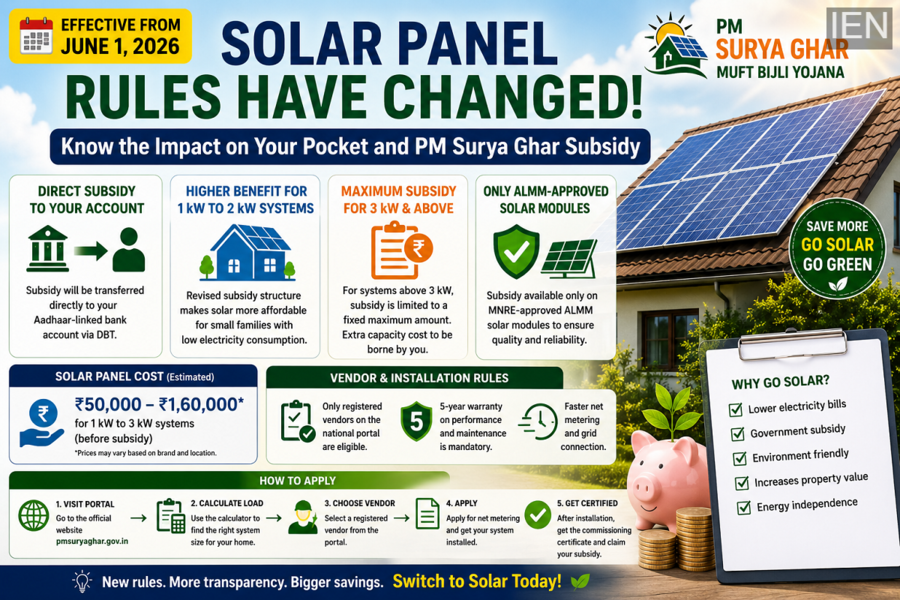
Homeowners planning to install rooftop solar panels should take note of the latest policy changes introduced from June 1, 2026. The government has updated several rules related to solar panel installation, vendor eligibility, subsidy disbursement, and equipment standards under the PM Surya Ghar Muft Bijli Yojana.
The revised framework aims to make the subsidy process more transparent, improve installation quality, and ensure that the benefits of the scheme reach genuine residential consumers.
These changes could directly affect the total cost of a solar installation, the subsidy amount received, and the process homeowners must follow to qualify for government support.
Direct Subsidy Transfer Introduced
One of the most significant changes is the introduction of a Direct Benefit Transfer (DBT) mechanism for rooftop solar subsidies.
Under the new system, subsidy payments will no longer be routed through installers or intermediaries. Instead, the subsidy amount will be credited directly to the homeowner's Aadhaar-linked bank account.
The move is expected to increase transparency, reduce delays, and minimize the chances of misuse of government incentives.
Revised Benefits for Small Residential Systems
The government has also restructured subsidy support for smaller rooftop solar systems.
Households consuming approximately 150 to 300 units of electricity per month and opting for 1 kW or 2 kW solar systems are expected to benefit from improved subsidy support.
The revised structure is designed to reduce the upfront financial burden on middle-class and lower-income families, making solar adoption more affordable for households with modest electricity requirements.
Subsidy Cap Fixed for Larger Systems
Homeowners planning to install systems larger than 3 kW should be aware of another important rule.
The government has fixed a maximum subsidy limit for rooftop solar installations. This means that even if a homeowner installs a 5 kW, 7 kW, or 10 kW system, the subsidy will not increase beyond the prescribed ceiling.
For example, if the maximum subsidy for a 3 kW system is fixed at ₹78,000, the same subsidy amount will apply even if a larger-capacity system is installed. The additional cost of higher capacity must be borne entirely by the homeowner.
ALMM-Approved Solar Panels Now Mandatory
Eligibility for government subsidies has also been linked to the quality and origin of solar equipment.
Going forward, subsidy benefits will be available only for systems that use solar modules listed under the Approved List of Models and Manufacturers (ALMM) issued by the Ministry of New and Renewable Energy (MNRE).
The measure is intended to promote quality standards and encourage the use of approved domestic manufacturing facilities.
What Will Happen to Solar Panel Prices?
Industry experts expect some changes in installation costs following the new regulations.
The government's focus on promoting domestically manufactured solar equipment is likely to reduce dependence on imported modules and support India's solar manufacturing ecosystem.
According to market estimates:
-
1 kW to 3 kW rooftop solar systems may cost approximately ₹50,000 to ₹1.6 lakh before subsidy.
-
Actual out-of-pocket expenses for consumers will be lower after government support is credited.
Vendor Rules Have Become Stricter
To improve service quality and prevent unauthorized installations, the government has tightened vendor eligibility requirements.
Only Registered Vendors Eligible
Consumers will now be required to select installers registered on the National Rooftop Solar Portal. Subsidy claims will not be processed for installations carried out by unregistered vendors.
Five-Year Warranty Made Mandatory
Under the revised guidelines, vendors must provide a minimum five-year performance and maintenance warranty for the complete solar system.
If technical issues arise during the warranty period, the installer will be responsible for addressing them.
Faster Net Metering Process
The government has also shortened timelines for electricity distribution companies to install net meters and connect rooftop solar systems to the grid.
The objective is to reduce approval delays and allow homeowners to start benefiting from solar generation sooner.
How to Apply Under the New Rules
Homeowners planning to install a rooftop solar system can follow these steps:
-
Visit the official PM Surya Ghar portal.
-
Calculate the required solar capacity based on monthly electricity consumption.
-
Select a registered vendor listed on the portal.
-
Apply for net metering approval.
-
Ensure installation is completed according to prescribed standards.
-
Obtain the commissioning certificate after installation.
-
Complete subsidy claim formalities for direct transfer to the linked bank account.
What Homeowners Should Keep in Mind
The updated rules are designed to make rooftop solar adoption safer, more transparent, and consumer-friendly. While larger systems will continue to receive support only up to the prescribed subsidy cap, smaller households may benefit from a more favorable subsidy structure.
With direct bank transfers, stricter vendor regulation, mandatory warranties, and faster grid approvals, the government is aiming to simplify the rooftop solar journey for residential consumers while ensuring better accountability across the sector.
For anyone planning to install solar panels in 2026, understanding these revised guidelines could help maximize subsidy benefits and avoid costly mistakes during the application process.
