
Retirement Investment: Where should you invest EPF money for regular income after retirement? Find out from experts..
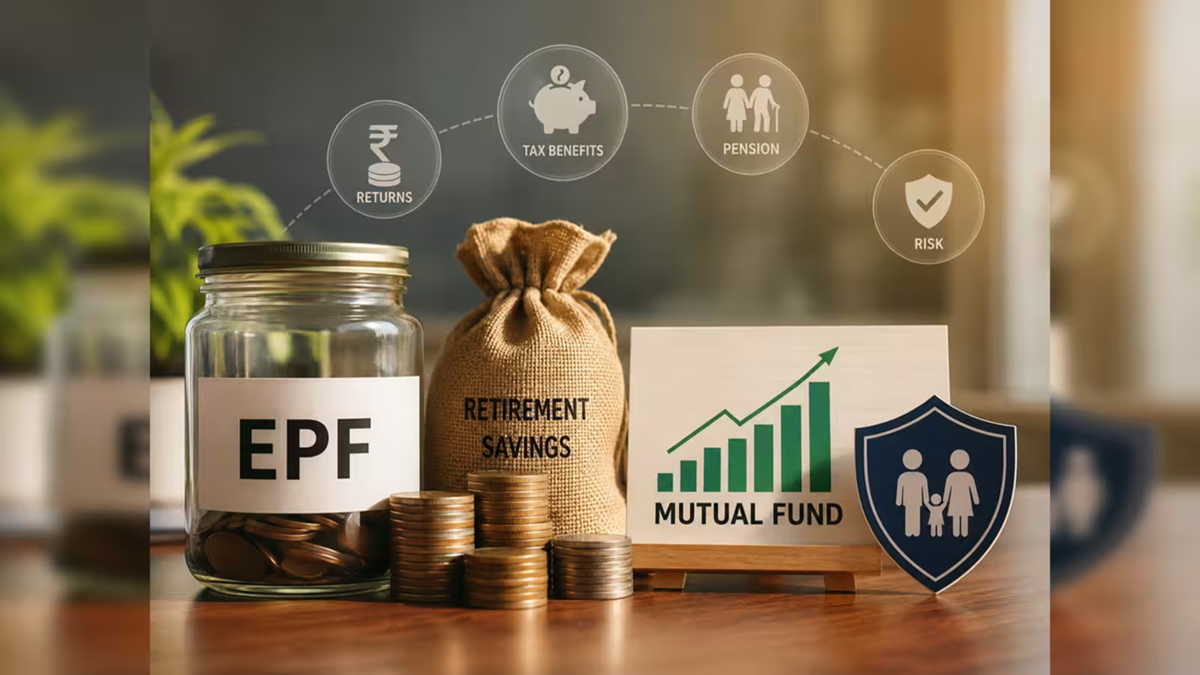
EPF Retirement Investment: Many salaried employees accumulate a substantial corpus in the Employees’ Provident Fund (EPF) by the time they retire. However, the real challenge begins once the salary stops. The question arises: how can this money be made to last for the long term? Should the entire amount remain in the EPF, or should a portion be invested in market-linked instruments to hedge against inflation? What level of risk is appropriate? And how can a lump-sum amount be converted into a source of regular income?
If you possess a large EPF corpus, the goal post-retirement is not merely to keep the money safe; it is equally important that the funds continue to cover your expenses in the years to come.
How EPF earns interest after retirement
There is often confusion regarding the interest earned on EPF funds after retirement. Kunal Kabra, founder of Kustodian Life, explains that under EPF rules, 58 is considered the official retirement age. While contributions to the EPF cease upon retirement, the balance continues to earn interest for a certain period.
The rules apply in two ways. If an individual retires at the age of 58, their EPF balance earns interest for three additional years—that is, until the age of 61. However, if someone retires before the age of 58, interest accrues only until they turn 58. Essentially, 58 acts as a cut-off age; the benefit of earning interest for three extra years is available only if retirement occurs at the official age of 58.
Let’s understand this with an example
Suppose someone retires at 57; they would earn interest until the age of 60. If someone retires at 55, interest would accrue until the age of 58. Even if someone retires as early as 45, interest would still be earned only up to the age of 58.
Typically, the interest rate on EPF hovers around 8 percent, but this interest is earned only within these specified limits. Even if an individual continues working beyond the age of 58, new EPF contributions generally cease, and interest accrual is limited to the age of 61. For this reason, experts believe that relying solely on the EPF for retirement is insufficient.
**Need for Fixed Income Arrangements**
Relying on a single instrument within the safe investment component of a retirement portfolio is not considered prudent. Akanksha Shukla, AVP of Wealth Management at Master Capital Services, notes that the EPF is primarily a vehicle for accumulating savings rather than a source of regular post-retirement income.
Therefore, it is essential to structure retirement savings in a way that ensures a steady income stream. For instance, the Senior Citizens’ Savings Scheme (SCSS) can offer relatively higher and stable returns. Meanwhile, bank fixed deposits remain a popular choice due to their simplicity and assured returns, particularly for those seeking monthly income.
Additionally, debt mutual funds can introduce flexibility and liquidity to the portfolio. Experts suggest that these funds make it easier to withdraw money periodically as needed.
**The Role of Equity in Retirement**
Many retirees believe that staying completely away from equities is the safest approach; however, doing so introduces a different risk: inflation eroding purchasing power over time.
According to Akanksha Shukla, given rising life expectancy and inflation, including equities in a retirement portfolio is becoming increasingly important.
Generally, allocating 15–20% of the portfolio to equities—specifically through large-cap, index, or hybrid funds—can foster long-term growth. The objective here is not necessarily to generate high returns, but to ensure the retirement corpus does not deplete over time.
**Why Proper Asset Allocation Matters**
Maintaining a balanced portfolio is crucial after retirement. This approach ensures a steady income stream while simultaneously providing a hedge against inflation. According to Akanksha Shukla, if someone has a corpus of around ₹3 crore, dividing the investment into four parts can be a common strategy. This could include EPF and other fixed-income instruments, debt investments, equities, and a small emergency fund. Essentially, the allocation could look something like this:
40% to 50% in fixed-income instruments
30% to 35% in debt investments
15% to 20% in equities
And a small emergency fund
How to generate regular income from a lump-sum amount
It is crucial to invest the substantial lump-sum amount received at retirement wisely. According to Swati Jain, CEO (Wealth) at Arihant Capital Markets, instead of investing the entire amount at once, one can utilize a Systematic Transfer Plan (STP).
Disclaimer: This content has been sourced and edited from Money Control. While we have made modifications for clarity and presentation, the original content belongs to its respective authors and website. We do not claim ownership of the content.
