
Relying on Form 16 Proves Costly: Employee Slapped with ₹51 Lakh Fine in ITR..
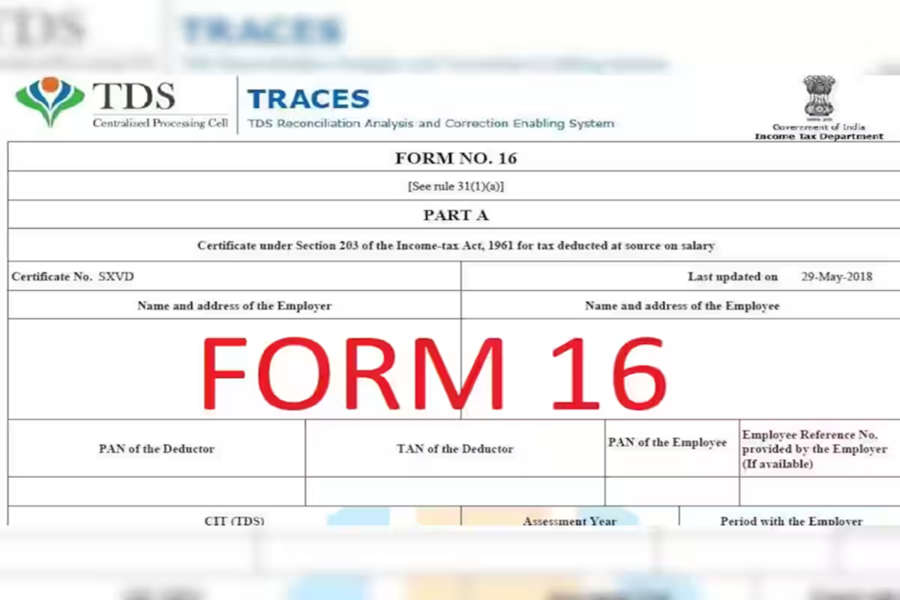
When filing their Income Tax Returns (ITR), most salaried individuals rely entirely on Form 16 issued by their employers. However, a recently surfaced case has demonstrated that claiming tax exemptions solely based on Form 16 can sometimes lead to severe complications. An employee in Bengaluru faced a hefty tax penalty of ₹51.20 lakh after filing his ITR. Subsequently, however, the Income Tax Appellate Tribunal (ITAT) ruled in the employee's favor, stating that he had not intentionally furnished any incorrect information. This case has now emerged as a significant lesson for millions of salaried taxpayers.
**Substantial Tax Exemption Claimed Based on Form 16**
This case involves Renil E.K. Kumar, an employee of Wipro. He filed his Income Tax Return for the Assessment Year 2022-23. In his return, he claimed a tax exemption of approximately ₹82 lakh, which was categorized under non-cash benefits related to Employee Stock Option Plans (ESOPs). The employee maintained that this information had been provided to him in the Form 16 issued by the company. Since the company had not deducted Tax Deducted at Source (TDS) on this amount, he assumed it was entirely tax-free. Following the filing of his return, a tax refund of approximately ₹30 lakh was also issued to him.
**Investigation Alters the Entire Scenario**
Subsequently, the Income Tax Department initiated a scrutiny assessment of the case. The investigating officer discovered that the claimed tax exemption was not valid as per the applicable regulations. Consequently, the entire exemption of ₹82 lakh was disallowed. As a result, the employee's total taxable income surged from approximately ₹84 lakh to ₹1.66 crore. Concurrently, the Department initiated penalty proceedings. Subsequently, treating this as a case of "misreporting of income," the Income Tax Department imposed a penalty of ₹51.20 lakh. The Department argued that had this case not come under scrutiny, such a substantial amount of income would have escaped taxation.
Employee Argues: Relying on Form 16 Was Not a Mistake
The employee challenged the Tax Department's decision before the ITAT. Although he accepted the additional tax demand and even deposited back the refund amount he had received, he argued that the imposition of a penalty was unjustified, as he had not intentionally furnished any incorrect information. He maintained that he had placed complete reliance on the Form 16 issued by his company. Since the company had classified the specific amount as tax-free income and had not deducted TDS on it, he believed that the tax regulations had been duly complied with. He further submitted that, owing to his limited knowledge of tax laws, he had relied on the information provided by his employer.
ITAT Grants Significant Relief to the Employee
After hearing the matter, the Bengaluru ITAT delivered a verdict in favor of the employee. The Tribunal acknowledged that the Form 16 had, indeed, reflected an amount of ₹82 lakhs as tax-exempt income. Under such circumstances, it is only natural for an employee to assume that the company has furnished accurate information in accordance with tax regulations. The ITAT ruled that merely relying on Form 16 cannot be construed as "intentionally furnishing incorrect information." The Tribunal further observed that the employee had fully disclosed all information about his income without concealing any details; therefore, imposing a penalty on him was deemed inappropriate.
Why This Verdict Is Crucial for Millions of Employees
Experts opine that this verdict holds immense significance for the millions of salaried individuals who rely solely on Form 16 while filing their Income Tax Returns (ITR). This case underscores the necessity of cross-verifying all tax exemptions and regulations before filing a tax return. Furthermore, it clarifies that if an employee honestly furnishes information based on available documents—disclosing all relevant facts without concealment—heavy penalties cannot be imposed merely on the grounds of a technical error. Nevertheless, experts continue to advise that in cases involving substantial tax claims, one should invariably seek professional tax advice to avoid facing such complications in the future.
Disclaimer: This content has been sourced and edited from NDTV India. While we have made modifications for clarity and presentation, the original content belongs to its respective authors and website. We do not claim ownership of the content.
