
PM Kusum Yojana 2025: Farmers Can Get Solar Pumps with Up to 90% Benefit — Eligibility, Subsidy & Online Application
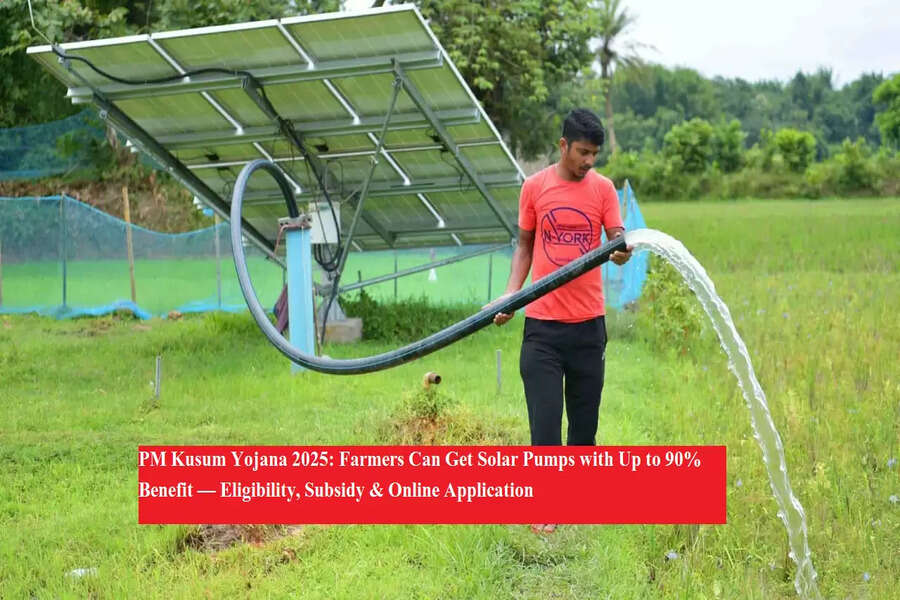
The PM Kusum Yojana 2025 is one of India’s most impactful programs for farmers, designed to reduce irrigation costs and promote renewable energy in agriculture. Under this scheme, farmers can install solar pumps and solar power plants at highly subsidized rates. In many cases, they receive up to 90% financial support, where 60% subsidy is provided by the government and 30% of the cost is arranged as loan, leaving the farmer to contribute only 10% of the total expense. This initiative is proving transformational in helping farmers switch from diesel-operated pumps to clean solar-powered irrigation systems.
Launched in March 2019 by the Ministry of New and Renewable Energy (MNRE), the PM KUSUM (Pradhan Mantri Kisan Urja Suraksha Evam Utthan Mahabhiyan) scheme aims to expand the use of solar energy in rural areas. The scheme not only reduces energy expenditure in farming but also enables farmers to earn extra income by selling surplus power generated through solar installations.
🔆 What is PM Kusum Yojana?
PM-KUSUM is a national mission that encourages farmers to adopt solar energy for irrigation. Under the scheme:
-
60% subsidy is given by the central and state government.
-
30% loan support is provided to cover installation expenses.
-
Farmers need to invest only 10% from their own pocket.
Through this model, farmers can irrigate their land without worrying about rising fuel expenses, power cuts, or high electricity bills. With solar pumps, they receive a reliable, low-cost energy source and long-term income prospects.
🌿 Major Objectives of PM KUSUM Yojana
-
Promote the use of renewable and clean energy in agriculture.
-
Reduce dependency on diesel and conventional electricity.
-
Provide affordable irrigation to farmers throughout the year.
-
Increase income by enabling farmers to sell surplus solar power.
-
Utilize barren farmland for setting up solar plants, ensuring long-term earnings.
🔸 Three Key Components of PM Kusum Scheme
| Component | Purpose |
|---|---|
| Component A | Installation of decentralized solar power plants up to 10 GW with a capacity of 500 kW–2 MW each. |
| Component B | Distribution of standalone solar pumps up to 7.5 HP for irrigation. Cost can reach approx. ₹17.5 lakh per unit. |
| Component C | Solarization of 10 lakh grid-connected agricultural pumps across the country. |
These three components ensure that farmers can use solar energy for irrigation, power generation, and income generation.
🌞 Benefits for Farmers Under Kusum Yojana
-
Low-cost irrigation with solar power.
-
Freedom from diesel expenditure and high electricity bills.
-
Option to sell excess solar energy and earn additional income.
-
Ability to use barren land for solar plants for stable earnings up to 25 years.
-
Farming can continue under elevated solar panels.
-
Reduced carbon emissions and a greener agricultural environment.
👨🌾 Who Can Apply for Solar Pump Subsidy?
✔ Individual farmers
✔ Groups of farmers
✔ FPOs (Farmer Producer Organisations)
✔ Panchayats and Cooperative Societies
✔ Water User Associations
🔹 PM Kusum Yojana 2025 Online Application Process
-
Visit the official portal pmkusum.mnre.gov.in.
-
Open the registration section and fill in the required details.
-
Create login credentials and select the solar pump subsidy option.
-
Upload the required documents and submit the application form.
-
Once approved, deposit 10% project cost as your share.
-
Installation is generally completed within 90–100 days of approval.
📝 Required Documents for Registration
-
Aadhaar Card
-
Land ownership papers (Khasra/Khatauni)
-
Bank Passbook
-
Declaration Form
-
Mobile Number
-
Passport-size Photo
The PM Kusum Yojana 2025 stands as a powerful step toward transforming agriculture in India. With the advantage of nearly 90% financial assistance, farmers can adopt solar irrigation without heavy investment. The scheme not only reduces the cost of farming but also offers an opportunity to generate stable long-term income while supporting environmental sustainability.
