
Overdraft vs Personal Loan: Which Loan Option Is Better for You During Financial Emergencies?
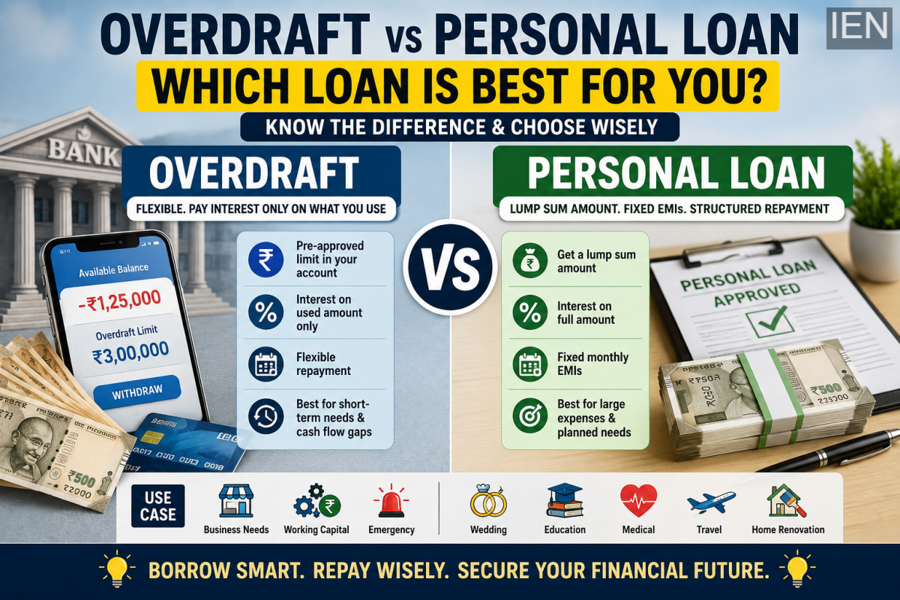
Rising living costs and unexpected expenses are forcing many people to look for quick financial support. Whether it is a medical emergency, home renovation, travel expense, education fee, or sudden business need, borrowing money has become a common solution for short-term financial pressure.
Among the most popular borrowing options offered by banks today are overdraft facilities and personal loans. While both provide access to funds during emergencies, they work very differently in terms of repayment structure, interest charges, flexibility, and approval process.
Many borrowers often get confused between the two and end up choosing an option that may not suit their financial needs. Understanding the difference between an overdraft and a personal loan can help individuals make smarter borrowing decisions and avoid unnecessary financial stress later.
What Is an Overdraft Facility?
An overdraft is a banking facility that allows customers to withdraw money from their account even if the available balance is low or temporarily insufficient.
Under this arrangement, the bank provides a pre-approved borrowing limit that the customer can use whenever needed. The borrower can withdraw funds up to the sanctioned limit and repay the amount later within the allowed period.
This facility is especially popular among business owners, self-employed professionals, and individuals who frequently deal with fluctuating cash flow requirements.
One major advantage of an overdraft is that borrowers are not required to pay fixed monthly EMIs like traditional loans. Instead, repayment remains more flexible, allowing customers to deposit funds whenever possible within the agreed timeline.
How Does a Personal Loan Work?
A personal loan is an unsecured loan offered by banks and financial institutions for personal expenses. In this type of loan, the borrower receives a fixed lump-sum amount approved by the lender.
The borrower must then repay the loan through fixed monthly installments, commonly known as EMIs, over a predetermined tenure.
Unlike secured loans, personal loans generally do not require collateral such as property, gold, or other assets. Approval is usually based on factors like income, employment stability, credit score, and repayment history.
Personal loans are widely used for:
- Wedding expenses
- Medical emergencies
- Travel planning
- Education costs
- Debt consolidation
- Home renovation
Biggest Difference Lies in Interest and Repayment
One of the most important differences between overdrafts and personal loans is the way interest is charged.
Interest in Overdrafts
In an overdraft facility, interest is charged only on the amount actually used by the customer, not on the total sanctioned limit.
For example, if the bank approves an overdraft limit of ₹5 lakh but the customer uses only ₹1 lakh, interest will apply only to the ₹1 lakh utilized amount.
This makes overdrafts more flexible and potentially cost-effective for short-term borrowing needs.
Interest in Personal Loans
In personal loans, interest is charged on the full sanctioned amount from the very beginning, regardless of how much of the money is immediately used.
Additionally, borrowers must continue paying fixed EMIs every month until the loan is fully repaid.
Which Option Gives Faster Access to Money?
Speed is another major factor people consider during emergencies.
If an overdraft facility has already been approved and linked to the account, customers can access funds almost instantly whenever required.
On the other hand, personal loans usually involve:
- Eligibility verification
- Credit assessment
- Documentation checks
- Approval processing
As a result, the loan amount may take two to three days or sometimes longer to reach the borrower’s account.
Which Loan Option Is Better for You?
The right option depends entirely on the borrower’s financial requirement, repayment capacity, and borrowing habits.
Overdraft May Be Better If:
- You need money for a short duration
- Your income fluctuates regularly
- You require flexible repayment
- You want to pay interest only on used funds
- You frequently face temporary cash shortages
Personal Loan May Be Better If:
- You need a large lump-sum amount
- You prefer fixed repayment planning
- Your monthly income is stable
- You are funding planned expenses like weddings or education
- You want a structured repayment schedule
Financial Experts Advise Careful Borrowing
Banking experts recommend evaluating total borrowing cost, repayment discipline, and financial stability before choosing any credit product.
Borrowers should compare:
- Interest rates
- Processing fees
- Repayment flexibility
- Prepayment rules
- Penalty charges
- Loan tenure
before making a final decision.
Experts also warn against borrowing more than necessary, as excessive debt can affect future financial stability and credit scores.
Final Verdict: Flexibility vs Structured Repayment
Both overdrafts and personal loans serve different financial purposes. Overdrafts offer greater flexibility and are ideal for temporary cash flow management, while personal loans provide structured financing for larger planned expenses.
Choosing the right borrowing option ultimately depends on understanding your financial goals, repayment capability, and urgency of need. A carefully planned decision can help avoid unnecessary financial burden and improve long-term money management.
