
Old Pension Scheme Update: Government Allows OPS Benefits in Select Cases Under New Rule
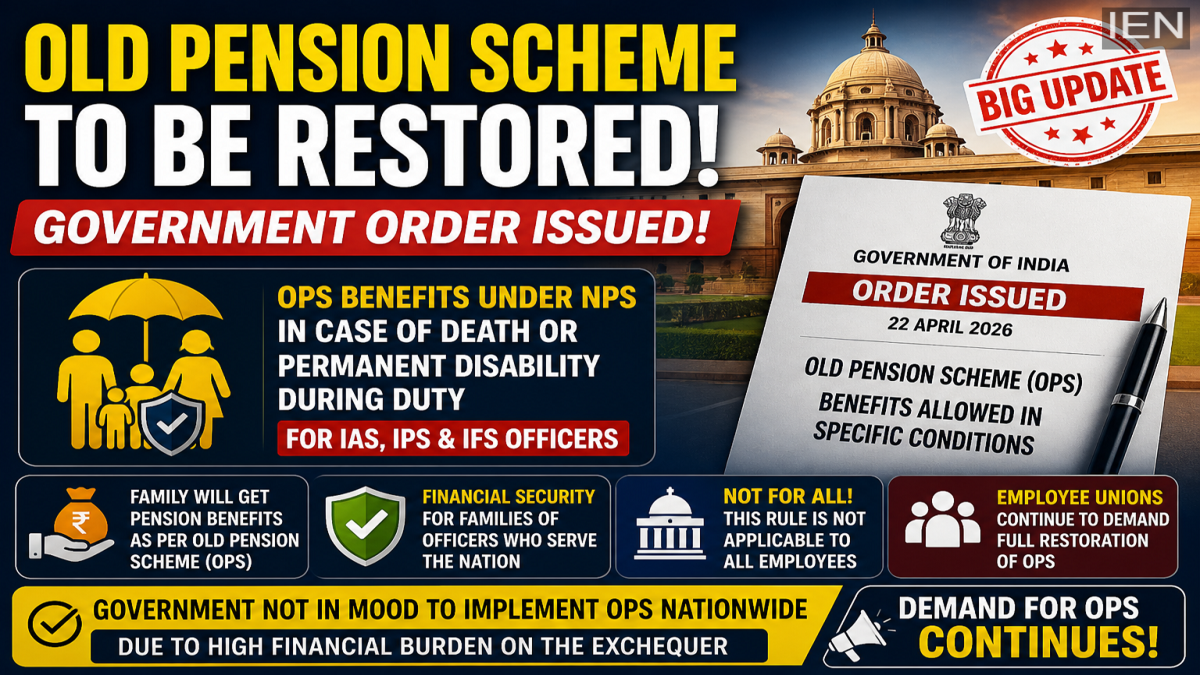
In a significant development related to pension reforms, the Central Government has introduced a new provision that brings limited relief to certain categories of employees. While there is no nationwide rollback of the New Pension System (NPS), the government has allowed the benefits of the Old Pension Scheme (OPS) in specific situations.
This update has sparked fresh discussions among government employees and pensioners, especially amid ongoing demands for the full restoration of OPS.
What Has the Government Announced?
As per the latest update issued on April 22, 2026, the government has introduced a rule that allows certain employees covered under the National Pension System (NPS) to receive benefits similar to the Old Pension Scheme (OPS) under special circumstances.
This move is not a blanket reinstatement of OPS but a targeted provision aimed at providing financial security in extreme cases.
Who Will Benefit From This Rule?
The new rule primarily applies to elite civil service officers such as:
- Indian Administrative Service (IAS)
- Indian Police Service (IPS)
- Indian Foreign Service (IFS)
If an officer under these categories faces death or permanent disability while performing official duties, their family will be eligible to receive pension benefits under the Old Pension Scheme.
This ensures better financial protection for families of officers who suffer severe consequences while serving the nation.
OPS vs NPS: What’s the Difference?
The Old Pension Scheme (OPS) provides a fixed monthly pension based on the employee’s last drawn salary, offering long-term financial security without market risk.
On the other hand, the National Pension System (NPS) is market-linked, where the final pension amount depends on investment returns. While NPS promotes long-term savings, it carries some degree of market uncertainty.
This is why many employee unions continue to demand a return to OPS, citing stability and predictability.
No Full Rollback of NPS
Despite the new provision, the government has made it clear that there are no plans to fully restore OPS across all sectors. One of the main reasons is the significant financial burden it would place on the exchequer.
Experts believe that implementing OPS nationwide could strain government finances due to its non-contributory and guaranteed nature.
Why Employees Are Still Demanding OPS
Employee organizations across the country have been consistently advocating for the return of OPS. Their key concerns include:
- Lack of guaranteed returns under NPS
- Market-linked risks affecting retirement security
- Rising cost of living and need for stable pension income
While the latest rule offers limited relief, it does not fully address these broader concerns.
What This Means Going Forward
The government’s decision reflects a balanced approach—offering protection in extreme cases while maintaining the existing pension structure for the majority of employees.
It also indicates that while reforms are possible, a complete shift back to OPS remains unlikely in the near future.
Final Takeaway
The latest update on the Old Pension Scheme brings partial relief by extending OPS-like benefits in cases of death or disability during service—but only for select officers. For most employees, the National Pension System will continue to remain in place.
As debates around pension reforms continue, employees and stakeholders will be closely watching for any further policy changes that could impact their financial future.
