
NSE EGR vs Gold ETF: Which Is the Better Gold Investment Option in 2026?
Gold continues to remain one of the most trusted investment assets for Indian households. Whether it is weddings, festivals, emergencies, or long-term wealth protection, Indians have traditionally viewed gold as both an emotional and financial asset.
However, the way people invest in gold is changing rapidly. Earlier, most buyers preferred physical jewellery, coins, or bars. Today, digital investment options such as Gold ETFs and NSE Electronic Gold Receipts (EGRs) are becoming increasingly popular among investors looking for convenience, safety, and transparency.
With gold prices witnessing strong momentum over the past year and a half, investors are now exploring which digital gold option offers better value in 2026.
Gold Buying Is No Longer Limited to Jewellery Shops
Modern gold investing has expanded beyond traditional physical purchases. Investors can now buy and trade gold almost like stocks through financial markets.
Two major digital investment options currently attracting attention are:
- Gold Exchange Traded Funds (Gold ETFs)
- NSE Electronic Gold Receipts (EGRs)
Both options allow investors to participate in gold price movements without physically storing gold at home.
However, their structure, liquidity, taxation, and usage differ significantly.
What Is a Gold ETF?
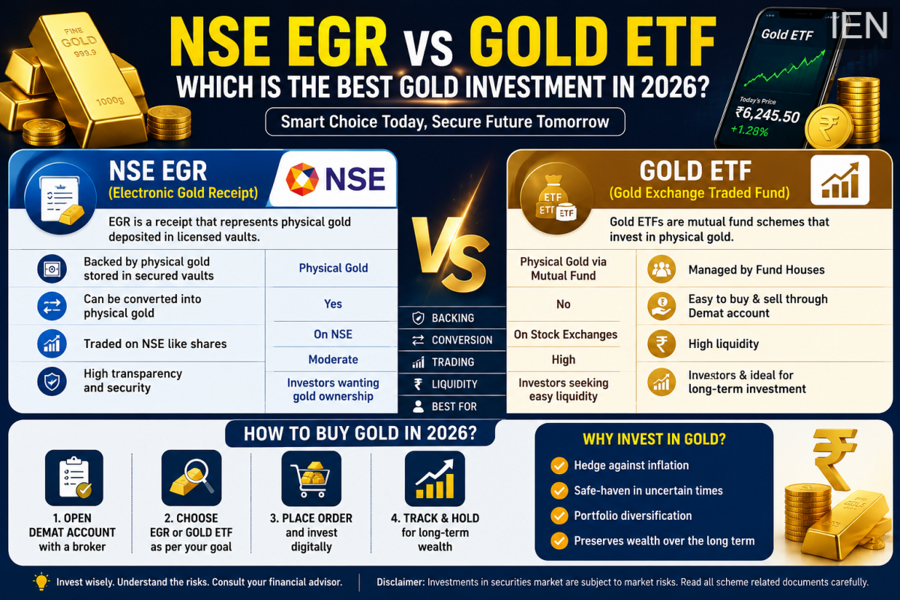
A Gold Exchange-Traded Fund (Gold ETF) is a mutual fund product that tracks gold prices and trades on stock exchanges just like shares.
Key features include:
- Investors buy units through Demat accounts
- Each unit represents a quantity of gold
- Fund houses manage the physical gold backing
- Prices move according to market gold rates
Gold ETFs are considered convenient because investors do not need to worry about:
- Storage
- Purity verification
- Theft risk
- Making charges
What Is NSE EGR?
National Stock Exchange of India Electronic Gold Receipts (EGRs) are a relatively newer digital gold investment mechanism introduced to formalize gold trading through stock exchanges.
Under this system:
- Investors deposit physical gold in authorized vaults
- In return, they receive electronic gold receipts
- These receipts can then be traded digitally on exchanges
EGRs are designed to create a transparent and standardized gold trading ecosystem in India.
Main Difference Between Gold ETF and EGR
Although both options provide exposure to gold prices, their operational structure is different.
Gold ETF
- Operates like a mutual fund
- Managed by asset management companies
- Backed by physical gold holdings of the fund
- Suitable for passive investors
NSE EGR
- Directly linked to physical gold stored in vaults
- Functions more like exchange-traded gold ownership
- Allows conversion between physical and electronic gold
- Aims to create organized gold market infrastructure
Which Option Is More Convenient?
For ordinary retail investors, Gold ETFs are currently considered easier and more familiar.
Reasons include:
- Easy buying through stockbrokers
- Strong liquidity in popular ETFs
- No handling of physical gold
- SIP investment options available in some platforms
EGRs, while promising, are still evolving and may currently feel more suitable for investors closely tracking gold markets or dealing with larger quantities.
Liquidity Comparison
Liquidity refers to how easily investors can buy or sell an asset.
Gold ETF Liquidity
Popular Gold ETFs generally offer:
- Better daily trading volume
- Faster buying and selling
- Wider investor participation
NSE EGR Liquidity
Since EGRs are relatively new:
- Trading participation is still developing
- Liquidity may vary across contracts
- Investor awareness remains lower compared to ETFs
Experts believe EGR liquidity may improve gradually as adoption increases.
Taxation Differences Matter
Tax treatment is one of the most important factors investors should compare before choosing between gold investment options.
Tax rules may differ depending on:
- Holding period
- Type of gold instrument
- Capital gains classification
- Applicable indexation rules
Financial advisors recommend investors consult tax professionals because gold taxation rules may evolve further in coming years.
Storage and Safety Advantages
Both Gold ETFs and EGRs eliminate many of the traditional risks associated with physical gold ownership.
Investors avoid concerns such as:
- Locker charges
- Theft risk
- Purity disputes
- Jewellery making charges
This makes digital gold investing increasingly attractive among younger investors.
Which Option Is Better for Long-Term Investors?
Experts say the right option depends on investment goals.
Gold ETF May Be Better If:
- You want simple investment exposure
- SIP-style investing is preferred
- Liquidity matters
- You are comfortable with mutual fund structures
NSE EGR May Be Better If:
- You want exchange-linked gold ownership
- Physical gold conversion matters
- You prefer direct vault-backed gold structures
- You actively track commodity markets
Gold Still Considered a Safe-Haven Asset
Despite the rise of modern investment products, gold continues to remain popular because it is often viewed as protection during:
- Inflation
- Currency weakness
- Economic uncertainty
- Geopolitical tensions
- Market volatility
This is one reason why demand for digital gold investment products has increased sharply in recent years.
Experts Suggest Diversified Gold Strategy
Financial planners generally advise investors not to put all savings into a single asset class, including gold.
Instead, gold is often recommended as part of a diversified portfolio alongside:
- Equity investments
- Fixed income products
- Retirement funds
- Emergency savings
Experts also suggest investors focus on financial goals, liquidity needs, taxation, and risk appetite before choosing between Gold ETFs and NSE EGRs in 2026.
