
No one will lose their life in a train accident; the government has created a mega plan worth 1.3 lakh crore..
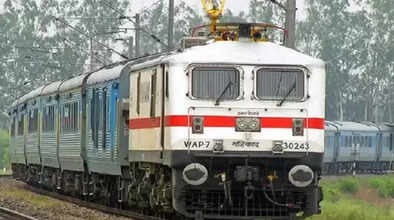
The government has become very serious about preventing train accidents, making rail safety a top priority. This is why the central government is considering the largest allocation ever for this sector. Sources familiar with the matter told Mint that the proposed expenditure for safety-related works could exceed ₹1.3 trillion in fiscal year 2027. This allocation, approximately 12% higher than the current year's budget, will be spent on infrastructure such as track renewal and maintenance, as well as the expansion of India's indigenous automatic train protection system, Kavach, a source said on condition of anonymity.
Increased Spending on Railway Safety
Safety has become a major political and public priority for Indian Railways. This proposed increase will significantly alter capital expenditure, with safety works likely to account for nearly half of the total rail capex in FY2027. Total capex is projected to increase from ₹2.52 trillion this year to approximately ₹2.76 trillion. While the accident rate has declined significantly over the past decade, recent incidents have raised safety concerns. The deadliest incident this year was a collision near Bilaspur, where a MEMU passenger train ran a red signal and collided with a stationary freight train, killing 11 people and injuring more than 20.
How Many Rail Accidents Have Occurred?
The railways recorded 31 accidents in FY2025 and 10 accidents up to November in the current fiscal year. Such accidents include collisions, fires, and derailments, resulting in loss of life and property. Between FY2015 and FY2024, 748 people died in 678 accidents. Officials say that operational safety indicators have improved significantly. Accidents per million train kilometers decreased from 0.11 in FY 2015 to 0.03 in FY 2024 – a 73 percent improvement.
To sustain this progress, the government has expanded the National Rail Safety Fund, under which over ₹1.08 trillion has already been spent on the advancement of critical assets. Mint reported on November 19 that Indian Railways is preparing to increase its capital expenditure next year. The safety budget for FY 2026 is ₹1.16 lakh crore, a marginal increase of only 2 percent from ₹1.14 lakh crore in FY 2025. Expenditure on safety works in FY 2024 was ₹1.01 lakh crore, compared to ₹87,327 crore in FY 2023.
More work on Kavach
Kavach is designated as India's national automatic train protection system, designed to automatically apply brakes in situations where the loco pilot fails to respond, including during poor visibility. So far, Kavach has been deployed on 1,465 kilometers of track and 121 locomotives. Kavach 4.0 is being implemented on 15,512 kilometers of track, but the total operational coverage is only slightly more than 2 percent of the approximately 67,000-kilometer rail network.
Some experts argue that money alone will not ensure safe operations. Shubhranshu, a railway professional and former head of the Rail Wheel Plant in Bela, said that Indian Railways does not lack funds for safety, track renewal, new rail wheels, or station development; he also led the design and production of the Vande Bharat Express. Over ₹1 trillion has already been allocated for Kavach, track renewal, upgrades, and new rail wheels in the coming years.
How much has been spent on safety in 20 years? He further stated that organizational discipline plays a more crucial role than capital expenditure. Most safety improvements are achieved through proper maintenance, training, accountability, and high-level incentives. This does not require massive funding. Investment alone does not guarantee safety. Expenditure on safety-related projects has increased significantly over time, rising from ₹70,273 crore during FY 2005-2014 to ₹1.78 lakh crore in FY 2015-2014, a 2.5-fold increase. Track renewal expenditure also increased 2.33 times during the same period, from ₹47,018 crore to ₹1.09 lakh crore.
What will be the focus?
The majority of the projected increase in safety expenditure will be spent on the maintenance of tracks, locomotives and coaches, signaling, replacing mechanical signaling with electronic interlocking, interlocking of unmanned level crossings, full track circuiting, high-power rails, GPS-based fog safety devices, and the rapid deployment of Kavach (an automatic train protection system). For FY 2026, the railways have allocated ₹22,800 crore for track renewal, ₹58,895 crore for rolling stock and maintenance, ₹8,601 crore for traffic facilities, and ₹6,150 crore for electrification.
Disclaimer: This content has been sourced and edited from TV9. While we have made modifications for clarity and presentation, the original content belongs to its respective authors and website. We do not claim ownership of the content.
