
Mutual Funds: Is Your Money in Mutual Funds Really Growing, or Are You Stuck? Here’s How to Check in Just 2 Minutes..
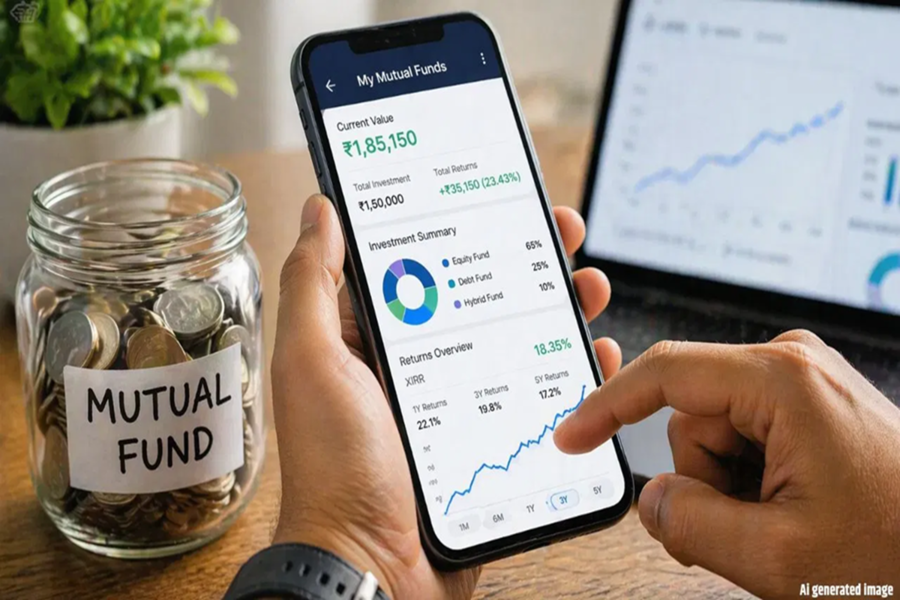
Every investor feels a sense of relief when they see green numbers in their mutual fund portfolio. But is your money truly growing at the same pace at which the market is rallying? Often, we remain under a delusion simply by looking at return figures, whereas, in reality, our fund may be growing significantly slower compared to others. Investing in the market isn't merely about putting money in; it is about ensuring that capital grows at the right pace. If you, too, are satisfied with your portfolio simply because it isn't incurring a loss, then it is high time you gave it a proper 'health checkup.'
**Don't Be Content with FD-like Returns; Beating Inflation is the Real Game**
The most fundamental rule of any investment is that it must outpace the rate of inflation. In the current scenario, if the inflation rate hovers around 6 percent and your investment returns are also hovering around the same figure, then, in reality, you are not making a profit. The real value of your capital is gradually eroding. In today's market, instruments such as Bank Fixed Deposits (FDs) and various government schemes are easily offering interest rates of 6 to 7 percent without any significant risk. Therefore, when you venture into riskier options like mutual funds, your expectations should be correspondingly higher. Long-term equity mutual fund investments typically require an average rate of return of at least 12 percent.
**Is Your Money Moving at a Sluggish Pace?**
Let's assume your fund is delivering a return of 10 percent, and you are extremely pleased with it. But have you checked whether other funds within the same category are generating returns of 14 to 15 percent? If that is the case, it is evident that your fund is performing very poorly.
Every mutual fund has its own specific 'benchmark index'—such as the Nifty 50 or the Sensex. This serves as the yardstick for measuring the fund's performance. If your fund consistently fails to outperform its own benchmark for two to three consecutive years, you can be certain that there is a major flaw somewhere in your investment strategy. When it comes to investing, it is premature to draw conclusions based solely on a single year's performance. The true strength and stability of any fund are best assessed over longer time horizons—typically 3 to 5 years.
**How to Measure True Risk**
A long-standing truth of the stock market is that higher returns often come hand-in-hand with higher risk. It is unwise to invest in a fund simply because it has experienced a sudden, massive surge. You must evaluate the magnitude of the risk the fund manager undertook to generate those returns. There are several technical—yet remarkably simple—metrics to measure this:
**Sharpe Ratio:** This metric indicates how much return the fund has generated relative to the risk taken. The higher this ratio, the better the fund is considered to be.
**Standard Deviation:** This reveals the degree of volatility or fluctuation in the fund's returns. A lower standard deviation is a hallmark of a fund's stability.
**Beta:** This measures the fund's sensitivity to market movements. If the Beta value exceeds 1, your fund will tend to be more volatile than the broader market—a clear indication of higher risk.
**For SIP Investors, 'XIRR' is the Ultimate Tool**
For investors who regularly invest their hard-earned money every month through a Systematic Investment Plan (SIP), attempting to estimate returns based solely on the NAV (Net Asset Value) is an incorrect approach. In an SIP, purchases are executed every month at varying prices and on different dates. Therefore, the **XIRR** (Extended Internal Rate of Return) is the appropriate metric to use here. This formula employs precise mathematical calculations—accounting for both time and the specific dates of each investment—to present your true, overall return as a percentage.
Furthermore, keep a keen eye on who is at the helm of the fund you have invested in (i.e., the fund manager) and how the fund's portfolio is allocated across various sectors. Frequent changes in the fund manager can potentially disrupt and compromise the investment strategy. It is not advisable to switch funds every time the market experiences a minor dip; however, if your fund has consistently underperformed its peers and benchmark for two to three years—or is taking on excessive risk without justification—then exiting that fund to seek out better alternatives is the hallmark of a prudent investor.
Disclaimer: This content has been sourced and edited from TV9. While we have made modifications for clarity and presentation, the original content belongs to its respective authors and website. We do not claim ownership of the content.
