
Mutual Fund Investment Strategy During Market Uncertainty: Experts Recommend Index and Large-Cap Focus
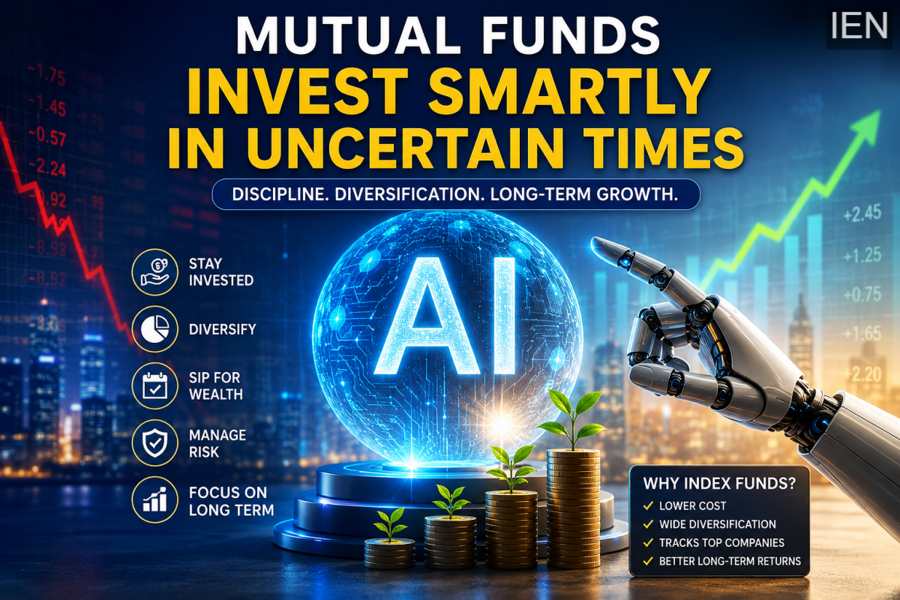
Volatility has once again returned to the financial markets as global tensions, rising crude oil prices, and geopolitical uncertainty continue to influence investor sentiment. Although Indian equity markets have started showing signs of recovery after the sharp decline linked to the Iran-related conflict, uncertainty still remains high.
The benchmark NIFTY 50 is currently trying to hold key support levels, and investors are now reconsidering how they should approach mutual fund investing during such unstable conditions.
Market experts say that despite short-term volatility, investors should avoid panic decisions and instead focus on disciplined long-term investment strategies, especially through systematic investment plans (SIPs), index funds, and quality large-cap exposure.
Experts Advise Investors Not to Panic
According to market professionals, sudden geopolitical events and crude oil spikes often create fear-driven corrections in equity markets. However, historical market behavior suggests that such shocks are usually temporary.
D D Sharma believes investors should resist the temptation to stop investments or exit mutual funds during periods of uncertainty.
He says many retail investors mistake temporary corrections as signs of a long-term market collapse. In reality, markets often recover once uncertainty begins to stabilize.
Financial planners argue that investors who continue disciplined investing during volatile phases often benefit more in the long run compared to those who try timing the market.
Why Index Funds Are Gaining Attention
Experts say index funds are becoming increasingly popular during uncertain market conditions because they provide broad diversification at lower costs.
According to analysts, investing through Nifty 50 Index Fund allows investors to gain exposure to India’s top 50 listed companies through a single investment vehicle.
This reduces:
- Dependence on individual stocks
- Stock-picking risk
- Market timing pressure
- Concentration risk
Passive investing strategies are particularly attractive during volatile phases because they help investors stay invested for the long term without making emotional decisions based on daily market fluctuations.
Low Expense Ratio Becoming a Key Factor
Experts also emphasize the importance of expense ratios while selecting mutual funds, especially for long-term investments.
According to market observations, some Nifty 50 index funds currently offer relatively lower expense ratios compared to peers.
For example:
- Nippon India Index Fund Nifty 50 Plan reportedly has an expense ratio of around 0.07 percent.
- Axis Nifty 50 Index Fund is estimated near 0.17 percent.
- DSP Nifty 50 Index Fund reportedly carries an expense ratio around 0.18 percent.
Experts say even small differences in expense ratios can significantly impact long-term returns because lower fund costs leave more gains in the hands of investors.
Long-Term SIP Investing Still Preferred
Financial advisors continue to recommend SIP-based investing during uncertain market periods.
Systematic Investment Plans help investors:
- Average out purchase costs
- Reduce timing-related stress
- Build investment discipline
- Benefit from market volatility through rupee-cost averaging
According to analysts, long-term SIP investing in diversified funds has historically delivered better outcomes than lump-sum investing during volatile periods.
Experts believe investors with long investment horizons should continue SIPs rather than pause them because market corrections often create better accumulation opportunities.
Market Risks Still Remain High
While Indian markets have recovered partially, analysts say several macroeconomic risks continue to affect sentiment.
According to market experts, major concerns currently include:
- Rising crude oil prices
- Weakness in the Indian rupee
- Slowing global economic growth
- Tight global financial conditions
- Supply chain disruptions
- Geopolitical instability
These factors could continue creating short-term market volatility and impact corporate earnings across sectors.
Large-Cap and Low-Volatility Strategies Favored
Investment professionals currently appear more comfortable with large-cap and quality-focused investing strategies.
Experts suggest that investors may consider focusing on:
- Large-cap funds
- Value-oriented investing
- Quality factor investing
- Low-volatility strategies
These segments are generally considered relatively more stable during uncertain economic periods.
Large-cap companies often have:
- Stronger balance sheets
- Better cash flow visibility
- Higher institutional ownership
- Greater resilience during economic slowdowns
As a result, they tend to experience comparatively lower volatility than smaller companies during market corrections.
Which Sectors Experts Prefer Right Now
Market analysts believe certain domestic economy-linked sectors are currently positioned better than export-dependent industries.
Sectors that experts are watching positively include:
- Industrials
- Automobiles
- Energy
- Metals
- PSU financials
These segments may benefit from domestic economic activity, infrastructure spending, and government-led growth initiatives.
On the other hand, export-oriented sectors such as IT may continue facing pressure because of slower global demand and uncertainty in international markets.
Why Discipline Matters More Than Timing
One of the key messages from investment experts is that long-term wealth creation depends more on discipline than short-term market predictions.
Analysts warn that repeatedly entering and exiting markets based on headlines often damages long-term returns.
Instead, experts suggest investors should focus on:
- Asset allocation
- Investment duration
- Risk tolerance
- Diversification
- Consistent investing habits
They also recommend periodic portfolio reviews instead of reacting emotionally to temporary market events.
Investors Advised to Stay Selective
Experts say the current environment requires selective investing rather than aggressive risk-taking.
Investors are being encouraged to:
- Avoid chasing short-term trends
- Maintain diversified portfolios
- Continue SIP investments
- Focus on quality businesses
- Keep realistic return expectations
- Match investments with long-term financial goals
Although uncertainty remains elevated globally, market professionals believe disciplined investing through mutual funds and index-based strategies can still help long-term investors navigate volatile market conditions effectively.
Disclaimer: Investment-related views and market opinions mentioned above are based on expert commentary and market observations. Investors should consult certified financial advisors before making investment decisions.
