
Loan Repayment or Investment: What Should You Do With Extra Money? A Smart Money Guide
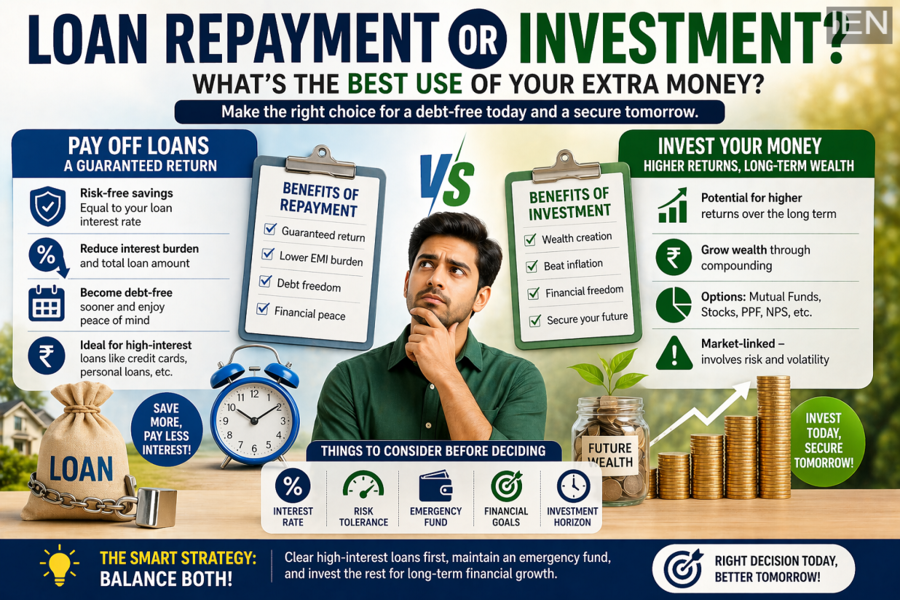
Whenever extra cash comes into your hands—be it a bonus, incentive, or savings—the biggest financial dilemma often follows: Should you repay your loan early or invest the money for future growth?
Both options have clear advantages. One can free you from debt faster, while the other can help build long-term wealth. The right choice depends on factors like interest rates, risk appetite, and your financial goals. Here’s a detailed breakdown to help you make the best decision.
Paying Off Loans: A Guaranteed Return
One of the strongest arguments for loan repayment is certainty. When you prepay a loan, you effectively earn a return equal to the loan’s interest rate.
For example:
- If your loan carries a 10% interest rate, prepaying it gives you a risk-free 10% return
- There’s no market volatility or uncertainty involved
This makes loan repayment one of the safest financial decisions, especially when dealing with high-interest liabilities.
Investment: Higher Returns, But With Risk
On the other hand, investing your extra money—whether in stocks, mutual funds, or other instruments—offers the potential for higher returns over time.
However:
- Returns are not guaranteed
- Markets can fluctuate
- You may face short-term losses
That said, historically, long-term investments in equities and funds have delivered better returns than many fixed-income options. The key here is patience and a long-term perspective.
Prioritize High-Interest Loans First
If you have debts like:
- Credit card dues
- Personal loans
- Consumer loans
These usually carry very high interest rates. In such cases, it is almost always smarter to repay these loans first, as no safe investment can consistently beat those interest rates.
What About Low-Interest Loans?
Loans like home loans generally come with relatively lower interest rates. In such cases:
- You may not need to use all your extra money for prepayment
- A portion of your funds can be allocated to investments
This approach allows you to balance debt reduction with wealth creation.
Don’t Ignore Liquidity Needs
Before making any decision, ensure you have an emergency fund in place.
- Keep at least 3–6 months of expenses readily available
- Avoid locking all your money into loan repayment or investments
Liquidity is essential for handling unexpected situations without financial stress.
Emotional vs Financial Perspective
Financial decisions are not always purely mathematical—they also involve psychology.
- Some people prefer being debt-free for peace of mind
- Others focus on long-term wealth creation through investments
Both perspectives are valid. The right choice depends on what makes you financially and mentally comfortable.
The Balanced Approach: Best of Both Worlds
In most cases, the smartest strategy is a balanced approach:
- Use part of your extra money to reduce loan burden
- Invest the remaining amount to grow your wealth
This way, you:
- Lower your interest liability
- Build a future financial cushion
- Reduce overall risk
Final Takeaway
There’s no one-size-fits-all answer to whether you should repay loans or invest.
- If your loan carries high interest, prioritize repayment
- If the interest is low, consider investing alongside repayment
- Always maintain an emergency fund before making decisions
Ultimately, the best strategy is the one that aligns with your financial goals, risk tolerance, and life priorities. A thoughtful balance between debt reduction and investment can help you achieve both financial stability and long-term growth.
