
LIC Whole Life Plans Compared: Jeevan Umang vs Jeevan Utsav—Which One Should You Choose?
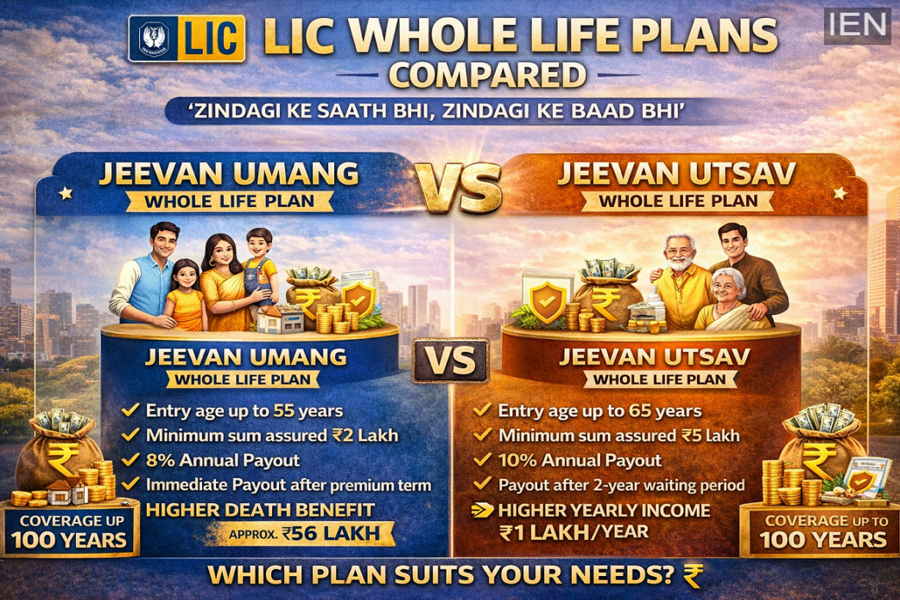
If you’re looking for a lifetime insurance plan with steady returns, the Life Insurance Corporation of India (LIC) offers two popular options—Jeevan Umang and Jeevan Utsav. Both plans promise lifelong risk cover (up to 100 years) along with regular payouts, but they differ in structure, benefits, and suitability.
Here’s a complete, easy-to-understand comparison to help you decide which plan fits your financial goals better.
What Makes These Plans Unique?
Both Jeevan Umang and Jeevan Utsav are whole life policies, meaning:
- Coverage lasts up to 100 years of age
- They offer annual payouts after premium payment period
- Provide death benefits + bonuses/additions
- Allow adding riders for extra protection
As explained in the source document , these plans combine insurance protection with long-term income generation.
LIC Jeevan Umang: Key Features
Jeevan Umang is designed for long-term financial stability with moderate returns.
Eligibility:
- Entry age: 0 to 55 years
- Minimum sum assured: ₹2 lakh
Premium Payment:
- Options: 15, 20, 25, or 30 years
- Flexible payment modes: yearly, half-yearly, quarterly, monthly
Benefits:
- After premium term ends → 8% of sum assured paid annually for life
- Loan facility available after 1 year
- Policy surrender allowed after 1 year
Death Benefit:
- Higher of:
- Basic sum assured
- 7× annual premium
- Plus bonus and final additional bonus (FAB)
LIC Jeevan Utsav: Key Features
Jeevan Utsav is a newer plan offering higher annual payouts but with a different structure.
Eligibility:
- Entry age: 0 to 65 years
- Minimum sum assured: ₹5 lakh
Premium Payment:
- Flexible term: 5 to 16 years
Benefits:
- After premium term + 2-year gap →
10% of sum assured paid annually for life
Additional Features:
- Loan available after 2 years
- Policy surrender allowed after 2 years
Death Benefit:
- Higher of:
- Basic sum assured
- 7× annual premium
- Plus guaranteed additions
Jeevan Umang vs Jeevan Utsav: Key Differences
| Feature | Jeevan Umang | Jeevan Utsav |
|---|---|---|
| Entry Age | Up to 55 years | Up to 65 years |
| Min Investment | ₹2 lakh | ₹5 lakh |
| Annual Payout | 8% of sum assured | 10% of sum assured |
| Payout Start | Immediately after premium term | After 2-year gap |
| Loan Availability | After 1 year | After 2 years |
| Bonus Type | Bonus + FAB | Guaranteed additions |
Example Comparison: Which Gives Better Returns?
Let’s simplify with an example (as outlined in ):
Scenario:
- Parent age: 35 years
- Child age: 8 years
- Sum assured: ₹10 lakh
Jeevan Umang:
- Annual premium: ~₹81,774
- Total premium: ~₹12.26 lakh
- Annual payout: ₹96,000 (from age 23 onwards)
- Death benefit: ~₹56 lakh (approx., with bonus)
Jeevan Utsav:
- Annual premium: ~₹66,173
- Total premium: ~₹9.92 lakh
- Annual payout: ₹1 lakh (after 2-year gap)
- Death benefit: ~₹16 lakh (approx.)
📌 Insight:
- Jeevan Umang offers higher death benefits
- Jeevan Utsav provides higher yearly income with lower premium
Which Plan Is Better for You?
Choose Jeevan Umang if:
- You want higher life cover
- Prefer immediate payout after premium term
- Long-term family security is your priority
Choose Jeevan Utsav if:
- You want higher annual income
- Prefer lower premium commitment
- Comfortable with a 2-year waiting period
Final Verdict
Both plans serve different financial goals:
- Jeevan Umang = Higher protection + stable income
- Jeevan Utsav = Better cash flow + lower cost
The right choice depends on whether you prioritize insurance coverage or regular income.
Disclaimer
This article is for informational purposes only. Policy benefits, returns, and bonuses may vary. Always consult a certified insurance advisor before purchasing any policy.
