
Is tax levied separately on making charges, in addition to the price of gold? Know the rules before the bill is issued..
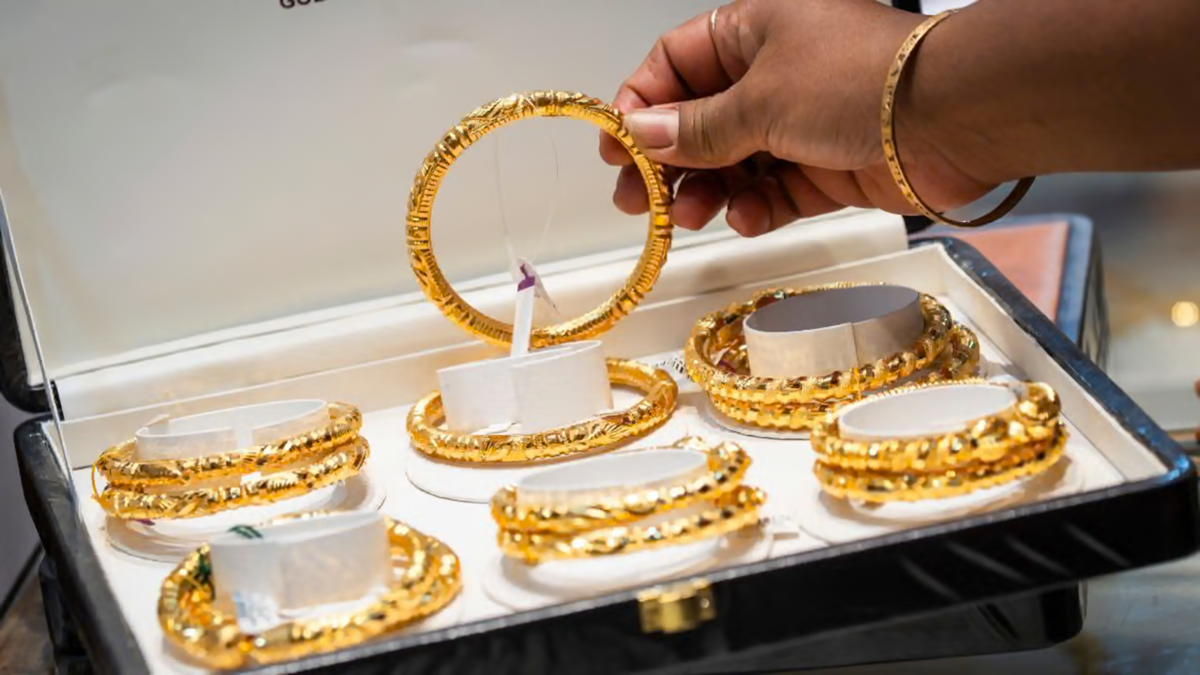
GST Rules for Gold Jewellery: Customers are often confused about taxes when purchasing gold, silver, or diamond jewellery. It is sometimes claimed that, in addition to the 3% GST on the price of gold, a separate 5% GST is applicable to the making charges. If a jeweller asks you to pay a separate tax on making charges, you should be cautious. According to the rules set by the Central Board of Excise and Customs (CBEC), customers are not required to pay a separate GST on making charges; rather, the tax applies to the total value of the jewellery. Whether the making charges are listed separately on the bill or included in the total price, a uniform GST rate of 3% is applied to the entire amount.
Understanding the Calculation with an Example
The government’s 'GST Sectoral Series' provides clarifications regarding questions related to the gems and jewellery sector. Even if the price of gold and the making charges are listed separately on the bill for a gold chain, the 3% tax applies to the total transaction value.
Consider this simple example: Suppose you purchase a 10-gram gold chain. If the cost of the gold is ₹1,28,000 and the making charges are ₹12,000, the total price of the chain comes to ₹1,40,000. Under government regulations, a 3% GST is applied to this entire amount, which totals ₹4,200. If a shopkeeper charges 3% on the gold (₹3,840) and an additional 5% on the making charges (₹600), the total tax would become ₹4,440—meaning the customer ends up paying an extra ₹240. This practice is entirely incorrect according to government regulations.
Where does the mention of a 5% GST on making charges come from?
In the market or on various websites, there is often a mention of a 5% GST being applicable to making charges. In reality, this 5% tax does not apply to the average consumer; rather, it pertains to transactions between jewelry manufacturers (jewelers) and the artisans (job workers) who craft the jewelry. This rule comes into play when a jeweler provides raw gold to an artisan for the purpose of creating jewelry.
If the artisan is registered under GST, they charge 5% GST on their labor—or "job charges." The jeweler can then claim an input tax credit (ITC) for this amount, which can be used to offset the tax liability arising from the sale of the finished jewelry. Conversely, if the artisan is exempt from GST registration, the jeweler is required to pay this tax under the "reverse charge" mechanism. In this case, too, the jeweler is entitled to claim an input tax credit. Consequently, this 5% tax is never added to the bill of a customer purchasing finished jewelry from a showroom.
**Rule Remains Unchanged Even After 'GST 2.0'**
During the 56th meeting of the GST Council held on September 3, 2025, significant revisions were made to tax slabs under what is referred to as "GST 2.0." However, the jewelry market was excluded from these changes. The Council maintained the existing 3% tax rate for the gems and jewelry sector. Current FAQs provided by 'Invest India' also reiterate that a 3% tax applies to the total value of jewelry.
This 3% GST rate on gold and silver has been in effect in the country since July 1, 2017. When GST replaced the Value Added Tax (VAT) system, a provision was established requiring a 3% tax to be collected from customers even on existing stock held by banks or agencies. Furthermore, the import of precious metals from abroad attracts a Basic Customs Duty (BCD) along with a 3% Integrated GST (IGST), for which banks can claim an input tax credit. As of May 13, 2026, the customs duty on gold is set at 15%.
Things to keep in mind when obtaining an invoice for jewellery
When purchasing ready-made jewellery from a store, a customer should ensure that only 3% GST is applied to the total amount. Accordingly, the tax on jewellery worth ₹1.40 lakh would be ₹4,200, while for a purchase of ₹2 lakh, the tax amount would be ₹6,000. However, if you are getting jewellery made by exchanging your old gold, or if you are having jewellery repaired, the rules may differ. In such cases, it is advisable to clearly ask the jeweller about the basis for tax calculation before the invoice is generated.
Disclaimer: This content has been sourced and edited from TV9. While we have made modifications for clarity and presentation, the original content belongs to its respective authors and website. We do not claim ownership of the content.
