
Inflation Is Quietly Eating Your Wealth: Why ₹1 Lakh Today Could Be Worth Just ₹61,000 in 10 Years
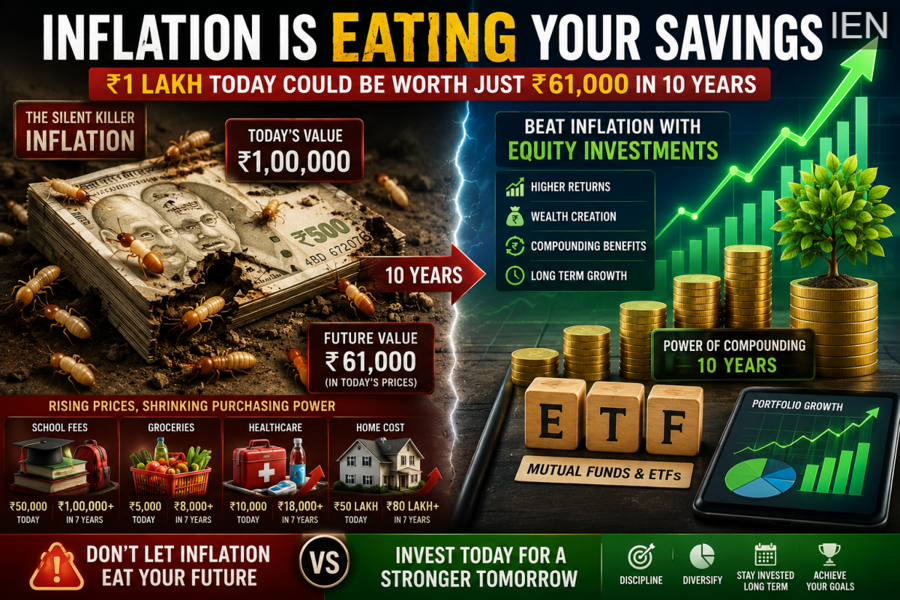
Many people believe their savings are growing as long as they are earning interest on bank deposits or traditional investment schemes. However, what often goes unnoticed is the hidden impact of inflation—a silent force that gradually reduces the purchasing power of money over time.
Financial experts frequently compare inflation to termites or rust. It may not be visible immediately, but it slowly erodes the real value of your hard-earned savings. As prices rise year after year, the same amount of money buys fewer goods and services, making long-term financial goals increasingly expensive.
This is why understanding real returns—not just nominal returns—is essential for successful wealth creation.
Why Your Money May Not Be Growing as Fast as You Think
Suppose your fixed deposit earns an annual return of 7%, while inflation is running at 5%.
At first glance, it appears that your money is growing by 7% every year. In reality, your purchasing power is increasing by only about 2%.
This difference between investment returns and inflation is known as the real return.
If inflation rises further or taxes reduce your post-tax returns, the actual gain can become negligible—or even negative.
The Hidden Cost of Inflation
Inflation affects every aspect of financial planning, from education and healthcare to retirement and housing.
Consider these examples:
Education Costs Can Double
A school fee of ₹50,000 per year today could easily exceed ₹1 lakh within seven to eight years if education costs continue rising at around 5% annually.
Cash Loses Value Over Time
If you simply keep ₹1 lakh in cash without investing it, inflation can significantly reduce its purchasing power.
At an inflation rate of around 5%, the real value of ₹1 lakh today could effectively shrink to nearly ₹61,000 after a decade in terms of what that money can actually buy.
Focus on Real Returns
An investment generating a 10% return may sound impressive. However, if inflation is 6%, the actual wealth creation is closer to 4%.
This is why financial planners advise investors to evaluate real returns rather than headline returns.
India's Inflation History Shows a Long-Term Pattern
While inflation occasionally falls to lower levels, India's long-term trend suggests that price increases remain a constant economic reality.
Retail inflation may move up and down from year to year, but historical data shows that inflation often remains within the 5% to 7% range over extended periods.
Just like compounding works for investments, inflation also compounds over time, steadily reducing purchasing power.
For long-term investors, ignoring inflation can be one of the biggest financial mistakes.
Can Equity Investments Beat Inflation?
One of the most common concerns among investors is whether equity-based investments can consistently outperform inflation.
Market volatility often creates uncertainty, especially during periods of economic stress. However, historical data suggests that equities have generally delivered stronger long-term returns than inflation.
According to research comparing long-term market performance with inflation trends, diversified equity investments have historically generated meaningful inflation-adjusted gains over extended periods.
The Long-Term Advantage of Equity and ETFs
Studies tracking the performance of broad-market equity indices indicate that long-term investors have often earned substantially higher returns than inflation.
Key observations include:
Inflation-Beating Growth
Over long investment horizons, equities have historically produced real returns that exceed inflation by several percentage points annually.
Short-Term Volatility Remains
In the short run, stock markets can experience sharp declines and periods of underperformance. Investors may even see negative returns during difficult economic conditions.
Recovery After Major Crises
Events such as the 2008 global financial crisis and the 2020 pandemic caused severe market corrections. However, investors who stayed invested through those downturns generally benefited from subsequent recoveries.
When Does the Power of Equity Become More Reliable?
Financial experts often emphasize that time is one of the most important factors in equity investing.
Research suggests that once investment horizons extend beyond seven to ten years, the impact of short-term market fluctuations tends to diminish significantly.
Over longer periods:
-
Market cycles balance out
-
Economic growth supports earnings expansion
-
Compounding becomes more powerful
-
Inflation-adjusted wealth creation improves
This is why many advisors recommend aligning equity investments with long-term goals such as retirement, children's education, or wealth creation.
Lessons for Mutual Fund and ETF Investors
Investors should understand that equity mutual funds and exchange-traded funds (ETFs) are not designed to guarantee inflation-beating returns every single year.
Short-term underperformance is always possible, particularly during market downturns.
However, investors who remain disciplined and maintain a long-term perspective are generally better positioned to benefit from the growth potential of equities.
Instead of chasing quick gains, experts recommend focusing on:
-
Long-term financial goals
-
Consistent investing
-
Portfolio diversification
-
Staying invested through market cycles
Final Takeaway
Inflation is one of the biggest threats to long-term wealth creation because it silently reduces purchasing power year after year. A savings strategy focused solely on traditional deposits may not always be sufficient to protect wealth after accounting for inflation and taxes.
While no investment can eliminate risk completely, equity-based investments such as diversified mutual funds and ETFs have historically shown a stronger ability to generate inflation-beating returns over longer periods.
The key lesson for investors is simple: don't just look at how much your money is growing—look at how much purchasing power it is actually gaining.
