
Indian Railways to Increase Train Fares from December 26: New Ticket Rates Explained
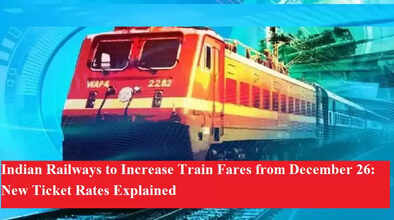
Indian Railways is set to revise passenger train fares starting Friday, December 26, 2025, making long-distance travel slightly more expensive. Under the newly announced fare structure, ticket prices will see a marginal increase for select categories and distances. According to railway estimates, this change is expected to generate nearly ₹600 crore in additional revenue, which will be used to improve services and infrastructure across the network.
However, the railways have clarified that the fare hike has been designed carefully to avoid burdening daily commuters and short-distance travelers. As a result, suburban services and monthly season tickets have been kept completely out of the fare revision.
Who Will Be Affected by the Fare Hike?
As per the new rules, only passengers traveling more than 215 kilometers will have to pay extra. If your journey is 215 km or less, there will be no change in ticket prices, regardless of the class of travel.
Here is how the revised fare structure will work:
-
Ordinary Class (beyond 215 km): Fare increase of 1 paisa per kilometer
-
Mail/Express Trains (Non-AC): Fare increase of 2 paisa per kilometer
-
Mail/Express Trains (AC Classes): Fare increase of 2 paisa per kilometer
-
Suburban Trains & Monthly Season Tickets: No fare change
This means the impact on passengers will be minimal, especially for those traveling shorter distances.
How Much More Will Passengers Pay?
To understand the impact better, consider this example:
If a passenger travels 500 kilometers in a non-AC class, the ticket price will increase by approximately ₹10. Railway officials have emphasized that this modest hike is unlikely to significantly affect travel plans, as the increase applies only to long-distance journeys.
The fare adjustment is aimed primarily at balancing operational costs while keeping rail travel affordable for the majority of passengers.
Relief for Daily Commuters and Short-Distance Travelers
One of the key highlights of this decision is the relief given to regular and short-distance commuters. Indian Railways has confirmed that:
-
Suburban trains will not see any increase
-
Monthly season tickets (MSTs) will remain unchanged
This move is intended to protect lower- and middle-income groups who rely on trains for daily commuting. The Railway Ministry stated that passenger affordability was kept in mind while finalizing the revised fares.
Revenue and Infrastructure Plans
The Railway Ministry also revealed that the previous fare revision implemented in July 2025 has already helped generate around ₹700 crore in revenue. With the new hike coming into effect, Indian Railways expects additional funds to support upgrades in:
-
Passenger amenities
-
Train services
-
Safety measures
-
Infrastructure modernization
Officials have reiterated that fare adjustments are necessary to maintain service quality while managing rising operational costs.
Special Trains for Christmas and New Year Rush
In view of the heavy passenger demand during the Christmas and New Year 2025–26 season, Indian Railways has made special travel arrangements. A total of 244 special train trips are being operated across eight railway zones, with more services likely to be announced if required.
Additional trains are running on high-traffic routes such as:
-
Delhi
-
Howrah
-
Lucknow
-
Mumbai–Goa (Konkan corridor)
These measures are expected to ease congestion and improve the chances of passengers getting confirmed seats during the festive rush.
Major Developments in Indian Railways
Alongside the fare revision, the Railway Ministry shared updates on several major projects. Notably, 100 percent land acquisition has been completed for the bullet train project in Maharashtra. In addition, between 2014 and 2025, Indian Railways has added:
-
Nearly 2 lakh new wagons
-
Over 10,000 locomotives
These developments reflect the government’s long-term focus on expanding capacity and modernizing the railway network.
Bottom Line
From December 26, 2025, train fares in India will rise slightly, but only for long-distance travelers. Short journeys, suburban services, and daily commuters remain unaffected. With minimal increases—often just a few rupees—the revised fares aim to strike a balance between passenger affordability and the financial needs of Indian Railways, while supporting better services in the future.
