
India’s Gas Economy Explained: LPG, PNG and Why the Strait of Hormuz Matters
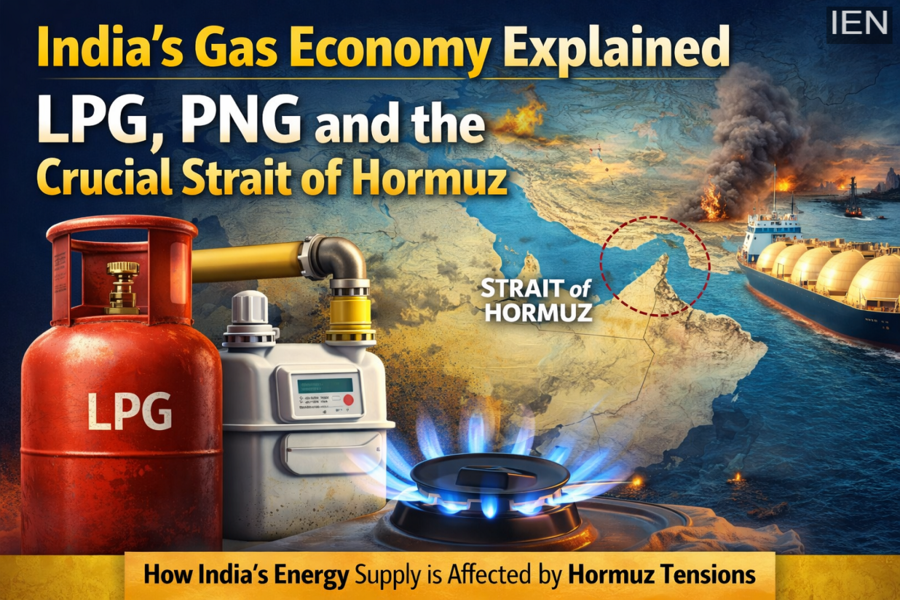
Rising geopolitical tensions in West Asia have started affecting global energy supply chains, and India is beginning to feel the impact. The ongoing conflict involving Iran, Israel and the United States has disrupted shipping routes, and the temporary closure of the Strait of Hormuz has created pressure on India’s gas supply.
Gas suppliers have reportedly invoked force majeure, a contractual clause used when companies cannot fulfil supply commitments due to extraordinary circumstances. As a result, shipments of liquefied petroleum gas (LPG) heading to India have slowed down. In several states including Maharashtra, Punjab and Andhra Pradesh, gas supply has either been reduced or temporarily halted.
To understand why this disruption matters, it is important to take a closer look at how India’s gas economy functions, the role of fuels like LPG and PNG, and how dependent the country is on imports.
How India’s Gas Economy Works
India consumes a significant amount of natural gas every day. Current estimates suggest the country uses around 190 million metric standard cubic meters per day (mmscmd) of gas. However, domestic production alone is not enough to meet demand, and nearly half of this requirement is fulfilled through imports.
Gas consumption is spread across several key sectors of the economy:
-
Fertilizer industry: Around 58 mmscmd of gas is used daily for fertilizer production.
-
Power generation: Gas-based power plants consume roughly 25 mmscmd.
-
Refineries and petrochemicals: These industries require about 22 mmscmd.
-
City gas distribution companies: Around 37 mmscmd of gas is supplied for household and commercial use.
The remaining gas is consumed by various other industries and manufacturing sectors.
Three Main Types of Gas Used in India
India’s energy ecosystem primarily relies on three types of gas-based fuels:
1. LPG (Liquefied Petroleum Gas)
LPG is the most widely used cooking fuel in Indian households. It is distributed in cylinders and is commonly used for domestic cooking.
In the financial year 2024, India consumed approximately 29.6 million tonnes of LPG. On average, the country uses around 2.6 million tonnes every month.
India currently has more than 330 million LPG consumers, with nearly 90% of demand coming from households. The remaining consumption comes from commercial establishments such as hotels, restaurants and catering businesses.
However, India relies heavily on imports to meet its LPG demand. More than 60% of the country’s LPG requirement is imported, and nearly 90% of those shipments pass through the Strait of Hormuz, making this shipping route extremely critical.
2. PNG (Piped Natural Gas)
PNG, or Piped Natural Gas, is supplied through pipelines directly to homes, restaurants and commercial establishments. It is widely used in cities where pipeline infrastructure is available.
PNG distribution in India is handled by City Gas Distribution (CGD) companies, including:
-
Mahanagar Gas Limited
-
Gujarat Gas Limited
-
Indraprastha Gas Limited
These companies supply natural gas not only to households but also to hotels, restaurants and small industries.
3. Commercial and Industrial Gas
Apart from LPG and PNG, industries also rely on commercial gas supplied through city gas networks. This fuel is used by a wide range of sectors including:
-
Hotels and restaurants
-
Hospitals
-
Manufacturing units
-
Glass and ceramic industries
These sectors depend heavily on uninterrupted gas supply to maintain operations.
Impact of Supply Disruptions
The slowdown in gas shipments caused by tensions in West Asia could have ripple effects across multiple industries in India.
Restaurant associations have warned that shortages of LPG cylinders may affect the food service industry. If the supply crunch continues, some restaurants may even face temporary closures. This could also impact food delivery platforms, which depend on restaurants operating normally.
Industries that rely on continuous gas supply may also face rising costs or operational disruptions if the situation worsens.
Government Prioritizes Key Sectors
To manage the situation, the central government has issued instructions to prioritize gas supply to essential sectors. These include industries critical to the economy, particularly fertilizer production.
The policy also covers regasified liquefied natural gas (RLNG), ensuring that essential industries receive adequate supply even during disruptions.
Following the announcement, shares of fertilizer companies witnessed gains, while city gas distribution companies also recorded market increases of up to 4%, reflecting investor confidence in government support for critical sectors.
Why the Strait of Hormuz Is Crucial
The Strait of Hormuz is one of the world’s most important energy shipping routes. A large portion of global oil and gas exports from the Middle East passes through this narrow waterway.
Because India imports a significant share of its LPG through this route, any disruption can quickly affect supply chains. The ongoing geopolitical tensions have once again highlighted India’s dependence on global energy markets and maritime trade routes.
The Bigger Picture
India’s gas economy plays a vital role in supporting households, agriculture, power generation and industrial activity. While the country has expanded its domestic production and pipeline infrastructure in recent years, import dependence remains a key challenge.
As geopolitical uncertainties continue to affect global energy flows, maintaining stable supply chains and diversifying energy sources will remain critical for India’s long-term energy security.
