
India’s First Income Tax Was Introduced in 1860 After the 1857 Revolt Shook British Finances
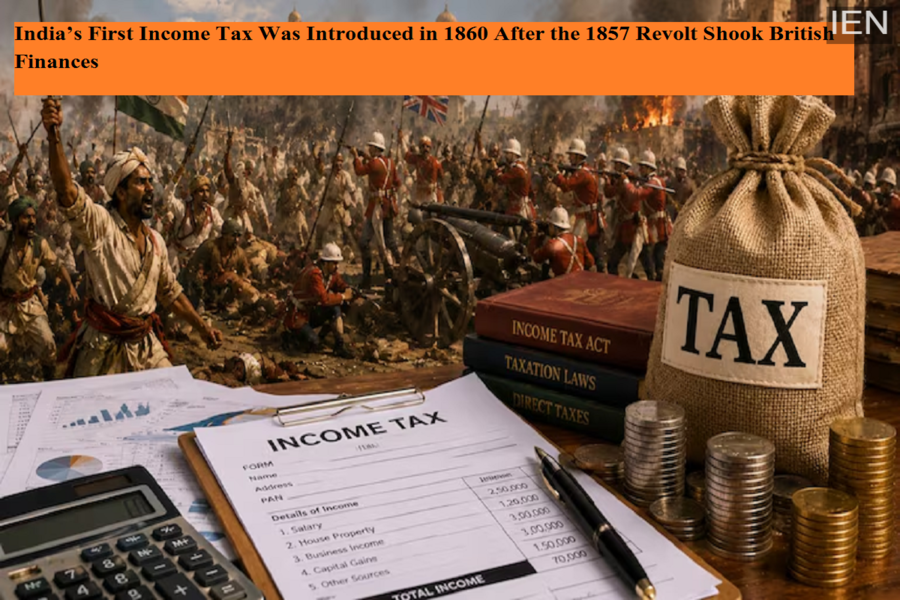
Today, income tax is one of the Indian government’s biggest sources of revenue, contributing heavily to public spending on infrastructure, defense, healthcare, railways, welfare schemes, and education. Every year, crores of Indians file Income Tax Returns (ITR) and pay taxes according to their earnings. But very few people know that India’s income tax system actually began because of a massive financial crisis triggered by the Revolt of 1857.
What started as an emergency measure by the British government later evolved into the modern tax structure that exists in India today. The story behind India’s first income tax law is deeply connected to war expenses, administrative challenges, and the economic aftershocks of the country’s first major uprising against British rule.
The 1857 Revolt Forced the British Government Into Financial Trouble
India witnessed its first income tax in the year 1860 during British colonial rule. The immediate reason behind its introduction was the massive economic pressure caused by the Revolt of 1857, which is also known as India’s First War of Independence.
The rebellion spread across large parts of the country and forced the British administration to spend enormous amounts of money on military operations, transportation, weapons, troop deployment, and administrative restructuring.
The financial burden became so severe that the British government began searching for new ways to generate revenue. This economic crisis ultimately laid the foundation for India’s first income tax system.
How Much Did the Revolt Cost the British Treasury?
Historical estimates suggest that the British administration in India generated annual revenue of nearly ₹30–35 crore during 1857–58. However, the cost of suppressing the revolt reportedly touched around ₹40 crore, which exceeded an entire year’s government revenue.
Reports presented before the British Parliament in 1858 stated that the uprising and military response created an additional financial burden of nearly £40 million on the British Empire.
A large part of this expenditure went toward:
- Sending additional troops to India
- Military transportation
- War operations
- Administrative changes after the revolt
- Expanding British control mechanisms
The financial stress became one of the biggest reasons for introducing direct taxation in India.
James Wilson Introduced India’s First Income Tax
To stabilize finances in India, the British government sent Scottish economist and financial expert James Wilson to India.
He is widely regarded as India’s first finance member and played a major role in shaping the country’s early financial administration.
In 1860, James Wilson presented India’s first formal budget and proposed the introduction of income tax for the first time in Indian history. The primary objective was simple — reduce the growing budget deficit and recover part of the financial losses caused by the revolt.
What Were the First Income Tax Rates in India?
The tax system introduced in 1860 was far simpler than today’s complex income tax structure.
According to the original income tax law:
- Individuals earning between ₹200 and ₹500 annually had to pay 2% tax
- Those earning above ₹500 annually had to pay 4% tax
While these amounts may appear extremely small today, ₹200 annual income during the 1860s was considered substantial. As a result, the tax mainly affected traders, professionals, businessmen, and high-income individuals.
Most farmers and laborers remained outside the tax net during that period.
The First Income Tax Was Initially Temporary
Interestingly, the British government did not initially intend to keep income tax permanently.
The tax was introduced as a temporary emergency measure to manage the financial crisis. Later, in 1865, the British administration removed the tax.
However, officials soon realized that direct taxation could become an effective and stable source of revenue. Over the following decades, different versions of income tax laws were reintroduced with various changes and modifications.
How India’s Modern Income Tax System Developed
Over time, the British administration gradually refined the tax structure in India.
A major milestone came in 1886 when a new Income Tax Act was introduced to create a more organized taxation system. Several amendments followed in later years to improve collection and administration.
After independence, the Government of India completely reviewed the tax framework and introduced the Income Tax Act of 1961, which still forms the backbone of India’s taxation system today.
Although the law has undergone multiple amendments over the decades, the 1961 Act remains the foundation of modern income tax administration in the country.
Why Income Tax Is So Important Today
In present-day India, income tax has become one of the most critical revenue sources for the central government.
The money collected through taxes is used to fund:
- National highways and roads
- Railway infrastructure
- Defense and security
- Public healthcare
- Education systems
- Welfare and subsidy schemes
- Digital and infrastructure development projects
What began in 1860 as a financial recovery tool after the 1857 revolt has now evolved into a central pillar of India’s economy and governance structure.
A Historic Crisis That Changed India’s Financial System Forever
The introduction of income tax in India was not part of an economic reform strategy or modernization plan. It was born out of crisis management during one of the most turbulent phases of British rule.
The Revolt of 1857 not only changed the political future of India but also permanently transformed its financial administration. The tax system created to repair a damaged colonial treasury eventually became one of the strongest foundations of India’s modern economy.
