
Income Tax Act 2025: Do You Need a New PAN Card? Government Clears Confusion Over PAN, ITR and New Forms
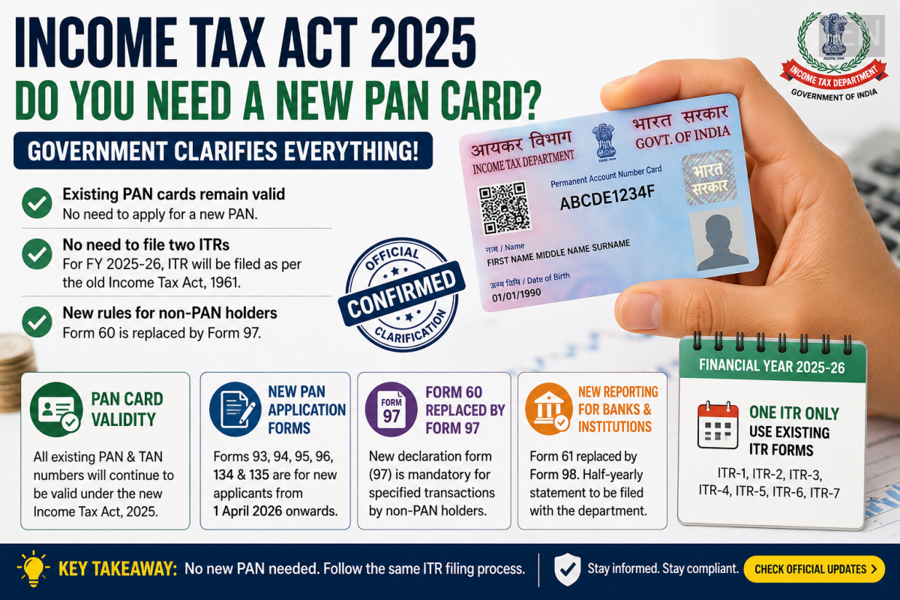
The implementation of the Income Tax Act, 2025 from April 1, 2026 has raised several questions among taxpayers across India. Many people have been wondering whether they need to apply for a new Permanent Account Number (PAN), whether their existing PAN remains valid, and if they will have to file two Income Tax Returns (ITRs) because of the transition to the new law.
The Income Tax Department has now issued clear clarifications, confirming that existing PAN cards will continue to remain valid and taxpayers will not be required to file two returns for the same financial year.
Here's everything taxpayers need to know about the new rules.
Existing PAN Cards Will Continue to Remain Valid
One of the biggest concerns among taxpayers was whether the new Income Tax Act would require everyone to obtain a fresh PAN card.
The Income Tax Department has clarified that existing PAN and TAN numbers will continue to remain valid under the new law.
Individuals who already possess a PAN card do not need to apply for a new one simply because the Income Tax Act, 2025 has replaced the Income Tax Act, 1961.
The government has confirmed that previously issued PAN numbers will continue to be accepted for all tax-related purposes.
Who Will Use the New PAN Application Forms?
The department explained that the newly introduced application forms—including Forms 93, 94, 95, 96, 134 and 135—are meant only for individuals and entities applying for PAN after April 1, 2026.
These revised forms are part of the administrative framework introduced under the new Income Tax Act.
Applicants who submitted PAN applications on or before March 31, 2026, do not need to submit fresh applications.
Their existing applications will continue to be processed under the transition provisions without requiring any additional paperwork.
Form 60 Replaced by Form 97
Another important procedural change relates to individuals who do not possess a PAN card but are required to undertake specified financial transactions.
Earlier, such individuals were required to submit Form 60.
Under the new Income Tax Act, Form 97 has replaced Form 60 for these declarations.
This change applies from the beginning of the new financial year governed by the Income Tax Act, 2025.
Individuals without a PAN should ensure they use the updated form wherever applicable.
New Reporting Requirement for Banks and Financial Institutions
The procedural changes are not limited to taxpayers alone.
Banks, companies and financial institutions that accept declarations from individuals without PAN will also have to follow revised reporting requirements.
Previously, these entities submitted Form 61.
Under the new framework, they will now be required to submit a half-yearly statement to the Income Tax Department using Form 98.
The change is intended to improve reporting consistency under the new legislation.
Do Taxpayers Need to File Two ITRs This Year?
Another misconception circulating among taxpayers is that the introduction of the new law requires filing two Income Tax Returns during the transition year.
The Income Tax Department has categorically denied this.
Income earned during Financial Year 2025-26 will continue to be governed by the provisions of the Income Tax Act, 1961.
Accordingly, taxpayers filing returns for Assessment Year 2026-27 will continue using the existing Income Tax Return forms, including:
-
ITR-1
-
ITR-2
-
ITR-3
-
ITR-4
-
ITR-5
-
ITR-6
-
ITR-7
There is no requirement to submit a second return because of the introduction of the new law.
Why the New Act Does Not Affect Current-Year Returns
Although the Income Tax Act, 2025 became effective from April 1, 2026, the applicable law for filing returns depends on the financial year in which the income was earned.
Since the income for FY 2025-26 accrued before the new Act became operational for assessment purposes, taxpayers will continue to follow the existing return filing framework for Assessment Year 2026-27.
This ensures a smooth transition without creating additional compliance burdens.
What Taxpayers Should Remember
The Income Tax Department has advised taxpayers not to rely on unverified information circulating online regarding PAN replacement or multiple ITR filings.
The key points are:
-
Existing PAN cards remain fully valid.
-
Existing TAN numbers also continue without change.
-
No fresh PAN application is required for current PAN holders.
-
PAN applications submitted before March 31, 2026, will continue to be processed normally.
-
Form 97 replaces Form 60 for specified declarations by individuals without PAN.
-
Banks and financial institutions will now file Form 98 instead of Form 61.
-
Only one Income Tax Return is required for Assessment Year 2026-27 using the existing ITR forms.
Final Takeaway
The introduction of the Income Tax Act, 2025 has modernized India's tax framework, but it does not require existing taxpayers to replace their PAN cards or file duplicate Income Tax Returns. The government has clarified that current PAN and TAN numbers remain valid, while only certain procedural forms have been updated for future applicants and institutions.
Taxpayers should continue following the existing filing process for Assessment Year 2026-27 and rely on official notifications issued by the Income Tax Department for any future changes.
Disclaimer: This article is intended for informational purposes only. Tax laws and compliance requirements may change through future notifications or amendments. Taxpayers should consult the official Income Tax Department guidelines or seek advice from a qualified tax professional before making tax-related decisions.
