
Important News for Those Installing Solar Panels: Rules Changing from June 1st—Find Out What Happens to Subsidies..
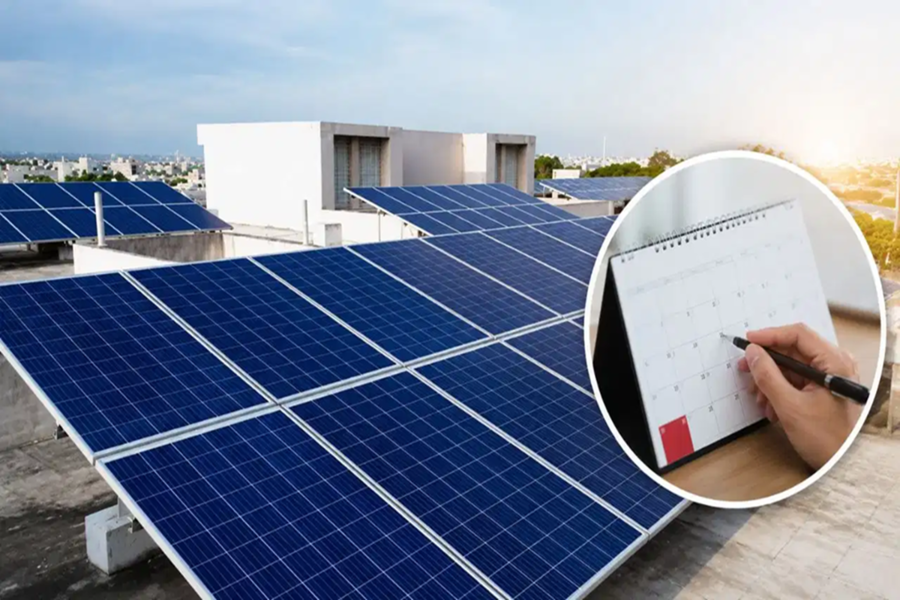
If you, too, are planning to install solar panels on your rooftop to find relief from the scorching heat and aim to bring your electricity bill down to zero, then there is a crucial piece of news for you. In fact, the government is set to implement a new regulation within the solar industry starting June 1, 2026. Under this new change (ALMM List-II), it will now be mandatory for the 'solar cells' used *within* the solar panels—in addition to the panels themselves—to meet government-prescribed standards. This decision will have a direct impact on your finances, as the cost of installing a solar system is likely to rise in the coming days. However, there is a silver lining: the subsidies available under the 'PM Surya Ghar Muft Bijli Yojana' (PM Surya Ghar Free Electricity Scheme) will continue to be provided just as before.
**What is the new rule coming into effect on June 1?**
Until now, the prevailing market regulation stipulated that solar panels installed in homes must be certified under the government's approved list (ALMM List-I). However, the government has now tightened this regulatory framework. Under the new rule, effective June 1, the individual 'solar cells' embedded *within* the solar panels must also be included in the government's approved list (List-II). The government has made it clear that this deadline will not be extended under any circumstances. The primary objective behind this move is to curb the use of substandard foreign-manufactured equipment.
**How much will the cost increase?**
The implementation of these new standards is expected to trigger a significant shift in the market. Experts believe that making the use of domestically manufactured solar cells mandatory will result in an increase in panel prices. If you opt to install a 1-kilowatt (1kW) solar system, you may have to incur an additional expense of approximately ₹3,000 compared to previous costs. Based on this calculation, a 2kW setup could place an additional financial burden of ₹6,000 on your pocket, while installing a 3kW system could cost you roughly ₹9,000 more. Furthermore, if the supply of approved solar cells in the market falls short, these costs could rise even higher.
**Will government subsidies be discontinued?** Alongside news regarding changes in market regulations, various misleading rumors are also circulating on social media. Claims are being made that the government is set to discontinue subsidies; however, this information is entirely baseless. The financial assistance provided to the general public under the ‘PM Surya Ghar: Muft Bijli Yojana’ (PM Surya Ghar: Free Electricity Scheme) will continue without any interruption. Consumers will continue to receive subsidies just as before: ₹30,000 for a 1 kW system, ₹60,000 for a 2 kW system, and a maximum of ₹78,000 for systems of 3 kW or higher. Several state governments will also continue to provide additional "top-up" subsidies from their end. The only change is that, going forward, the paperwork, vendor selection, and verification processes required to avail of the subsidy benefits will become slightly more stringent.
What are the options for consumers?
If you are planning to install a new system, you primarily have two paths to choose from. The first option is the ‘Subsidy Route.’ This is best suited for families who wish to eliminate their electricity bills. However, under this route, you are required to select only those technologies and components that have been approved by the government. The second path is the ‘Freedom Route,’ under which you do not receive any subsidy. This option is ideal for those who wish to utilize the very latest global technologies (such as HJT, HDT, or Lithium batteries). It serves as a robust and sustainable option for regions prone to frequent and severe power outages. While the initial upfront cost may be higher in this case, the long-term performance of the system proves to be exceptional.
Disclaimer: This content has been sourced and edited from TV9. While we have made modifications for clarity and presentation, the original content belongs to its respective authors and website. We do not claim ownership of the content.
