
How many varieties of crude oil are there? What is the difference between crude oil from the US, Russia, Iran-Iraq, and Britain?
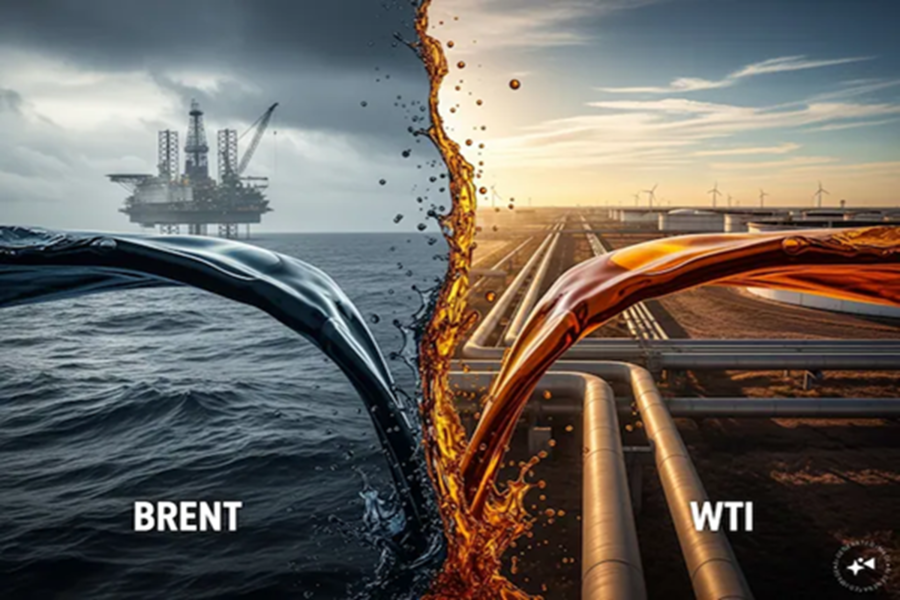
Whenever oil prices rise, crude oil invariably makes headlines; however, it would be incorrect to assume that there is only one type of crude oil in the world. In reality, crude oil comes in various varieties, and the oil produced by each country differs in terms of its composition, quality, and price. This is much like wheat: while it is fundamentally the same grain, there is a distinct difference between varieties such as *Sharbatī* wheat and *Desī* wheat.
The quality of any crude oil is determined by two primary factors. The first is its density—that is, how light or heavy the oil is. Lighter oils are classified as "Light," while heavier ones are termed "Heavy." Light oil flows more easily through pipelines and is less expensive to refine. The second criterion is its sulfur content. Oil with low sulfur levels is referred to as "Sweet," whereas oil with high sulfur levels is designated as "Sour." The "sweeter"—meaning the lower the sulfur content—the better and more expensive the oil tends to be. It is based on these two parameters that all the world's crude oil is ranked.
**America's Crude Oil: WTI**
The crude oil found in the United States is known as WTI (West Texas Intermediate). It is considered one of the finest crude oils in the world. It is exceptionally light and "sweet," falling into the "Light Sweet" category. Its sulfur content is negligible; consequently, it is easy to refine and can be readily processed into gasoline, diesel, and other fuels. Extracted from the oilfields of Texas, North Dakota, and Louisiana, this oil serves as the backbone of America's "Shale Revolution." During the 2010s, the United States ramped up its oil production to such an extent that it surpassed both Saudi Arabia and Russia to become the world's largest oil producer. While the price of WTI serves as a benchmark, it is primarily a reference point for the U.S. domestic market.
**Britain's Crude Oil: Brent**
While WTI acts as the benchmark for the United States, "Brent" is recognized as the global benchmark for crude oil. The price of approximately 80 percent of the world's oil deals is benchmarked against the oil extracted from the North Sea, near the coasts of Britain and Norway. When you hear on television that crude oil has reached $100 per barrel, it is the price of Brent that is being referred to. This, too, falls under the "Light Sweet" category of oil.
A major advantage of Brent is that it is extracted offshore; consequently, it can be easily shipped to any port in the world. This is the reason why it typically sells for $3 to $7 more per barrel than WTI.
**Russia's Urals**
Russian crude oil is known as Urals. In reality, it is a blend derived from a mixture of oils from various fields located around Siberia and the Ural Mountains. In terms of quality, it falls into the "Medium Sour" category. It is slightly heavier and contains a higher sulfur content than Brent. Because of its elevated sulfur levels, refining it is somewhat more difficult and costly. Under normal market conditions, Urals typically sold for $2 to $5 less per barrel than Brent.
Following the war in Ukraine in 2022, when Western nations imposed sanctions on Russian oil, Russia was compelled to seek out new buyers for its crude. India and China seized this opportunity, purchasing Urals at a discount of $15 to $30 per barrel compared to Brent. This is the primary reason why India's imports of Russian oil surged manifold after 2022. Russia also possesses another variety of crude known as ESPO, which is transported directly from Siberia to China via a pipeline. This is a "Light Sweet" crude of superior quality.
**Crude Oil from Iran and Iraq**
The oil produced by these two Middle Eastern nations falls into the "Heavy Sour" category. This implies that it is viscous, dense, and rich in sulfur. Iran's "Iranian Heavy" and Iraq's "Basrah Heavy" are prime examples of this type of crude. Refining these types of oil is the most difficult and expensive process, as it requires specialized technology to remove the sulfur. This is precisely why crude oil from Iran and Iraq sells at a significantly lower price than WTI and Brent. A key characteristic of these oils is that they are found in extremely large reserves.
Iraq possesses the world's fourth-largest oil reserves, while Iran holds the fourth-largest *proven* oil reserves. Asian nations—such as India, China, Japan, and South Korea—construct specialized refineries designed to process this "heavy and sour" crude, thereby enabling them to generate higher profits from this lower-cost oil. However, purchasing oil from Iran has become a risky undertaking due to U.S. sanctions imposed on the country. Any nation or company that purchases oil from Iran risks being barred from accessing the U.S. market.
Is there only one type of crude oil in the world?
No; crude oil comes in various varieties, and each type is distinct.
What factors determine the quality of crude oil?
Its density (whether it is "light" or "heavy") and its sulfur content.
What is the difference between "light" and "heavy" oil?
Light oil is lighter in weight and less expensive to refine, whereas heavy oil is heavier and more costly to refine.
What is the difference between WTI and Brent?
WTI serves as the U.S. benchmark for crude oil, while Brent serves as the global benchmark
Why is Russia's Urals crude oil cheaper?
It is classified as "medium sour," which makes it more expensive to refine.
Disclaimer: This content has been sourced and edited from News18 Hindi. While we have made modifications for clarity and presentation, the original content belongs to its respective authors and website. We do not claim ownership of the content.
