
How Are Power Banks Made, and What Causes Them to Catch Fire? Get All the Details Here
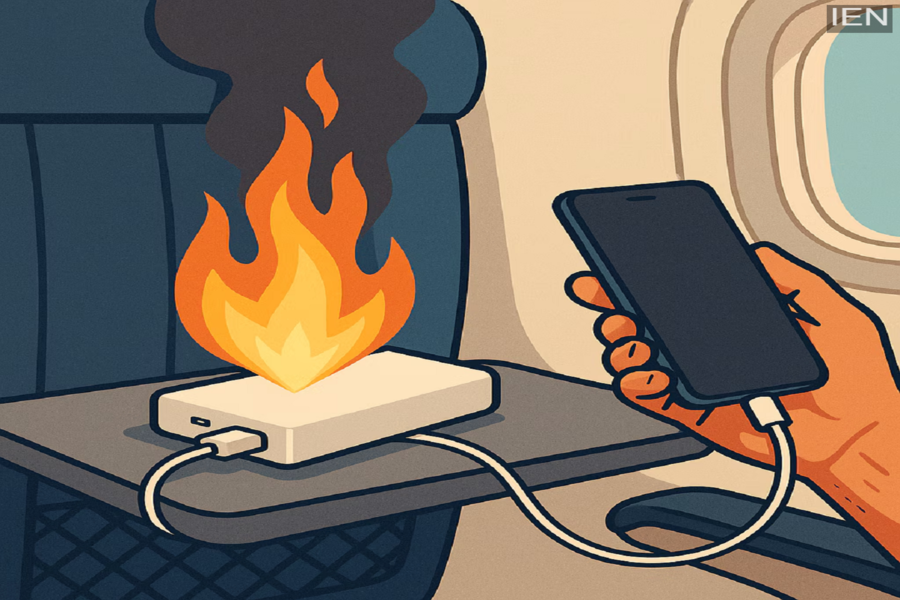
How Power Banks Are Made: Incidents involving power banks catching fire have reignited the debate regarding their safety. In light of this, it has become crucial to understand how power banks are manufactured and the specific reasons that can lead to them catching fire.
How Power Banks Are Made: A power bank caught fire inside an IndiGo flight at Chandigarh Airport. Fortunately, the flight had already landed by the time the incident occurred, and no injuries or damage were reported. Due to a series of such incidents occurring one after another, the use of power banks on flights has now been restricted. Following this incident in Chandigarh, discussions surrounding power banks and their safety have once again come to the forefront. Today, we will attempt to understand how power banks are constructed and the various factors that can cause them to catch fire.
How Is a Power Bank Made?
A power bank can be conceptualized as a battery encased within a plastic or metal shell. Its top layer serves as the positive terminal, while the bottom layer acts as the negative terminal. Sandwiched between these two layers is a thin separator film. This film is as thin as a sheet of paper and functions as a divider between the positive and negative sides. The interior is filled with a flammable liquid (electrolyte), which facilitates the flow of electricity. This entire assembly is packed extremely tightly and kept under pressure. When the device is being charged, ions travel from one side to the other through the liquid electrolyte; as soon as it is unplugged, these ions return to their original positions. This entire process occurs with great speed.
What Causes Power Banks to Catch Fire?
Power banks—or batteries in general—do not explode without warning. Typically, a malfunction or internal anomaly occurs first, followed by an explosion. When examining the specific reasons why a power bank might catch fire, several factors come into play:
- Heat: If a power bank is placed in a hot environment, or if it overheats during use, there is a significant risk of it exploding. Damage from Drops: If a power bank is dropped forcefully, its internal separator can sustain damage. This can disrupt the chemical reactions occurring inside, potentially leading to a fire.
- Faulty Chargers: Defective or substandard chargers can also be a cause of fires. Such chargers fail to regulate voltage effectively, which can gradually degrade the separator within the power bank.
- Battery Aging: If a power bank or its battery becomes excessively old, it can generate internal gas. This causes the power bank to swell, creating a risk of fire during use.
When the separator becomes compromised—whether due to physical damage or other factors—the negative and positive electrodes may come into contact. This causes electricity to flow along an unintended path, resulting in the overheating of the electrolyte. Consequently, internal pressure builds up, and as the trapped gas attempts to escape, it ignites.
