
Gas Cylinder: Do Gas Cylinders Also Have an Expiry Date? Why Are Codes Like 'A 26' or 'B 27' Inscribed on Them?
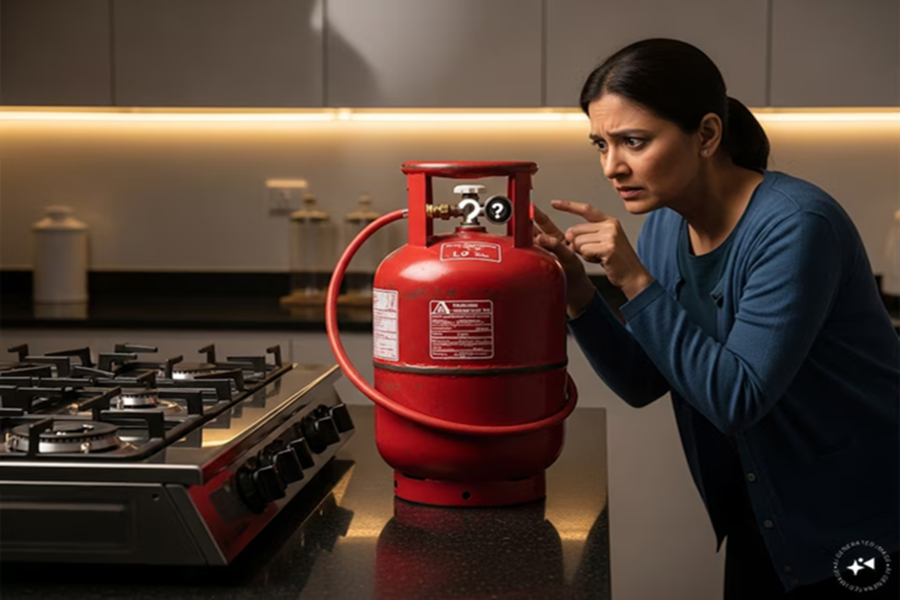
The codes inscribed on gas cylinders do not pertain to their 'expiry date,' but rather to their 'testing date.' LPG cylinders are manufactured in strict adherence to rigorous internal and external safety standards to ensure they can withstand high pressure. The alphanumeric codes (such as A 26 or B 27) printed near the cylinder's handle actually indicate the specific date by which the cylinder must next be sent for a safety test.
As early as 2007, Indian Oil Corporation Limited (IOCL) issued a circular clarifying that a specific timeframe is established for the statutory testing and repainting of LPG cylinders. The code inscribed on the cylinder denotes this specific timeframe, enabling distributors and the company to identify which cylinders are due to be sent to a laboratory for re-inspection. This code does not represent an expiry date.
To decode these printed codes, four English letters—A, B, C, and D—are utilized. These four letters correspond to the four distinct quarters of a calendar year. For instance, the letter 'A' is used to designate the first quarter of the year—that is, January through March. Similarly, 'B' signifies the April-to-June quarter, 'C' signifies the July-to-September quarter, and 'D' signifies the October-to-December quarter.
The numerals accompanying these letters indicate the specific year in which the cylinder's next inspection is scheduled to take place. If a cylinder in your home bears the inscription 'A 26,' it simply means that it is scheduled to be sent for re-testing during the first quarter of the year 2026 (i.e., by March). Likewise, if a cylinder is marked with 'B 27,' it is scheduled for its next safety inspection during the second quarter of 2027 (i.e., by June). Gas cylinders are manufactured using extremely robust 'special steel' and feature a protective coating to prevent rusting. Their production is carried out in strict compliance with the rigorous regulations set forth by the Bureau of Indian Standards. Licenses to manufacture cylinders are granted exclusively to companies that have received accreditation from the Chief Controller of Explosives (CCOE).
The total service life of a standard domestic gas cylinder is stipulated at 15 years, provided it continues to successfully pass all requisite safety tests. According to regulations, it is mandatory for the cylinder to undergo a comprehensive quality inspection and hydro-testing at least twice during these 15 years. The first inspection is conducted 10 years after the cylinder's manufacture, while the second inspection takes place 5 years thereafter.
If a consumer receives a cylinder whose testing validity date has expired, they should immediately lodge a complaint with the concerned agency. Although Oil Marketing Companies take measures to ensure that no 'outdated' cylinders enter the market, it remains essential—as a matter of awareness—for every homemaker and citizen to check these codes.
The date inscribed on an LPG cylinder serves solely as a re-testing marker, intended to prevent accidents and uphold the structural integrity of the system. Therefore, the next time a new cylinder is delivered to your home, be sure to check the year—along with the accompanying letter 'A, B, C, or D'—stamped on its handle, and use it in your kitchen with complete peace of mind.
Disclaimer: This content has been sourced and edited from News18 Hindi. While we have made modifications for clarity and presentation, the original content belongs to its respective authors and website. We do not claim ownership of the content.
