
Free Treatment Up to ₹5 Lakh, Pre-Existing Diseases Covered: How to Benefit from the Ayushman Card Scheme
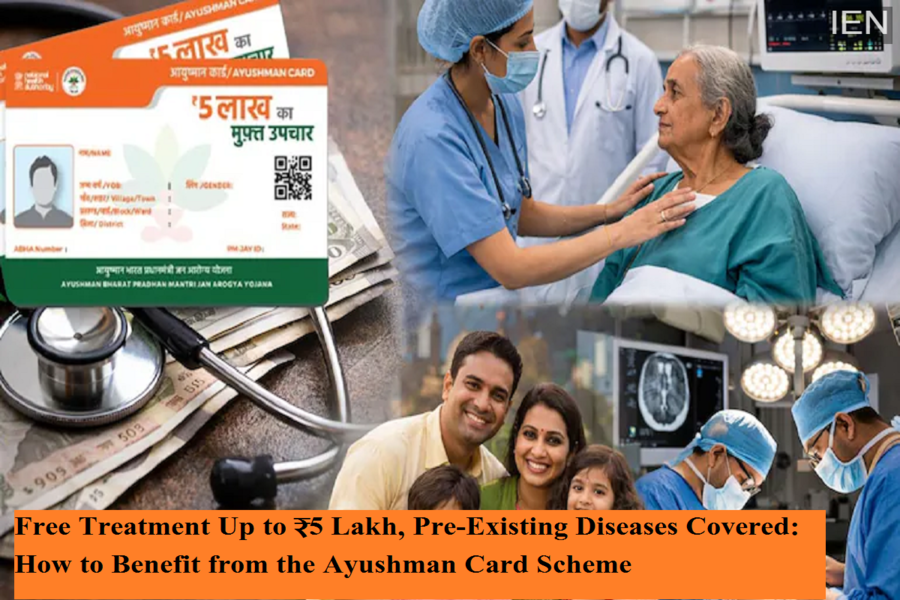
The Ayushman Card, issued under the Pradhan Mantri Jan Arogya Yojana (PM-JAY), is one of India’s largest government-backed health protection schemes. Its primary objective is to protect economically weaker families from the heavy financial burden of serious medical treatment. Under this scheme, an eligible family can receive cashless medical treatment worth up to ₹5 lakh every year, covering a wide range of critical illnesses and procedures.
One of the most important features of the Ayushman Card is that it covers pre-existing diseases from day one. This means beneficiaries do not have to wait for a specific period after enrolling to receive treatment for illnesses they already suffer from. Treatment can be availed not only in government hospitals but also in empanelled private hospitals across the country.
What Is the Ayushman Card?
The Ayushman Card is a health card issued to eligible families under PM-JAY. It serves as proof of entitlement to free and cashless medical care up to ₹5 lakh per year per family. The coverage applies collectively to the entire family and is not limited to a single member.
The scheme aims to ensure that lack of money does not prevent people from accessing quality healthcare, especially during serious or life-threatening illnesses.
Who Is Eligible for the Ayushman Card?
The Ayushman Card is not available to all citizens. Eligibility is determined based on socio-economic criteria, primarily using the Socio-Economic Caste Census (SECC) data.
In rural areas, the scheme covers families that:
-
Do not own a permanent (pucca) house
-
Are landless and depend on daily wage labour
-
Have no regular earning member
-
Belong to Scheduled Caste (SC) or Scheduled Tribe (ST) categories
In urban areas, the focus is on workers from the unorganised sector, such as:
-
Street vendors and hawkers
-
Domestic helpers
-
Drivers and conductors
-
Construction workers
-
Sanitation workers
-
Daily wage labourers
If a family’s name appears in the SECC database, they are likely to be eligible for an Ayushman Card.
Who Is Not Eligible?
Certain groups are excluded from the scheme, including:
-
Income tax payers
-
Most government employees
-
Financially well-off individuals and large business owners
-
Families already covered under comprehensive government or corporate health insurance schemes
The aim is to ensure that the benefits reach those who genuinely need financial support for healthcare.
How to Apply for an Ayushman Card
The Ayushman Card can be generated through both online and offline methods, making the process accessible to everyone.
Online Method
Applicants can visit the official Ayushman Bharat website and log in using their registered mobile number. After checking eligibility, they can complete the KYC process using Aadhaar or another valid identity document. Once verified, the Ayushman Card can be downloaded instantly.
Offline Method
Eligible individuals can visit the nearest Common Service Centre (CSC) or a government hospital with an Ayushman Mitra desk. By providing Aadhaar, ration card, and mobile number, biometric verification is completed, and the card is issued on the spot.
How to Avail Treatment Using the Ayushman Card
Using the Ayushman Card for treatment is simple and hassle-free. The cardholder needs to visit any empanelled government or private hospital under the scheme. After presenting the card, the hospital’s Ayushman Mitra verifies eligibility and initiates the approval process.
Once approved, treatment begins on a cashless basis, covering hospitalisation, medicines, diagnostic tests, surgery, and even post-treatment follow-up care. Patients do not need to make any upfront payments.
Diseases and Treatments Covered
The scheme includes over 1,500 medical and surgical packages, covering a wide range of treatments such as:
-
Heart surgeries
-
Kidney dialysis
-
Cancer treatment
-
Brain and neurological procedures
-
Orthopaedic surgeries and joint replacements
-
Treatment for serious accidents
There is no age limit, and coverage applies equally to children, adults, and senior citizens.
Key Benefits of the Ayushman Card
The biggest advantage of the Ayushman Card is financial security during medical emergencies. Families do not have to sell assets, take loans, or depend on others to afford treatment. The ₹5 lakh annual cover applies to the entire family, making it especially useful for households with multiple dependents.
Beyond healthcare, the scheme acts as a safety net that protects families from slipping into poverty due to high medical expenses.
Why the Ayushman Card Is Essential
In India, healthcare costs continue to rise, and medical emergencies often push families into financial distress. The Ayushman Card acts as a shield for those who want timely medical care but cannot afford it.
If you are eligible and have not yet applied for the Ayushman Card, delaying it could prove costly in the future. This card functions like a strong health insurance policy, ensuring access to quality treatment without worrying about money when it matters the most.
