
Financial aid of ₹1 lakh for weddings: How to avail the benefits of the Chief Minister's Mass Marriage Scheme in UP..
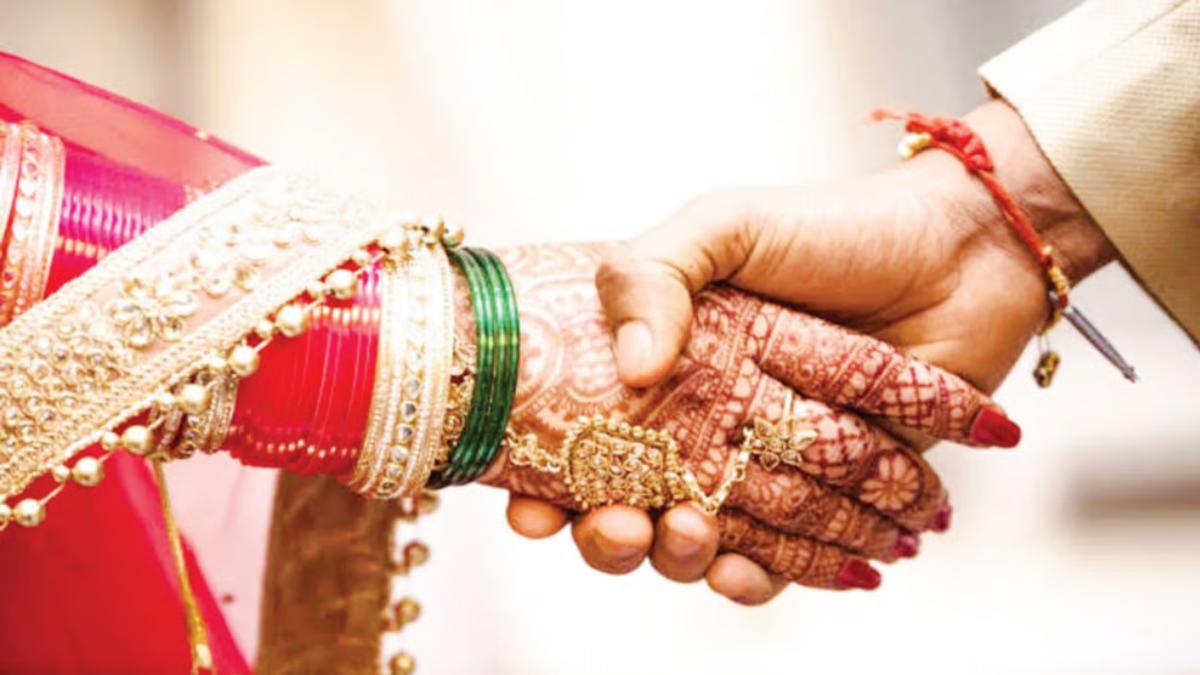
A significant change has been made to the rules of the Uttar Pradesh government’s 'Chief Minister’s Mass Marriage Scheme' (Mukhyamantri Samuhik Vivah Yojana). Under this scheme, which provides a total assistance of ₹1 lakh for the marriages of daughters from poor families, ₹64,000 will now be transferred directly into the bride’s bank account. This cash amount replaces the silver anklets and toe rings that were previously provided. In other words, the value of the silver anklets and toe rings—approximately ₹4,000—has been deducted from the ₹25,000 previously allocated for gift items and added to the amount transferred directly to the bride’s bank account.
Consequently, the amount deposited into the bride’s account will now be ₹64,000 instead of ₹60,000. The remaining funds consist of ₹21,000 for gift items and ₹15,000 to cover expenses for the wedding ceremony, such as the venue (pandal), catering, and tents.
Anil Gupta, a Block Development Officer (BDO) in Uttar Pradesh, notes that the wedding season begins after Navratri. The government organizes mass marriage ceremonies under this scheme in various locations; however, to ensure a smooth process and avoid last-minute complications, applicants should begin the application procedure 20 days to a month in advance.
Conditions for availing the assistance:
The total annual income of the applicant's family must be ₹3 lakh or less. At the time of the wedding, the bride must be at least 18 years old, and the groom must be at least 21 years old. The bride must be a permanent resident of Uttar Pradesh. The scheme is open to all poor families, including those from SC, ST, OBC, minority, and general categories. It also covers the remarriage of widows and divorced women. The marriage must take place exclusively during a mass wedding ceremony organized by the government; the scheme’s benefits do not apply to private or individual weddings.
How to Apply
If you wish to avail the benefits of this scheme and want to know the correct application procedure, you may choose either the online or offline method, according to your convenience.
Online Application Process
To ensure the entire process is transparent and straightforward, the Government of Uttar Pradesh has made online application via Aadhaar card mandatory. Follow these steps to complete the process:
First, visit the official website of the scheme at cmsvy.upsdc.gov.in. On the homepage, click on the 'Apply' or 'New Registration' option. Enter the Aadhaar numbers of both the bride and the groom, and complete the e-KYC process using an OTP. Accurately provide all the required information in the form, such as personal details, income, caste, residential information, and the bride’s bank account number along with the correct IFSC code. Upload scanned copies of the bride and groom's photographs, proof of age, income certificate, and the bank passbook. After carefully reviewing the form, submit it and take a printout of the generated receipt or application form. Once the online form is filled, attach photocopies of all necessary documents to the printout and submit it to your local Block or Municipal office for physical verification—this must be done at least 15 to 45 days before the scheduled wedding date.
Offline Application Process
If you find it difficult to fill out the online form yourself, the government also provides an easy offline (paper-based) application option. You can obtain the application form for this scheme free of charge from your nearest Block Development Officer’s office, Gram Panchayat Secretary’s office, Municipal office, or the District Social Welfare Department. Fill in the details—including the names of the bride and groom, full address, income information, and bank account details—clearly and legibly. Along with the form, you must submit the Aadhaar cards of both the bride and the groom; proof of age (such as a 10th-grade mark sheet, birth certificate, or school leaving certificate); an income or residence certificate issued by a Tehsildar; and a copy of the bride’s bank passbook, clearly showing the account number and IFSC code.
If applicable, attach a photocopy of the caste certificate, duly signed by you. Also, do not forget to include passport-sized photographs of both the bride and the groom. Residents of rural areas should submit the completed form at their Block office, while those in urban areas should submit it to the relevant official at the Municipal Council or Municipal Corporation office. Be sure to obtain a receipt upon submission.
How to contact the authorities:
If you reside in a rural area, contact the Block Development Officer (BDO) or the Gram Panchayat Secretary for your region. In urban areas, you may visit your local Municipal Council, Municipal Corporation, or Municipal Panchayat office and contact the Executive Officer. Alternatively, you can visit the District Social Welfare Officer’s office, located at the 'Vikas Bhawan' (Development Building) at the district headquarters. For any queries or to file a complaint, you may call the government’s official helpline number, 14568.
Who receives assistance in MP, and how much is provided?
Total assistance amount: Under this scheme, a total of ₹55,000 is provided to each eligible couple. Of this, ₹49,000 is transferred directly to the bride’s bank account to help her set up her household, while ₹6,000 is provided to the organization conducting the mass wedding. Eligibility: The applicant must be a permanent resident of Madhya Pradesh, and the family must either hold a BPL (Below Poverty Line) card or be registered as belonging to a low-income category on the 'Samagra' portal.
What are the provisions of the scheme in Maharashtra?
Financial Assistance: Newlywed couples participating in a mass wedding receive financial aid of ₹25,000, which is credited directly to their bank accounts. Incentive for Organizations: Registered organizations that conduct these weddings receive an additional grant of ₹4,000 per couple.
Eligibility: The scheme is primarily intended for individuals belonging to Scheduled Castes, Neo-Buddhists, and economically weaker sections who are native residents of Maharashtra.
Disclaimer: This content has been sourced and edited from News18 Hindi. While we have made modifications for clarity and presentation, the original content belongs to its respective authors and website. We do not claim ownership of the content.
