
FD vs Lump Sum Investment: Where Should You Put ₹10 Lakh for Better Returns? Full Comparison Explained
If you have a lump sum of ₹10 lakh to invest, the biggest question is often this: should you choose the safety of a fixed deposit or the higher return potential of an equity mutual fund lump sum? Both options can grow your money through compounding, but the final outcome can look very different over time.
For many investors, this decision is not just about returns. It is also about peace of mind, risk tolerance, inflation, and how long the money can stay invested. A fixed deposit, or FD, offers stability and predictable returns. An equity mutual fund lump sum, on the other hand, comes with market fluctuations but can potentially create much larger wealth in the long run.
When you compare both options across 10, 15, and 20 years, the difference becomes much clearer.
Fixed Deposit: Stable and Predictable, but Slower Growth
A fixed deposit remains one of the most popular choices for conservative investors. It is considered safer because the capital is protected and the return rate is known in advance. This makes it suitable for people who do not want uncertainty and prefer steady, low-risk growth.
For this comparison, let us assume an average annual FD return of 7%, which is a commonly used benchmark in the current environment.
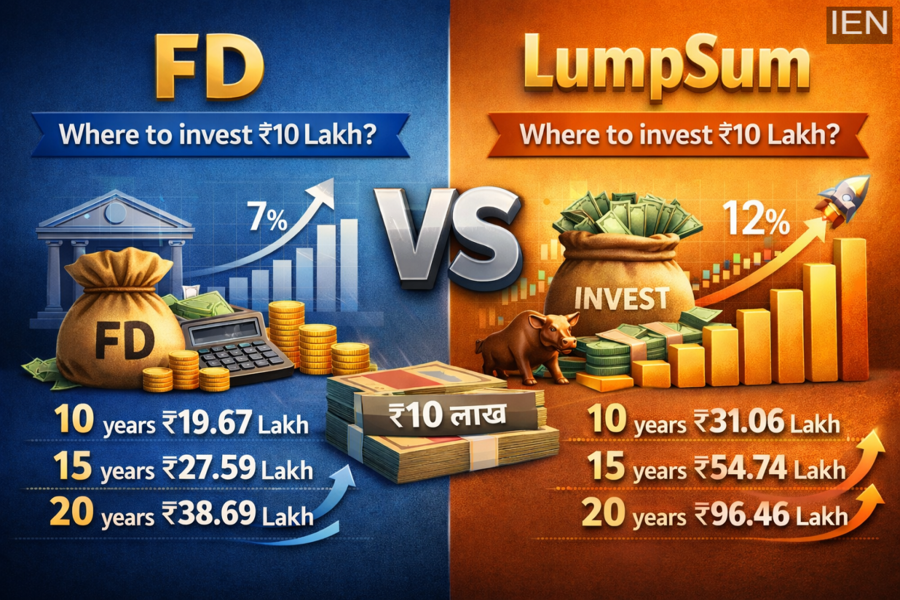
Here is how ₹10 lakh can grow in an FD at 7% annual compounded return:
- In 10 years, the amount can grow to around ₹19.67 lakh
- In 15 years, it can become nearly ₹27.59 lakh
- In 20 years, it may rise to about ₹38.69 lakh
At first glance, this looks like solid growth. However, the real picture changes when inflation is taken into account. If inflation remains around 5% to 6% over the years, the actual purchasing power of your returns becomes much lower. In simple terms, your money may grow on paper, but the real value of that growth may not feel as impressive.
That is the biggest limitation of FDs. They protect capital, but they may not always help create substantial long-term wealth after adjusting for inflation.
Lump Sum in Equity Mutual Funds: More Volatility, Stronger Long-Term Potential
Now consider the second option: investing the same ₹10 lakh as a lump sum in an equity mutual fund. Unlike an FD, this route is linked to market performance. Returns are not fixed, and short-term ups and downs are common. But over longer periods, equities have historically delivered stronger wealth creation.
For this example, let us assume an annual return of 12%, which falls within the long-term average range often associated with equity mutual funds.
Here is how ₹10 lakh can grow at 12% compounded annually:
- In 10 years, it can become about ₹31.06 lakh
- In 15 years, it may grow to nearly ₹54.74 lakh
- In 20 years, it can rise to around ₹96.46 lakh
That is a striking difference. The same ₹10 lakh that grows to about ₹38.69 lakh in an FD over 20 years could come close to ₹1 crore in an equity mutual fund lump sum investment.
This is the real power of higher compounding. Even a small difference in annual returns can create a very large gap in wealth over a long period.
Why the Gap Becomes So Large
Both FD and mutual fund lump sum investments benefit from compounding. The key difference lies in the rate of return. Since FDs generally offer lower interest rates, wealth grows at a slower pace. Equity investments, despite the volatility, usually generate higher returns over long periods, which accelerates compounding.
The longer the investment horizon, the bigger the gap becomes. Over 10 years, the difference is noticeable. Over 20 years, it becomes massive.
Is Lump Sum Always the Better Option?
Not necessarily. A lump sum investment in equity is not automatically the right choice for every investor. Timing matters. If markets are at a high level and you invest a large amount at once, the portfolio may remain under pressure for some time. There is also fund selection risk. If the chosen fund underperforms, returns may fall short of expectations.
That is why some investors prefer SIPs, where money is invested gradually instead of all at once. SIPs can reduce the timing risk associated with investing a large amount in a volatile market.
Still, if your investment horizon is long enough and you can handle market fluctuations without panicking, a lump sum investment in equity mutual funds can offer much faster and more meaningful growth than an FD.
Which Option Should Investors Choose?
The right decision depends on three things: your financial goal, your risk appetite, and your time horizon.
An FD may be more suitable if:
- You want capital safety above everything else
- You have a short- to medium-term goal
- You are uncomfortable with market volatility
A lump sum mutual fund investment may be more suitable if:
- Your goal is long-term wealth creation
- You can stay invested for 10 to 20 years
- You are willing to tolerate market ups and downs
For many people, a balanced strategy can work better than choosing only one. Keeping a portion in FDs can provide safety and liquidity, while investing the rest in equity mutual funds can improve long-term growth potential.
Final Word
If your priority is safety and predictable returns, FD remains a dependable option. But if you are aiming for stronger long-term wealth creation and can accept market risk, an equity mutual fund lump sum investment has the potential to deliver far superior results.
The choice is not about which option is universally better. It is about which one fits your financial needs better.
Disclaimer: This article is for informational purposes only. Mutual fund investments are subject to market risks. Please consult a qualified financial advisor before making any investment decision.
