
FD vs Gold: Which investment option is safer, and what returns have they yielded over 20 years? Everything in 5 points..
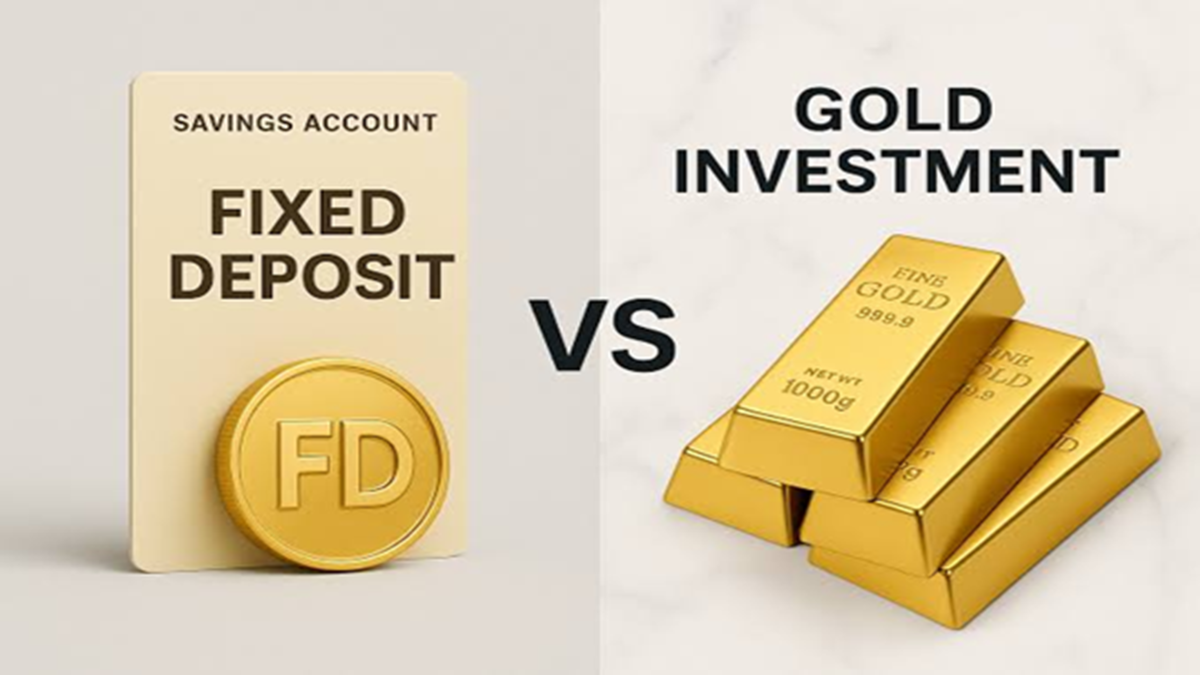
When it comes to investment, safety is the primary concern for most people. Questions regarding the potential returns on their invested capital and whether the principal amount remains secure constantly occupy their minds. Therefore, today we will discuss two investment avenues that are largely insulated from stock market volatility yet offer attractive returns.
These investment options are Fixed Deposits (FDs) and Gold. Indeed, these avenues keep your capital safe from market fluctuations while generating returns. However, the question arises: which is better—FDs or Gold—and what kind of returns can one expect from each? Let us analyze which option holds the potential to build significant wealth for you in the future.
1. FD vs. Gold: Which is safer?
Generally speaking, FDs are considered safer. Opening an FD with a bank ensures guaranteed returns and provides insurance coverage of up to ₹5 lakh through the Deposit Insurance and Credit Guarantee Corporation (DICGC). In contrast, gold prices depend on domestic and international market dynamics, making them susceptible to short-term fluctuations.
2. Which leads in terms of returns?
Experts suggest that gold can yield excellent returns over the long term. For instance, gold has delivered an annual CAGR of approximately 11.2% to 15.1% over the past 20 years. Meanwhile, FDs have offered annual returns in the range of 5–8%, remaining unaffected by market volatility.
Gold Calculation
Investment Amount: ₹1,00,000
Investment Tenure: 20 years
CAGR Return: 11.2%
Estimated Return (Amount): ₹8.66 lakh
FD Calculation
Investment Amount: ₹1,00,000
Investment Tenure: 20 years
Estimated Interest: 8%
Estimated Return (Amount): ₹4.66 lakh
The calculations show lower returns for FDs; however, remember that FD returns are guaranteed, whereas returns on gold can fluctuate.
3. What offers protection against inflation?
Experts suggest that gold can be useful during inflationary periods because its price tends to rise alongside inflation. In contrast, FD returns are fixed and often fail to beat inflation. Gold, however, retains its value over the long term.
4. FD vs. Gold: Which is more liquid?
Gold offers higher liquidity; it can be sold anywhere and at any time. Conversely, it is generally not advisable to break an FD before maturity. Premature withdrawal of an FD can result in a loss of interest earnings.
5. Which is more tax-efficient?
Gains from gold are subject to a Long-Term Capital Gains (LTCG) tax of 20%, which is lower than the tax applicable to FDs. FD interest is taxed according to the investor's income tax slab, although individuals in lower income brackets may find some relief there.
Disclaimer: This content has been sourced and edited from Dainik Jagran. While we have made modifications for clarity and presentation, the original content belongs to its respective authors and website. We do not claim ownership of the content.
