
EPF vs PPF vs NPS: Which Retirement Investment Option Is Better? Key Differences Explained
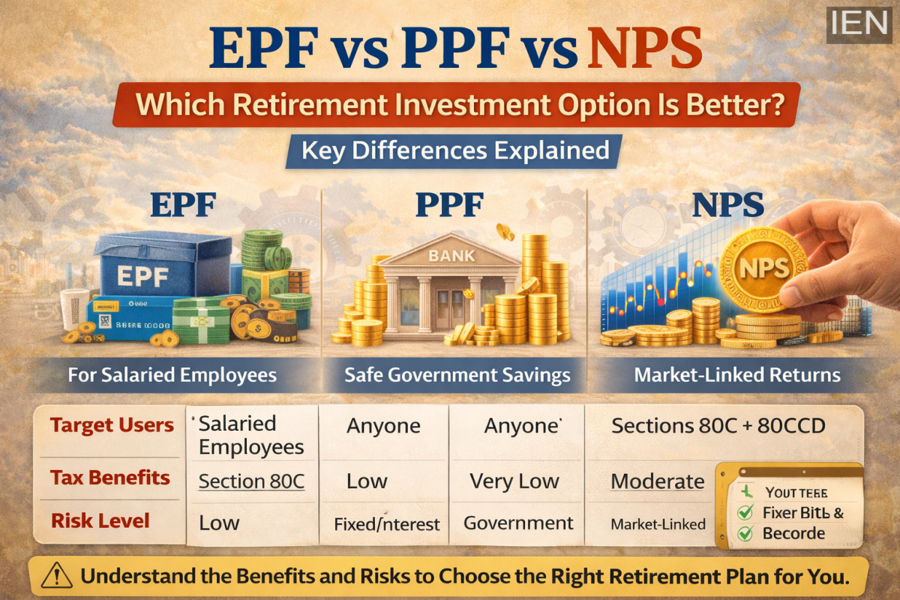
Planning for retirement is one of the most important financial decisions individuals make during their working years. In India, several long-term investment options are available to help people build a retirement corpus. Among them, the Employees’ Provident Fund (EPF), Public Provident Fund (PPF), and National Pension System (NPS) are considered some of the most reliable and widely used schemes.
However, many investors often find it difficult to choose between these three options. While all of them are designed to support long-term financial security after retirement, they differ in terms of eligibility, returns, risk levels, and tax benefits. Understanding these differences can help investors make better decisions based on their financial goals.
Why Retirement Planning Matters
With rising life expectancy and increasing living costs, building a stable retirement fund has become essential. A well-planned retirement portfolio ensures that individuals can maintain their lifestyle and cover expenses even after they stop earning a regular income.
When choosing a retirement investment plan, factors such as returns, risk level, tax advantages, and investment duration should be carefully considered. EPF, PPF, and NPS all serve this purpose but operate in different ways.
Employees’ Provident Fund (EPF)
The Employees’ Provident Fund (EPF) is primarily designed for salaried employees working in the organized sector. It is a mandatory savings scheme where both the employee and the employer contribute to the retirement fund.
Every month, a portion of the employee’s basic salary and dearness allowance (DA) is deposited into the EPF account. The employer contributes an equal amount, which helps the retirement savings grow steadily over time.
Key Features of EPF
-
Contributions from both employee and employer
-
Government-backed scheme managed by EPFO
-
Relatively stable interest rates
-
Long-term retirement corpus creation
EPF is considered a disciplined savings plan because contributions are deducted automatically from salaries. Over time, this consistent investment can build a substantial retirement fund.
Public Provident Fund (PPF)
The Public Provident Fund (PPF) is one of the safest long-term investment options in India. It is backed by the government and is known for offering guaranteed returns along with tax benefits.
PPF accounts come with a 15-year lock-in period, making them suitable for long-term financial planning. Investors can make yearly contributions and earn interest that is revised periodically by the government.
Key Features of PPF
-
Government-backed investment with low risk
-
Long-term savings option with 15-year maturity
-
Attractive tax benefits under Section 80C
-
Interest earned is tax-free
PPF is suitable for individuals who prefer stable returns and minimal risk, making it a popular choice among conservative investors.
National Pension System (NPS)
The National Pension System (NPS) is a relatively newer retirement scheme compared to EPF and PPF. It is designed to provide regular income after retirement and is regulated by the Pension Fund Regulatory and Development Authority (PFRDA).
Unlike EPF and PPF, NPS is a market-linked investment scheme. The funds are invested in a mix of equity, corporate bonds, and government securities. This structure allows the potential for higher returns over the long term.
Key Features of NPS
-
Market-linked investment with potential for higher returns
-
Flexible asset allocation between equity and debt
-
Additional tax benefits under Section 80CCD
-
Pension income available after retirement
However, since NPS investments are linked to financial markets, returns may fluctuate depending on market performance.
EPF vs PPF vs NPS: Key Differences
| Feature | EPF | PPF | NPS |
|---|---|---|---|
| Target Users | Salaried employees | Anyone | Anyone |
| Risk Level | Low | Very Low | Moderate |
| Return Type | Fixed interest | Government-declared interest | Market-linked |
| Lock-in Period | Until retirement | 15 years | Until retirement |
| Tax Benefits | Section 80C | Section 80C | 80C + 80CCD |
Which Option Is Better for Retirement?
There is no single answer to which option is best, as each scheme serves different financial needs.
-
EPF is ideal for salaried employees who want disciplined savings with employer contributions.
-
PPF suits conservative investors looking for safe, government-backed returns.
-
NPS is better for investors who are comfortable with market exposure and want potentially higher returns over the long term.
Financial experts often recommend diversifying across multiple retirement schemes rather than relying on just one option. A balanced approach using EPF, PPF, and NPS together can help build a stronger retirement fund.
Building a Secure Retirement
A well-structured retirement strategy is essential for long-term financial stability. By understanding the differences between EPF, PPF, and NPS, investors can choose the combination that aligns best with their income level, risk tolerance, and retirement goals.
Starting early and investing consistently in these schemes can help individuals create a strong financial cushion, ensuring a comfortable and secure life after retirement.
