
EPF vs PPF: Investing ₹10,000 Monthly for 15 Years — Which Scheme Can Build a Bigger Retirement Fund?
Understanding Two Popular Government-Backed Retirement Schemes
Planning for retirement is a crucial part of financial management. Most individuals aim to build a strong financial cushion that can support them after their working years. In India, many investors prefer government-backed savings schemes because they offer stability, safety, and tax benefits.
Two of the most popular long-term retirement savings options are Employee Provident Fund (EPF) and Public Provident Fund (PPF). Both schemes encourage disciplined saving and help individuals accumulate a significant corpus over time. However, they differ in terms of eligibility, interest rates, flexibility, and withdrawal rules.
A common question many investors ask is:
If someone invests ₹10,000 per month (₹1.2 lakh per year) for 15 years, which scheme will generate higher returns?
Let’s understand the numbers and features.
What Is EPF (Employee Provident Fund)?
The Employee Provident Fund (EPF) is a retirement savings scheme designed mainly for salaried employees working in the organized sector. It is managed by the Employees’ Provident Fund Organisation (EPFO).
Under this scheme:
-
Employees contribute 12% of their basic salary plus dearness allowance (DA) to their EPF account.
-
Employers contribute a similar amount, although a portion of the employer’s contribution goes into the pension scheme.
Current Interest Rate
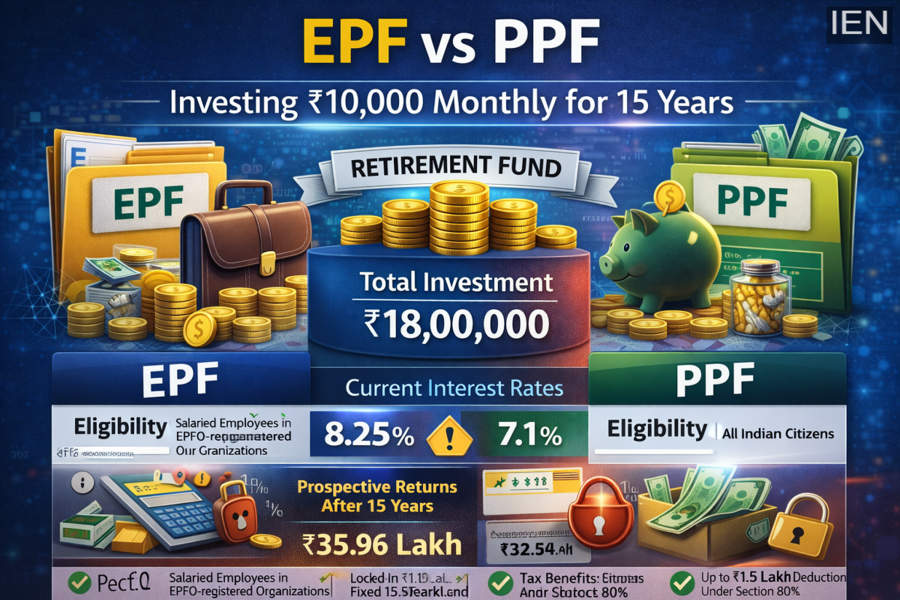
At present, EPF offers an annual interest rate of about 8.25%.
The primary objective of this scheme is to create a substantial retirement corpus for employees. Partial withdrawals are also allowed for specific purposes such as education, marriage, medical emergencies, or buying a house.
What Is PPF (Public Provident Fund)?
The Public Provident Fund (PPF) is another government-backed long-term savings scheme, but unlike EPF, it is not limited to salaried employees.
Any Indian citizen can open a PPF account, including:
-
Self-employed individuals
-
Salaried professionals
-
Parents investing on behalf of their children
PPF accounts can be opened at banks or post offices.
Current Interest Rate
The current interest rate offered by PPF is 7.1% per annum.
One key feature of PPF is its 15-year lock-in period, although partial withdrawals and loans are allowed under certain conditions.
Key Differences Between EPF and PPF
1. Eligibility
-
EPF: Only available to employees working in EPFO-registered organizations.
-
PPF: Open to all Indian citizens.
2. Interest Rate
-
EPF: Around 8.25% annually.
-
PPF: Around 7.1% annually.
Because of the higher interest rate, EPF generally has the potential to generate slightly better returns over the long term.
3. Lock-in Period
-
PPF: Fixed lock-in period of 15 years.
-
EPF: Partial withdrawals allowed in certain circumstances.
4. Minimum Investment
-
PPF: Minimum annual deposit of ₹500 required.
-
EPF: Contribution depends on the employee’s salary.
5. Tax Benefits
Both EPF and PPF offer tax advantages under Section 80C of the Income Tax Act, allowing deductions up to ₹1.5 lakh per financial year. Additionally, interest earned and maturity amounts are generally tax-free under specified conditions.
Example: Investing ₹10,000 Per Month for 15 Years
If a person invests ₹10,000 every month, the annual investment becomes ₹1,20,000.
Over 15 years, the total invested amount will be:
₹1,20,000 × 15 = ₹18,00,000
Estimated Returns
EPF (8.25% interest):
After 15 years, the total value could reach approximately ₹35,96,445 (around ₹35.96 lakh).
PPF (7.1% interest):
After 15 years, the total value could grow to approximately ₹32,54,567 (around ₹32.54 lakh).
Difference in Returns
The estimated difference between the two schemes after 15 years could be around ₹3.4 lakh, mainly due to the higher interest rate offered by EPF.
Which Scheme Is Better?
Both EPF and PPF are safe and reliable long-term investment options supported by the government. The choice between them depends largely on an individual’s employment status and financial goals.
-
EPF may generate higher returns due to a higher interest rate and employer contribution.
-
PPF offers flexibility and accessibility for all individuals, including self-employed investors.
Final Takeaway
If you are a salaried employee eligible for EPF, it can be a powerful retirement tool thanks to employer contributions and higher interest rates. On the other hand, PPF remains an excellent option for individuals seeking secure, tax-efficient, long-term savings with guaranteed government backing.
Carefully evaluating both schemes can help investors build a strong retirement corpus and long-term financial stability.
