
E20 Petrol and Insurance Claims: Government Clears the Air on Viral Rejection Rumors
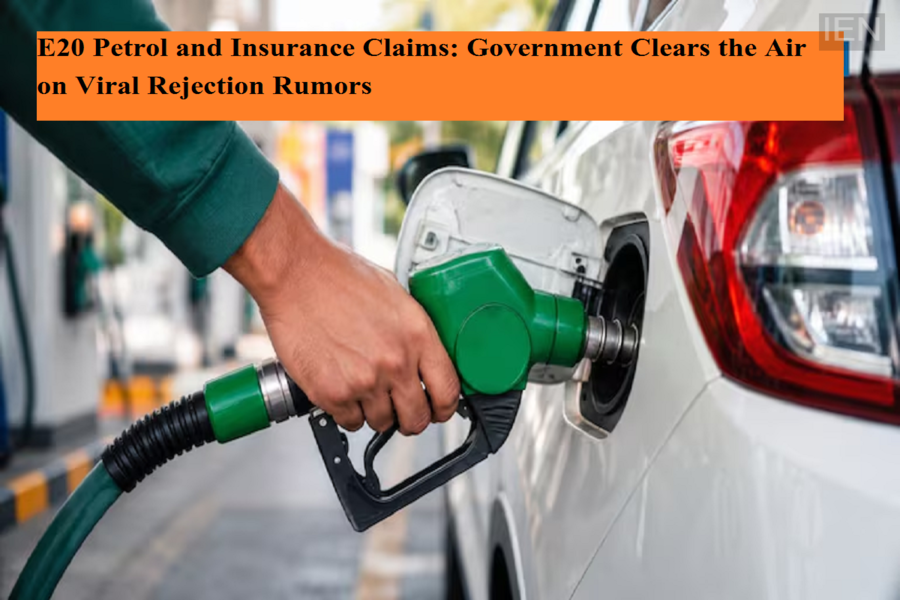
A wave of confusion surrounding E20 petrol and motor insurance claims has prompted both the government and the insurance industry to issue clarifications. Recent social media posts had claimed that using E20 fuel could lead to the rejection of motor insurance claims, sparking concern among vehicle owners across the country.
The government has now firmly rejected these claims, stating that simply using E20 petrol does not affect the validity of a motor insurance policy and cannot be used as the sole reason for denying an insurance claim.
What Is E20 Fuel?
E20 fuel is a blend consisting of 20% ethanol and 80% petrol. It forms part of India's broader strategy to reduce dependence on imported crude oil, lower fuel costs, and promote cleaner energy alternatives.
The fuel has already been introduced at petrol pumps across many parts of the country and is gradually becoming a standard offering.
As E20 availability expands, many vehicle owners—particularly those with older cars and two-wheelers—have raised questions about its impact on engine performance, warranty coverage, and insurance protection.
How Did the Controversy Begin?
The debate gained momentum after reports and social media discussions suggested that damage caused by E20 fuel could create complications during insurance claim settlements.
These claims quickly spread online, leading many motorists to believe that insurers might reject claims if a vehicle was found to be running on E20 petrol.
The concern was especially significant for owners of older vehicles who worried that their engines might not be fully compatible with higher ethanol blends.
Since E20 petrol is now widely available, many consumers felt they had limited alternatives when refueling their vehicles.
Government Issues Official Clarification
To address the growing confusion, the government's fact-checking agency clarified that the viral claim was misleading.
According to the official clarification, the use of E20 petrol does not invalidate a motor insurance policy. Vehicle owners cannot be denied claim benefits merely because they filled their vehicles with E20 fuel.
The clarification was issued after widespread concern among motorists and aimed to reassure consumers that standard fuel usage does not automatically affect insurance coverage.
Insurance Industry Responds
Leading insurer ICICI Lombard also issued a statement addressing the issue.
The company clarified that motor insurance claims are not rejected solely because a vehicle was fueled with E20 petrol. Insurance policies remain valid, and claim decisions are based on a range of factors rather than the type of approved fuel being used.
Insurers typically evaluate:
-
Nature of the accident or damage
-
Policy terms and conditions
-
Vehicle condition
-
Cause of loss
-
Supporting documentation
-
Investigation findings, where applicable
Fuel type alone is generally not a determining factor in claim approval or rejection.
Relief for Owners of Older Vehicles
The clarification has come as welcome news for owners of older vehicles, many of whom had become concerned after reading reports linking E20 usage to potential insurance complications.
Industry observers note that uncertainty increased because ethanol-blended fuel is now becoming more common, and many motorists were unsure whether their insurance coverage would remain unaffected.
The latest statements from both the government and the insurance sector have helped ease those concerns.
Government Pushes Ahead With Higher Ethanol Blends
While E20 fuel is still being rolled out nationwide, the government is already working to expand the use of higher ethanol blends.
Recently, E85 fuel was introduced at select fuel stations. This blend contains a significantly higher proportion of ethanol compared to E20 and is part of India's long-term clean energy roadmap.
Initially, E85 fuel has been launched at a limited number of fuel stations. Authorities plan to gradually expand its availability over the coming years through government-owned oil marketing companies.
Why India Is Promoting Ethanol-Based Fuels
The government's ethanol-blending program is aimed at several strategic objectives:
Reducing Crude Oil Imports
India imports a large share of its crude oil requirements. Increasing ethanol use can help reduce dependence on imported fuel.
Supporting Energy Security
A diversified fuel mix improves long-term energy security and reduces exposure to international oil price fluctuations.
Helping the Environment
Higher ethanol blending can contribute to lower carbon emissions and support cleaner transportation initiatives.
Boosting the Agricultural Sector
Ethanol production creates additional demand for agricultural feedstocks, potentially benefiting farmers and rural industries.
What Vehicle Owners Should Know
The latest clarification makes one thing clear: using E20 petrol does not automatically lead to the rejection of a motor insurance claim.
Policyholders should continue following manufacturer recommendations regarding fuel compatibility and vehicle maintenance. Insurance claims will continue to be assessed according to policy terms, damage circumstances, and established claim procedures—not simply based on the use of E20 fuel.
For motorists concerned about insurance coverage, the government's clarification provides reassurance that filling up with E20 petrol alone is not a valid reason for claim rejection.
