
Big Relief for Salaried Employees: 50% HRA Tax Benefit Now Extended to 8 Cities
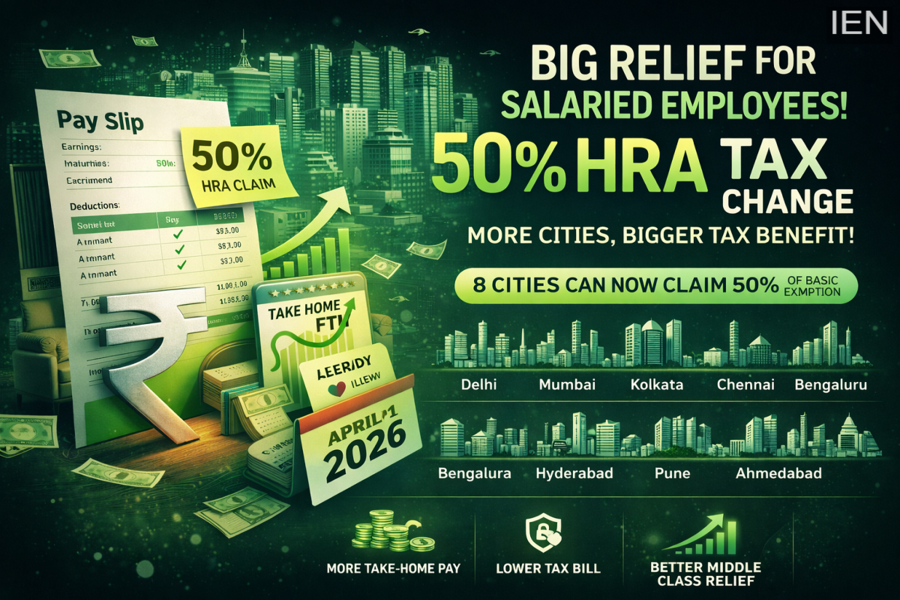
In a major boost for salaried taxpayers, the government has revised House Rent Allowance (HRA) rules, allowing more employees to claim higher tax exemptions. With the start of the new financial year from April 1, 2026, the updated provisions under Central Board of Direct Taxes (CBDT) aim to reflect rising rental costs in urban India and increase disposable income for the middle class.
50% HRA Benefit Now Available in More Cities
Earlier, only employees living in four metro cities—Delhi, Mumbai, Kolkata, and Chennai—were eligible to claim up to 50% of their basic salary as HRA tax exemption.
For all other cities, the limit was capped at 40%.
However, under the new rules, four more cities have been added to the ‘metro-equivalent’ category:
- Bengaluru
- Hyderabad
- Pune
- Ahmedabad
This means employees working in these eight cities can now claim up to 50% of their basic salary as HRA exemption, reducing their taxable income and increasing their take-home salary.
How This Change Benefits You
The revised HRA rule directly impacts your salary structure:
- Lower taxable income: Higher HRA exemption reduces your tax liability
- More take-home salary: Savings on tax means more money in hand
- Better alignment with rent reality: Reflects rising housing costs in growing cities
Experts believe that this move will especially benefit professionals in rapidly expanding urban hubs where rents have surged significantly in recent years.
Why the Government Made This Change
In cities like Bengaluru and Pune, rental costs have increased sharply, often matching or even exceeding those in traditional metro cities.
The earlier 40% limit did not accurately reflect these ground realities. By expanding the list, the government aims to:
- Provide relief to the middle class
- Increase spending power
- Support urban housing demand
Additional Benefits Under Old Tax Regime
Apart from HRA changes, the government has also enhanced other tax benefits for those opting for the old tax regime:
1. Education and Hostel Allowance
Higher exemption limits for children’s education and hostel expenses.
2. Free Meals and Coupons
Relief on employer-provided meal benefits like food coupons.
3. Lower TCS on Foreign Expenses
Reduced Tax Collected at Source (TCS) on foreign travel and overseas education expenses.
These measures collectively aim to ease financial pressure on salaried individuals.
Stricter Compliance Measures Introduced
While the government has provided tax relief, it has also tightened compliance:
- Digital verification of HRA claims to prevent fake rent receipts
- Increased scrutiny using technology-based systems
Additionally, to curb speculative trading, the government has increased the Securities Transaction Tax (STT) on Futures & Options (F&O) by up to 150%.
What It Means for Taxpayers
For employees living in cities like Hyderabad or Ahmedabad, this change can significantly improve monthly savings.
However, taxpayers must ensure:
- Proper rent agreements
- Valid rent receipts
- Accurate documentation
This will help avoid issues during verification.
Conclusion
The revised HRA rules mark a significant step toward making tax policies more aligned with real-world expenses. By expanding the 50% exemption benefit to more cities, the government has offered meaningful relief to salaried individuals.
As rental costs continue to rise in urban India, such measures can help ease financial stress while boosting disposable income and consumption.
