
8th Pay Commission: Why Employee Unions Want Minimum Basic Pay Raised from ₹18,000 to ₹69,000
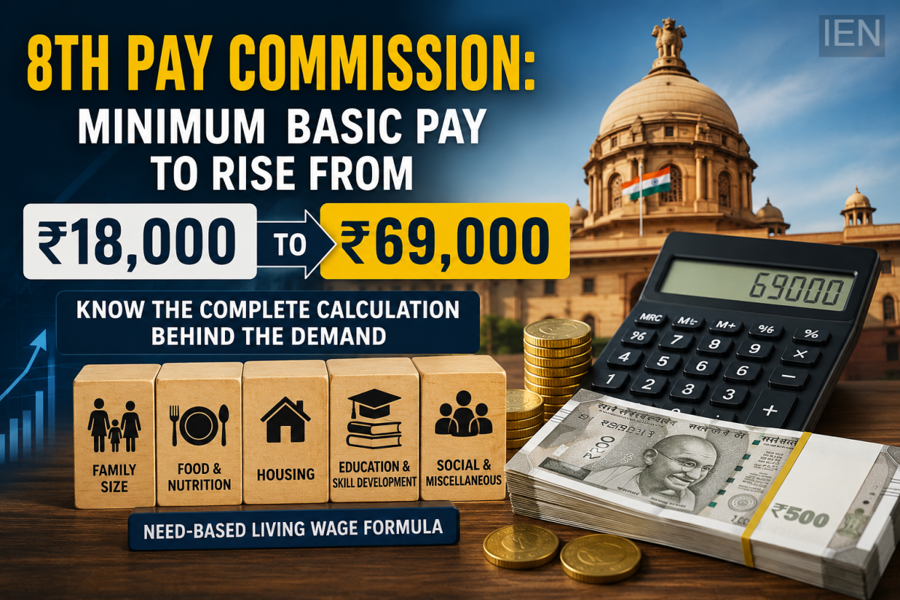
8th Pay Commission Update: Here's the Complete Formula Behind the ₹69,000 Minimum Salary Proposal
A fresh proposal from Central Government employee unions has reignited discussions around the 8th Pay Commission, with a demand to increase the minimum basic salary from ₹18,000 to ₹69,000 per month. While the figure has attracted significant attention, employee representatives say it is not based solely on a higher fitment factor. Instead, they argue that the proposal reflects a comprehensive revision of the formula used to calculate a need-based living wage.
According to the staff side of the National Council–Joint Consultative Machinery (NC-JCM), the existing methodology under the 7th Pay Commission no longer reflects current household expenses, inflation, and the rising cost of living. The organization has therefore recommended a new framework that takes into account larger family sizes and updated expenditure patterns.
It is important to note that ₹69,000 is a proposal submitted by employee representatives and has not been approved by the Central Government or the 8th Pay Commission.
Why Are Employee Unions Seeking a New Formula?
The employee side of the NC-JCM believes that the assumptions used by the 7th Pay Commission have become outdated due to changing economic conditions.
According to the memorandum submitted by the unions, today's household expenditure extends well beyond basic food and clothing. Rising housing costs, education expenses, healthcare, and support for dependent family members have significantly increased the financial burden on employees.
To address these realities, the unions have proposed revising the entire formula used to determine the minimum basic pay rather than simply increasing salaries through a higher fitment factor.
Proposal to Expand the Family Unit
One of the biggest changes suggested by employee organizations relates to the definition of the family unit used for salary calculations.
Existing Formula Under the 7th Pay Commission
The current model is based on a three-unit family, consisting of:
-
Employee: 1.0 unit
-
Spouse: 0.8 unit
-
Two children: 0.6 unit each (1.2 units combined)
Proposed Formula for the 8th Pay Commission
The employee unions have proposed expanding this to a five-unit family by including additional dependents.
The proposed family composition is:
-
Employee: 1.0 unit
-
Spouse: 1.0 unit (increased from 0.8)
-
Two children: 0.8 unit each (1.6 units total)
-
Dependent parents and, where applicable, dependent parents-in-law: 0.8 unit
This results in a total of 5.2 units, which the unions suggest may be treated as a five-unit family for wage calculations.
According to employee representatives, this structure better reflects the financial responsibilities of many government employees today.
Suggested Changes in Living Cost Calculations
Along with revising the family size, the memorandum recommends updating the assumptions used to calculate essential household expenses.
Among the key proposals are:
Higher Nutritional Requirement
The unions have recommended using the latest Indian Council of Medical Research (ICMR) guideline of 3,490 calories per day while estimating food and clothing expenses.
Increased Housing Allocation
The proposal seeks to increase the housing component from 3% to 7.5% of the total expenditure, arguing that accommodation costs have risen substantially over the years.
Utilities
Fuel, electricity, and water expenses should account for 20% of the total household cost, according to the proposed formula.
Education and Skill Development
The memorandum recommends allocating 25% of household expenditure towards children's education and skill development.
Social and Miscellaneous Expenses
An additional 5% has been proposed to cover social obligations, festivals, family events, recreation, and other miscellaneous expenses.
Employee organizations believe these revisions would provide a more realistic estimate of the cost of maintaining a reasonable standard of living.
How Was the 3.833 Fitment Factor Calculated?
After incorporating the revised family structure and updated expenditure assumptions, the NC-JCM estimated that the minimum monthly basic salary should be around ₹69,000.
Based on the current minimum basic pay of ₹18,000, this translates into a fitment factor of approximately 3.833.
The calculation is straightforward:
₹18,000 × 3.833 ≈ ₹69,000
Employee representatives have also suggested that the same fitment factor should be applied while revising pensions so that pensioners receive proportionate benefits under the new pay structure.
This proposed fitment factor is considerably higher than the figures of around 2.0 to 2.5 that have been widely discussed in recent months.
What Could Be the Impact?
If a higher fitment factor and revised wage formula are accepted, the impact would extend beyond entry-level salaries.
A revision in the minimum basic pay would also affect:
-
Basic salary across all pay levels
-
Dearness Allowance calculations
-
House Rent Allowance (HRA)
-
Other salary-linked allowances
-
Pension and retirement benefits
-
Overall pay matrix under the 8th Pay Commission
However, the final extent of any revision will depend on the recommendations ultimately accepted by the government.
Final Decision Is Yet to Be Taken
At present, the proposal for a ₹69,000 minimum basic salary remains a recommendation from employee unions, not an approved policy.
The 8th Pay Commission is expected to review submissions from employee organizations, government departments, ministries, and other stakeholders before preparing its final report.
Only after the Commission submits its recommendations and the Central Government formally approves them will details such as the minimum basic pay, fitment factor, revised pay matrix, and pension revision formula become official.
Until then, the ₹69,000 salary figure should be viewed as a proposal under consideration rather than a confirmed outcome.
