
8th Pay Commission: What will be the new pay scale based on salary, and how much will the amount increase? Here is the list.
8th Pay Commission: Employees’ demands regarding the 8th Pay Commission have intensified. A proposal has been submitted to the government seeking to raise the minimum wage to ₹69,000, modify pay scales, and introduce new benefits.
8th Pay Commission Update: Central government employees and pensioners have been awaiting the 8th Pay Commission for a long time. Over the past few days, the buzz surrounding the 8th Pay Commission has gained significant momentum across the country. Speaking of the latest updates, the National Council – Joint Consultative Machinery (NC-JCM) has submitted its memorandum to the Central Government and the Commission. This memorandum outlines demands for various changes concerning the salaries, pensions, and Dearness Allowance (DA) of central government employees, among other matters. Let us explore this subject in detail.
Demands Regarding Salary and Benefits
Among the key demands put forth by employee organizations is the proposal to increase the minimum wage from the current ₹18,000 to ₹69,000. Additionally, prominent demands include an annual increment of 6 percent and a minimum salary hike of ₹10,000 at the time of promotion.
The organizations have also demanded that employees receive a minimum bonus equivalent to 30 days’ pay, and that the Commission introduce relaxations in the rules governing gratuity.
Demands for Changes in Pay Scales
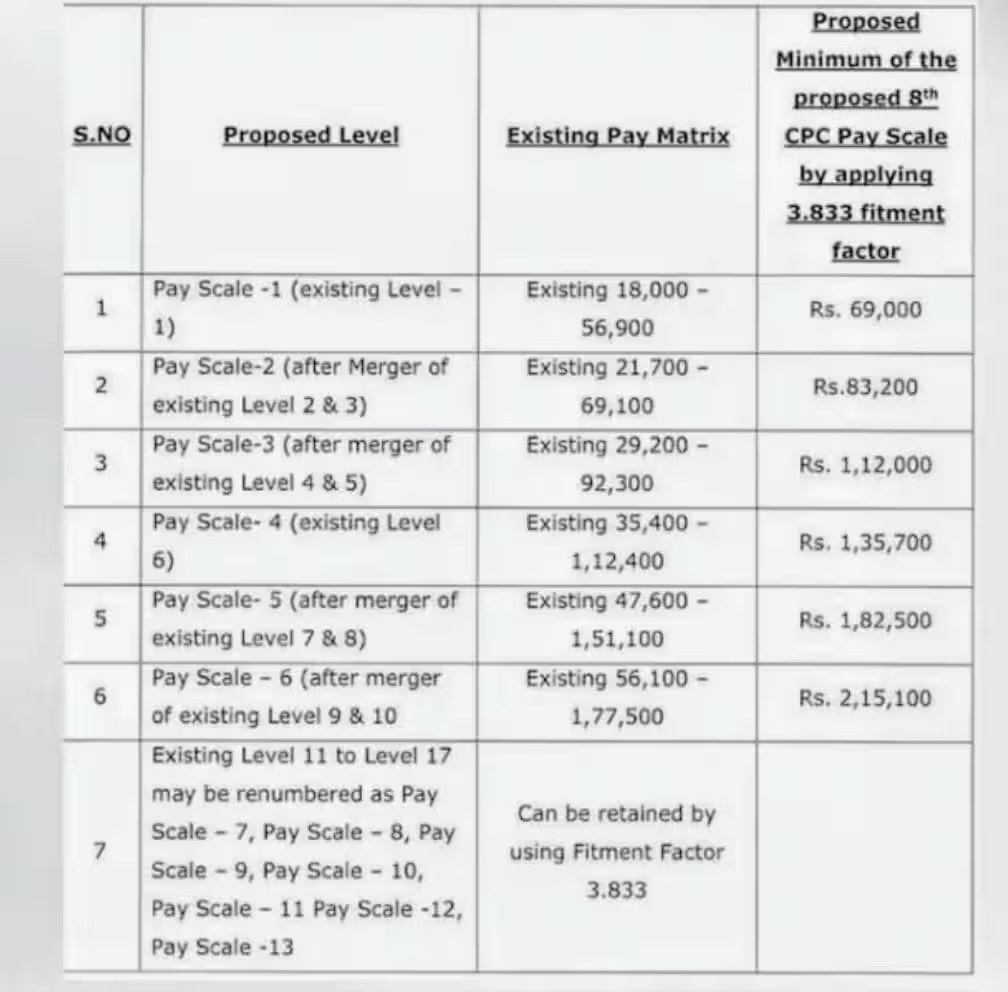
According to the organizations’ demands, the salary range in Pay Scale-1 (currently Level 1)—which presently falls between ₹18,000 and ₹56,900—should be revised to a minimum of ₹69,000.
Similarly, for Pay Scale-2—where the current salary ranges from ₹21,700 to ₹69,100—the demand is to raise the minimum salary to ₹83,200. Currently, the salary in Pay Scale-3 ranges from ₹29,200 to ₹92,300; the memorandum includes a demand to raise this minimum to ₹1,12,000.
Demands for Changes in Leave Policies
The organization has demanded significant changes regarding employee leave policies. The memorandum proposes extending maternity leave to 240 days and paternity leave to 45 days. Additionally, a demand has been put forward to allow for the accumulation of Earned Leave (EL) without any upper limit.
Demands for New Benefits
Among the organization’s new demands is a proposal to increase the limit for leave encashment to 600 days. Furthermore, a demand has been made to provide a facility for 50% leave encashment upon the completion of 20 years of service. In addition, demands have been raised for separate medical leave provisions for women, as well as the provision of 60 days of ‘Parent Care Leave.’
