
8th Pay Commission Salary Hike: From Peons to Senior Officers, Who Could Get the Biggest Pay Jump?
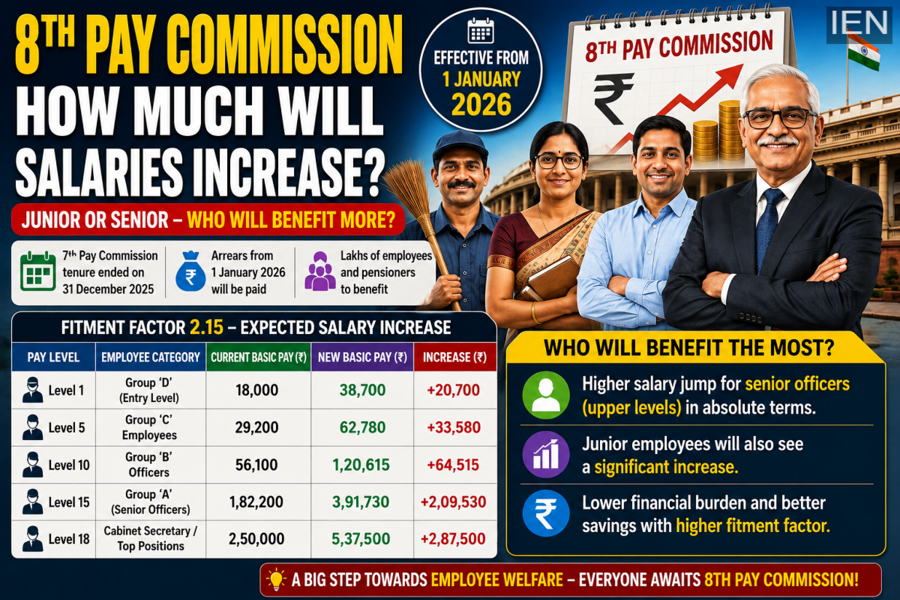
The upcoming 8th Pay Commission has become one of the most discussed topics among central government employees and pensioners across India. Ever since the Modi government announced the formation of the commission earlier this year, employees from every pay level — from entry-level staff to senior officers — have been eagerly calculating how much their salaries could increase under the new structure.
One of the biggest questions being debated is which category of employees will benefit the most once the revised salary framework is implemented. While junior employees are expected to see a significant improvement in minimum pay, senior officers may receive the highest increase in absolute salary terms.
Revised Salaries to Be Effective From January 2026
Although the final recommendations of the 8th Pay Commission are still awaited, the revised pay structure is expected to take effect from January 1, 2026.
The validity of the 7th Pay Commission officially ended on December 31, 2025. As per standard practice, any increase approved under the new commission will likely be calculated from January 2026 onward. This means employees may also receive arrears for the period between implementation and the official salary revision announcement.
The arrear amount could become substantial depending on the final fitment factor approved by the government.
Why the Fitment Factor Is So Important
The most important element in determining salary hikes under any pay commission is the fitment factor.
The fitment factor acts as a multiplier used to calculate the revised basic salary from the existing pay structure.
Under the 7th Pay Commission, the fitment factor was fixed at 2.57.
New Basic Pay=Current Basic Pay×Fitment FactorNew\ Basic\ Pay = Current\ Basic\ Pay \times Fitment\ FactorNew Basic Pay=Current Basic Pay×Fitment Factor
Now, experts and employee unions are debating what multiplier may be adopted under the 8th Pay Commission.
According to several analysts, considering inflation and current economic conditions, a fitment factor around 2.15 appears realistic. However, employee unions have demanded a significantly higher fitment factor of 3.83.
Expected Salary Hike Across Different Pay Levels
If a fitment factor of 2.15 is considered, estimated salary revisions for various employee categories may look like this:
| Pay Level | Employee Category | Current Basic Pay | Estimated New Basic Pay | Estimated Increase |
|---|---|---|---|---|
| Level 1 | Group D / Entry-Level Staff | ₹18,000 | ₹38,700 | ₹20,700 |
| Level 5 | Group C Employees | ₹29,200 | ₹62,780 | ₹33,580 |
| Level 10 | Group B Officers | ₹56,100 | ₹1,20,615 | ₹64,515 |
| Level 15 | Senior Group A Officers | ₹1,82,200 | ₹3,91,730 | ₹2,09,530 |
| Level 18 | Cabinet Secretary / Top Officials | ₹2,50,000 | ₹5,37,500 | ₹2,87,500 |
These figures remain estimated calculations based on the proposed fitment factor and not official government confirmation.
Who May Benefit the Most?
The calculations clearly indicate that senior officials at higher pay levels could receive the biggest gains in terms of absolute salary increase.
For example:
- A Level 1 employee may see a rise of around ₹20,700 in basic pay
- A top Level 18 officer could witness an increase of nearly ₹2.87 lakh
This means higher-ranking officials are likely to benefit more in actual monetary terms.
However, experts note that pay commissions generally aim to maintain balanced percentage-based growth across all categories to ensure fairness within the salary structure.
Junior Employees Still Expected to Gain Significantly
Despite senior officers receiving larger nominal increases, junior employees are also expected to witness meaningful improvements in earnings.
The likely rise in minimum basic pay could help entry-level employees manage inflation, rising household expenses, housing costs, healthcare spending, and education-related financial pressure more effectively.
Employee unions argue that stronger revisions are especially necessary for lower and middle-income government staff due to the rising cost of living over the past several years.
Why Employees Are Closely Watching the 8th Pay Commission
The 8th Pay Commission is expected to impact:
- Central government employees
- Pensioners
- Railway staff
- Defense personnel
- Teachers
- Administrative officers
Apart from salary revisions, the commission may also influence:
- Dearness Allowance calculations
- Pension structures
- House Rent Allowance (HRA)
- Travel and medical allowances
As discussions continue, government employees across India are closely monitoring every development related to the final fitment factor and implementation timeline.
Final Decision Still Awaited
While multiple estimates and calculations are circulating widely, the government has not yet officially announced the final fitment factor or revised salary structure.
Financial experts believe the final recommendations will depend on:
- Inflation trends
- Government finances
- Economic growth
- Fiscal planning
- Employee welfare considerations
Until then, salary projections remain speculative, though expectations among employees continue to rise rapidly.
For now, the 8th Pay Commission remains one of the most important financial developments for lakhs of government employees and pensioners waiting for clarity on future salary growth and retirement benefits.
