
8th Pay Commission: Railway Unions Push for 3.80 Fitment Factor, Demand Major Salary Hike
As discussions around the 8th Pay Commission gather momentum, a leading railway employees’ organization has submitted a series of ambitious proposals that could significantly increase salaries and career growth opportunities for technical staff across Indian Railways.
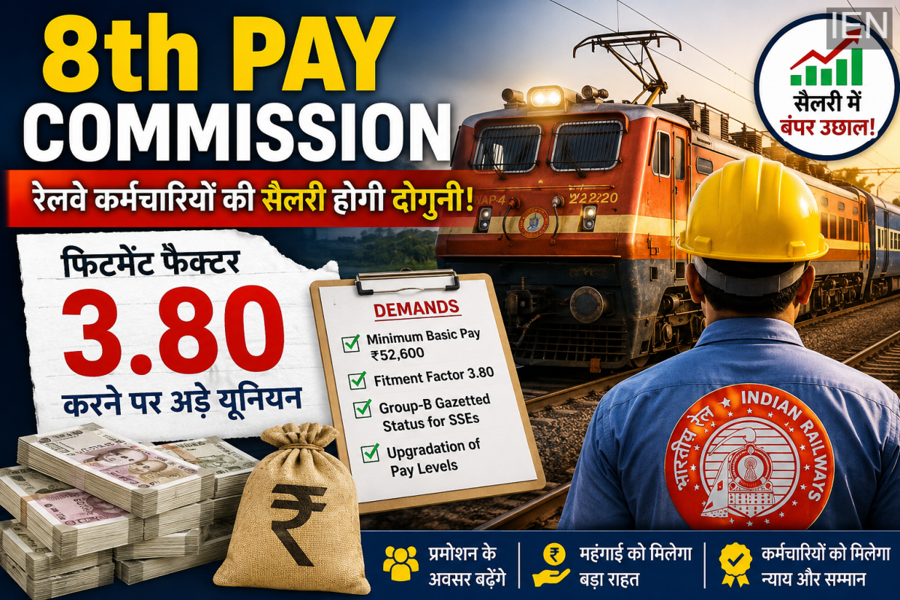
The Indian Railway Technical Supervisors Association (IRTSA) has urged the pay commission to revise the minimum basic pay to ₹52,600 and introduce a higher fitment factor of up to 3.80 for certain employee categories. If these recommendations are accepted, railway employees could see one of the biggest salary revisions in recent years.
The demands were formally presented during a meeting between the employee association and representatives of the 8th Pay Commission panel.
Key Meeting Held in Hyderabad
Last month, officials of the Indian Railway Technical Supervisors Association participated in an official consultation with the 8th Pay Commission in Hyderabad.
According to the association, its representatives submitted a comprehensive memorandum highlighting the concerns of technical supervisors, Junior Engineers (JEs), and Senior Section Engineers (SSEs).
The presentation focused on long-standing issues related to pay disparities, limited promotion opportunities, allowances, and career progression within the railway system.
The association argued that existing salary structures do not adequately reflect the responsibilities, technical expertise, and risks associated with these positions.
Major Salary and Fitment Factor Demands
One of the most significant proposals concerns the revision of the minimum salary and fitment factor.
The association has recommended:
-
Increasing the minimum basic salary to ₹52,600.
-
Fixing a fitment factor of 2.92 for Level-1 employees.
-
Implementing a fitment factor of 3.50 for safety-category staff and employees in Pay Levels 6, 7, and 8.
-
Introducing a fitment factor of 3.80 for middle-management categories in Pay Levels 9 to 12.
A higher fitment factor would substantially increase revised salaries under the new pay commission framework.
Employee representatives argue that current compensation levels no longer match rising living costs, inflation, and the expanding responsibilities of technical personnel.
Demand for Group-B Gazetted Status for SSEs
The association has also called for Senior Section Engineers to be granted Group-B Gazetted status.
According to IRTSA, SSEs handle critical operational and technical responsibilities but do not receive corresponding administrative recognition and promotional opportunities.
Granting Group-B status, they argue, would improve career prospects and create a more balanced organizational structure within railway technical departments.
Proposal to Upgrade Pay Levels
Another major demand involves upgrading the pay scales of Junior Engineers and Senior Section Engineers.
The association has emphasized that these employees often manage complex technical operations, safety-critical systems, infrastructure maintenance, and operational supervision.
Given the nature of their duties, employee representatives believe the existing pay structure does not adequately compensate them for the level of responsibility they shoulder.
Incentive Scheme for Technical and Maintenance Staff
IRTSA has also proposed introducing a dedicated group incentive scheme for technical employees working in open-line operations and maintenance divisions.
The suggested incentive framework would be based on Railway Board guidelines and would reward employees for efficiency, performance, and operational excellence.
The organization believes such incentives could improve productivity while recognizing the contributions of frontline railway personnel.
Challenges Faced by Railway Technical Employees
During discussions with the pay commission panel, the association highlighted several structural issues affecting technical staff.
Limited Promotion Opportunities
One of the primary concerns relates to career stagnation.
According to the association, many graduate engineers recruited directly into Senior Section Engineer grades remain stuck in the same position for extended periods due to a lack of promotional vacancies.
This often leads to frustration and reduced career progression opportunities.
Shortage of Group-B Positions
IRTSA pointed out significant imbalances in the distribution of Group-A, Group-B, and Group-C posts within technical departments.
The limited number of Group-B positions restricts upward mobility and creates bottlenecks in the promotion process.
The association has urged the commission to address these structural issues while framing future recommendations.
MACPS and Training Period Benefits
The employee body has also sought reforms in the implementation of the Modified Assured Career Progression Scheme (MACPS).
Key suggestions include:
-
Counting training periods as part of regular service for MACPS eligibility.
-
Implementing MACPS benefits retrospectively from January 1, 2006, in line with various judicial decisions.
According to employee representatives, these changes would help remove anomalies affecting career advancement and financial progression.
Restoration of Allowances
The association has demanded the restoration and expansion of several employee benefits and allowances.
Among the key requests are:
-
Reinstatement of PCO Allowance for Senior Section Engineers in Pay Level 8.
-
Extension of Night Duty Allowance.
-
Enhanced Overtime Allowance provisions.
-
Risk and Hardship Allowance for eligible employees.
-
Expansion of Accident-Free Service Awards to open-line engineers and maintenance personnel.
The association believes these benefits are essential for employees working under demanding operational conditions.
What Happens Next?
At present, these proposals represent recommendations submitted by the employee organization to the 8th Pay Commission.
The commission is currently gathering inputs from various employee groups, unions, departments, and stakeholders before preparing its final report.
Whether the government accepts these demands will become clear only after the commission submits its recommendations and the final implementation framework is approved.
For now, railway employees across the country are closely watching developments, as the outcome could significantly influence salaries, allowances, promotions, and retirement benefits under the 8th Pay Commission.
Disclaimer
The salary figures and fitment factor projections mentioned above are based on demands submitted by employee organizations. Final revisions, if any, will depend on the recommendations of the 8th Pay Commission and subsequent approval by the Government of India.
