
8th Pay Commission: How a 2x, 2.5x or 3x Fitment Factor Could Boost Basic Pay and HRA Across Pay Levels
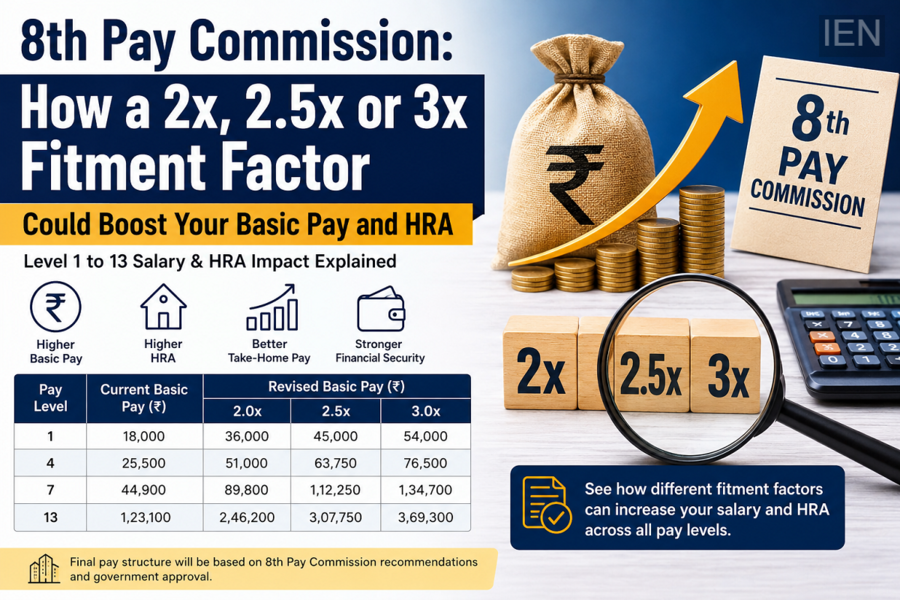
The discussion around the 8th Pay Commission continues to gain momentum as millions of central government employees wait for clarity on salary revisions. Among all the factors being debated, the fitment factor remains the most significant because it directly determines the revised basic salary and influences several other allowances.
Employee unions have proposed different fitment factors ranging from 2.0 to 3.8. While the government has not yet announced the final figure, many employees are trying to estimate how their salaries could change if the fitment factor is fixed at 2.0x, 2.5x, or 3.0x.
Here is a simplified look at how these three scenarios could affect basic pay and House Rent Allowance (HRA) for employees from Pay Level 1 to Pay Level 13.
Why the Fitment Factor Matters
The fitment factor is a multiplier applied to the existing basic pay to calculate the revised salary under a new pay commission. Since multiple allowances, including HRA, are linked to the basic salary, even a modest increase in the fitment factor can significantly raise an employee's overall monthly earnings.
Although several employee organizations have suggested higher fitment factors, the final decision will depend on the recommendations of the 8th Pay Commission and subsequent government approval.
Estimated Basic Salary Under Different Fitment Factors
The following examples illustrate how basic pay could increase if the government adopts different fitment factors.
Pay Level 1
Current Basic Pay: ₹18,000
-
With a 2.0x fitment factor: ₹36,000
-
With a 2.5x fitment factor: ₹45,000
-
With a 3.0x fitment factor: ₹54,000
Pay Level 4
Current Basic Pay: ₹25,500
-
2.0x: ₹51,000
-
2.5x: ₹63,750
-
3.0x: ₹76,500
Pay Level 7
Current Basic Pay: ₹44,900
-
2.0x: ₹89,800
-
2.5x: ₹1,12,250
-
3.0x: ₹1,34,700
Pay Level 13
Current Basic Pay: ₹1,23,100
-
2.0x: ₹2,46,200
-
2.5x: ₹3,07,750
-
3.0x: ₹3,69,300
These calculations are only indicative and are based on applying the proposed fitment multipliers to the current basic pay.
How HRA Could Increase Along With Basic Pay
House Rent Allowance is calculated as a percentage of the revised basic salary. Therefore, any increase in basic pay automatically results in a higher HRA, even though the fitment factor itself is not directly applied to the allowance.
At present, HRA rates are determined according to the city category:
-
X Category Cities: 30% of Basic Pay
-
Y Category Cities: 20% of Basic Pay
-
Z Category Cities: 10% of Basic Pay
If a 2.0x fitment factor is assumed while the existing HRA rates remain unchanged, the estimated monthly HRA would look like this:
Pay Level 1
Revised Basic Pay: ₹36,000
-
X Cities: ₹10,800
-
Y Cities: ₹7,200
-
Z Cities: ₹3,600
Pay Level 4
Revised Basic Pay: ₹51,000
-
X Cities: ₹15,300
-
Y Cities: ₹10,200
-
Z Cities: ₹5,100
Pay Level 10
Revised Basic Pay: ₹1,12,200
-
X Cities: ₹33,660
-
Y Cities: ₹22,440
-
Z Cities: ₹11,220
Pay Level 13
Revised Basic Pay: ₹2,46,200
-
X Cities: ₹73,860
-
Y Cities: ₹49,240
-
Z Cities: ₹24,620
The actual HRA received by employees will depend on both the revised basic pay and the city classification applicable to their posting.
Experts Say Even Small Changes Can Have a Big Impact
According to banking and financial experts, even a slight increase in the fitment factor can substantially improve employees' monthly earnings because many salary components are linked to the basic pay. A higher basic salary not only raises HRA but can also influence retirement benefits and other allowances that are calculated as a percentage of basic pay.
However, experts also caution that these figures should be viewed only as illustrative estimates until the government announces the official recommendations.
Final Decision Yet to Be Announced
The figures discussed above are based on possible fitment factor scenarios and should not be considered final salary revisions. The actual pay structure for central government employees will become clear only after the 8th Pay Commission submits its recommendations and the Union Government formally approves them.
Until then, employees can use these calculations to understand how different fitment factors may affect their future salary and HRA under various pay levels.
