
8th Pay Commission: Big Salary Boost Likely for Railway Employees, Minimum Pay May Reach ₹52,600
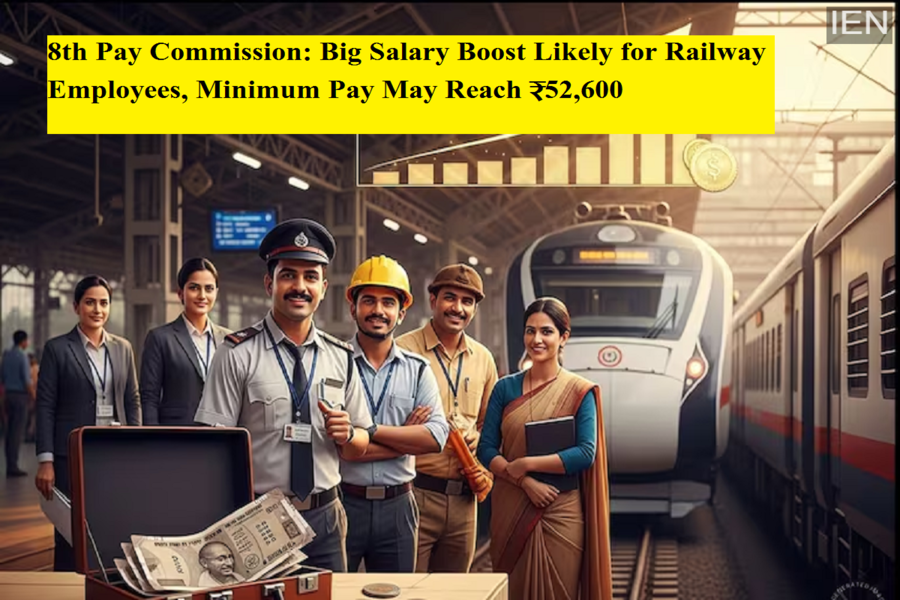
There could be major relief ahead for railway employees under the upcoming 8th Pay Commission, as fresh proposals suggest a significant increase in salaries, allowances, and benefits. According to recent developments, the minimum basic salary for central government railway staff may rise to around ₹52,600, along with a revised pay structure and multiple fitment factors.
These proposals have been submitted by the Indian Railway Technical Supervisors Association (IRTSA), which has urged the government to implement wide-ranging changes to better reflect the responsibilities and skill levels of technical employees.
Proposal for Multiple Fitment Factors
One of the most notable demands is the introduction of five different fitment factors instead of a single uniform multiplier. The association argues that employees at different levels have varying responsibilities, experience, and job complexities, and therefore should not be evaluated under the same formula.
The proposed fitment structure includes:
- Level L-1 to L-5: 2.92
- Level L-6 to L-8: 3.50
- Level L-9 to L-12: 3.80
- Level L-13 to L-16: 4.09
- Level L-17 to L-18: 4.38
This tiered system is expected to create a more balanced and fair salary structure across different employee categories.
Expected Salary Structure for Key Posts
The proposal also outlines revised salary levels for various technical positions in the रेलवे (railways) sector:
- Junior Engineer (Level-7): ₹1,57,400
- Senior Section Engineer (Level-8): ₹1,66,800
- Head SSE (Level-9): ₹2,01,600
- Chief SSE (Level-10): ₹2,13,000
- Principal SSE (Level-11): ₹2,57,000
These figures indicate a substantial increase compared to current pay scales, making the proposal highly significant for employees.
Annual Increments and Promotions
The association has also recommended:
- 5% annual increment for employees
- Additional increment benefits equivalent to two years’ growth during promotions
In terms of career progression, a revised MACP (Modified Assured Career Progression) system has been suggested. Under this, employees could receive up to five promotions over 30 years, at intervals of 6, 12, 18, 24, and 30 years.
Key Changes Proposed in Allowances
Several important changes in allowances have also been proposed:
Dearness Allowance (DA)
- Creation of a new Consumer Price Index (CPI) including modern expenses like internet, health insurance, and bottled water
- Proposal to make DA tax-free
- Suggestion to merge 50% DA with basic salary
House Rent Allowance (HRA)
A revised four-category structure has been suggested:
- Class A cities: 40% + DA
- Class B cities: 30% + DA
- Class C cities: 20% + DA
- Class D cities: 10% + DA
Other Benefits and Welfare Proposals
The IRTSA has also pushed for improvements in employee welfare:
- Night Duty Allowance (NDA): Removal of existing limits and application of a uniform formula
- Children Education Allowance (CEA): Coverage up to postgraduate level with ₹10,000 monthly support
- Travel Allowance: Proposed increase to three times the current rates
- Leave Encashment: Up to 50% encashment allowed; retirement limit increased from 300 to 600 days
Retirement and Insurance Benefits
The proposal also focuses on long-term financial security:
- Demand to reintroduce the Old Pension Scheme (OPS) for employees recruited after 2004
- Increase gratuity limit to ₹50 lakh
- Enhancement in group insurance coverage up to ₹50 lakh with lower premiums
Why These Proposals Matter
According to the association, these demands are based on the increasing workload, technical complexity, and risk involved in railway jobs. The goal is to ensure that employees receive compensation that matches their skills and responsibilities.
Final Takeaway
While these proposals have created optimism among railway employees, it is important to note that they are still under consideration. The final decision will be taken by the 8th Pay Commission, and any changes will be implemented only after official approval.
If accepted, these recommendations could lead to one of the most significant salary overhauls in recent years—bringing higher income, better benefits, and improved financial security for thousands of railway employees across India.
