
YouTube's New Rule: Harder to Hide AI Content; AI Labels to Appear on Videos and Photos—Find Out How It Will Impact Reach..
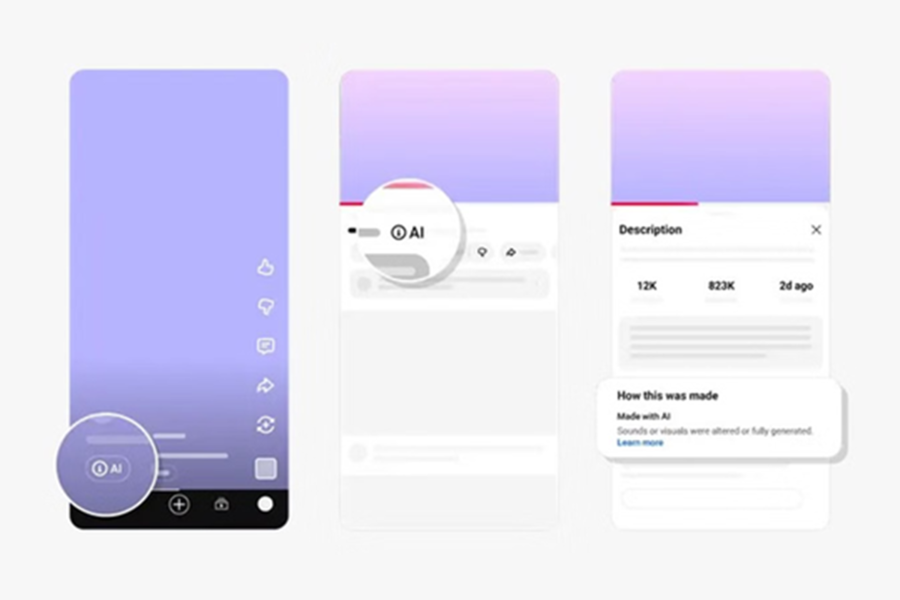
AI-generated content detection: AI-generated videos are spreading rapidly across the internet. These videos and photos are so realistic that it has become difficult for average users to distinguish between what is real and what is fake. In light of this, YouTube is set to implement a major change on its platform. Moving forward, "AI-generated" labels will be prominently displayed on all YouTube content—including long-form videos and Shorts—so that viewers can immediately identify whether AI has been utilized in the creation of the content. Additionally, YouTube is introducing an automated AI detection system that will independently identify AI-generated content.
YouTube Shorts AI label: AI labels will now be clearly visible on videos and Shorts
Previously, AI disclosure labels on YouTube were often hidden within the description panel, causing them to go unnoticed by average viewers. However, this is now poised to change completely.
Here is how:
For Long-form Videos: If a long-form video has been created using AI, its disclosure label will now appear directly below the video player and immediately above the description section, ensuring that it catches the user's eye.
For YouTube Shorts: Furthermore, viewers watching Shorts will now see an AI label displayed as an overlay directly on top of the video itself, allowing them to instantly determine whether the content is authentic or AI-generated while scrolling through their feed.
Which Content Will Feature the New AI Disclosure?
The company states that this new labeling policy will apply to all photorealistic and "meaningfully altered" AI-generated content. This means that if a video appears to have been shot using a real camera—but was actually created or modified using AI—YouTube will display a label on it. However, for content that is animated, humorous, unrealistic, or features only minor modifications, the disclosure may still appear within the description section.
YouTube Will Independently Identify AI Content
The most significant aspect of this major rollout is YouTube's new automated AI detection system. In other words, YouTube's own AI technology will automatically identify AI-generated content created by creators. Even if a creator attempts to be deceptive by failing to manually disclose the use of AI in their video, YouTube's internal signals will still detect it.
Furthermore, if YouTube identifies significant use of photorealistic AI in a video, the platform will automatically apply an 'AI' label to it. However, creators will retain the right to update or challenge the disclosure status if they believe their content has been flagged in error.
**AI Labels May Be Permanent on Certain Videos**
YouTube has clarified that, in some instances, the AI disclosure cannot be removed; it will remain entirely permanent. These cases include the following types of videos:
**Videos created using YouTube's AI tools:** If a creator has produced a video using YouTube's own AI tools—such as Veo or Dream Screen—the AI label may appear on it permanently.
**Content containing C2PA metadata:** Content that includes C2PA metadata and clearly indicates full AI generation may also be subject to a permanent disclosure.
**Option to Update Status if Incorrectly Flagged**
The company has also clarified that if a creator believes their video has been mistakenly flagged as AI-generated content, they may request to update the disclosure status.
**Will this impact creators' monetization and reach?**
No. YouTube has implemented this system with its creators' earnings in mind. The company has explicitly stated that creators need not be concerned; the presence of an AI label will not affect a video's monetization eligibility or its performance within the recommendation system. In other words, the sole purpose of the AI disclosure is to enhance transparency, not to limit the reach of the content.
**Why This Change Became Necessary**
Over the past few months, there has been a manifold increase in the volume of fake and photorealistic videos created with the assistance of AI tools. In light of this, YouTube wants viewers to be able to easily distinguish between content that is authentic and content that has been created with the help of AI. The company believes that this step will help maintain trust in the platform.
Disclaimer: This content has been sourced and edited from Amar Ujala. While we have made modifications for clarity and presentation, the original content belongs to its respective authors and website. We do not claim ownership of the content.
