
Solar panels laid on train tracks instead of rooftops! This country is set to achieve a remarkable feat..
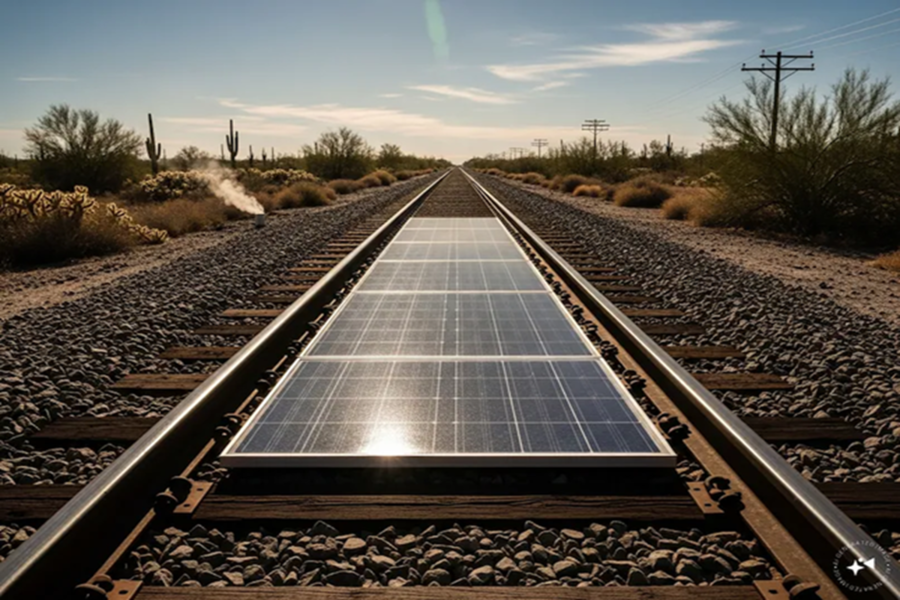
In our country, over 2.4 million households have solar panels installed. But did you know there is a country where solar panels have been laid right between the railway tracks? We are talking about Switzerland, where a startup called Sun-Ways has launched a unique solar project. In April 2025, 48 solar panels were installed on a 100-meter stretch of track near the village of Buttes. You might be wondering why these panels were placed where trains pass over them; here is the answer.
These solar panels are designed to withstand the weight, vibrations, and dust generated by passing trains. This three-year trial aims to generate clean energy without utilizing agricultural land. Trains pass over these panels without stopping. This technology has the potential to transform railway networks worldwide into solar farms. Joseph Scuderi, the founder of Sun-Ways, conceived this idea in 2020 while at a train platform.
He devised a plan to utilize the empty space between railway tracks for installing solar panels. The company collaborated with the Swiss track maintenance firm Scheuchzer to develop a specialized system. This system can lay 1-meter-wide panels—much like unrolling a carpet—beneath moving trains. It can cover up to 1,000 square meters in a single day. The panels are fully removable, allowing them to be taken out for maintenance and reinstalled; furthermore, the work can be carried out without disrupting train services.
In 2023, Swiss voters rejected a proposal to install solar panels in the Alps. Large-scale solar farms often impact agricultural land, open fields, and scenic landscapes. Railway tracks, however, are already established on government-owned land and receive direct sunlight. Installing solar panels on them eliminates the need to clear new land and results in less environmental damage. According to researchers, installing solar panels in locations such as railway corridors, canals, and parking areas is a superior option.
In 2023, the Swiss Federal Office of Transport rejected the project due to safety concerns. The International Union of Railways also raised objections, citing potential issues like micro-cracks, fire hazards, and glare that could disturb train drivers. Sun-Ways addressed all these concerns by reinforcing the panels, applying anti-glare coatings, and installing sensors. The project received approval after a 10-month review. The panels are now withstanding the weight of trains, brake dust, and mechanical pressure.
This is a small-scale, 18-kilowatt project expected to generate approximately 16,000 kilowatt-hours of electricity annually—enough to power a few households. However, the primary objective is not electricity generation but testing the panels' durability under active train traffic. The trial will run until April 2028, monitoring factors such as glare, dirt accumulation, panel malfunctions, and track compatibility. If successful, the system could potentially generate 1 terawatt-hour of electricity from Switzerland's 5,000 kilometers of track—representing 2 percent of the country's total consumption.
There are over a million kilometers of railway lines worldwide, and this system could potentially be installed on half of them. However, challenges remain regarding tunnels, shaded areas, snowy regions, and junctions. France's rail operator, SNCF, is analyzing the results of this pilot project, and several other European rail operators are observing the initiative with interest. The United States, which boasts the world's longest rail network at 140,000 miles, is also exploring this technology. It offers an excellent method for generating solar energy without requiring additional land.
According to an Economic Times report, Sun-Ways CEO Joseph Scuderi envisions trains running on electricity generated directly from the tracks they travel on, with power from the panels feeding straight into the train's traction system. While this goal is still some way off, it appears feasible. Martin Heinrich, a researcher at the Fraunhofer Institute, has hailed the concept as an excellent idea. Notably, Sun-Ways is the first company to develop a removable solar system designed for use with moving trains. A decision regarding the next steps will be taken only after a three-year trial period.
This project also demonstrates that solar panels can be installed without cutting down forests, damaging agricultural land, or acquiring new land. If successful, this project could transform railway networks worldwide into sources of green energy. This small-scale experiment in Switzerland could mark the beginning of a major shift. For now, the trains are running, and the focus is on seeing how successful this technology proves to be.
Disclaimer: This content has been sourced and edited from News18 Hindi. While we have made modifications for clarity and presentation, the original content belongs to its respective authors and website. We do not claim ownership of the content.
