
Smartwatch vs. Fitness Tracker: Which has better battery life—Fitbit Air or Google Pixel Watch? Know the difference..
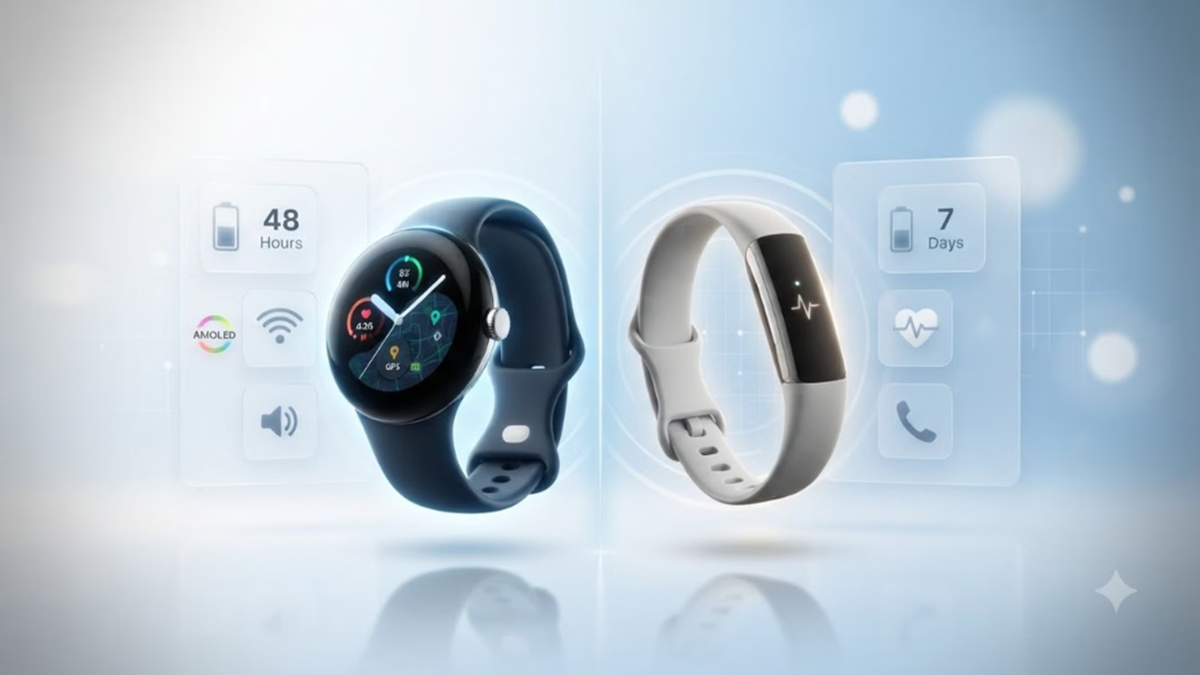
There can be significant differences in features and battery life between smartwatches and fitness trackers. Smartwatches, which typically feature larger screens and more advanced smart capabilities, usually require more frequent charging, whereas screenless fitness trackers can last for several days. The Fitbit Air and Google Pixel Watch are examples of such devices. If you are unsure about the differences regarding battery backup and features, let’s take a closer look at how they compare.
How long does the Fitbit Air last?
The Fitbit Air is claimed to last up to seven days on a single full charge. It primarily tracks health metrics; however, you need to use a phone to view this data and other information.
In real-world usage, the battery backup was found to be close to the company's claims. One reviewer used it continuously for seven days and still had about 15 percent battery remaining. Meanwhile, in a test by PhoneArena, the battery level dropped from 70 percent to 29 percent after four days of use.
What is the battery life of the Pixel Watch 4?
The 41mm model of the Google Pixel Watch 4 is claimed to last up to 30 hours with the Always-On Display enabled, while the 45mm model is rated for up to 40 hours of battery life.
The new Pixel Watch 5 is also rated for up to 40 hours of battery life. However, in actual usage, the Pixel Watch 4's battery backup exceeded the company's claims.
According to a test by Android Central, the 45mm model lasted for about 48 hours, with 10 to 15 percent battery remaining at that point.
Additionally, Google claims a battery backup of up to 72 hours—or about three days—for the 45mm model when Battery Saver mode is enabled.
How do the Fitbit Air and Pixel Watch 4 differ?
Beyond battery life, there are also significant differences in the features offered by the two devices. The Pixel Watch 4 features a 3,000-nit AMOLED display, a speaker, dual-frequency GPS, and an LTE radio in the cellular model.
In contrast, the Fitbit Air lacks features such as a display, built-in GPS, and a speaker; it relies on a phone for data like location information. Consequently, the two devices cater to different needs.
Which device for whom?
The Fitbit Air focuses primarily on tracking health and fitness metrics, whereas the Pixel Watch 4 offers a wider range of features as a full-fledged smartwatch. Due to its larger screen, GPS, and other smart capabilities, the Pixel Watch 4 has a shorter battery life compared to the Fitbit Air.
Google suggests using the Pixel Watch during the day, while the Fitbit Air can be worn at night for sleep tracking. Thus, rather than viewing them as direct alternatives to one another, the two devices can be seen as serving distinct needs.
