
Satellite: Network straight from the sky to your phone! By 2030, 46% of the world's smartphones will feature satellite calling..
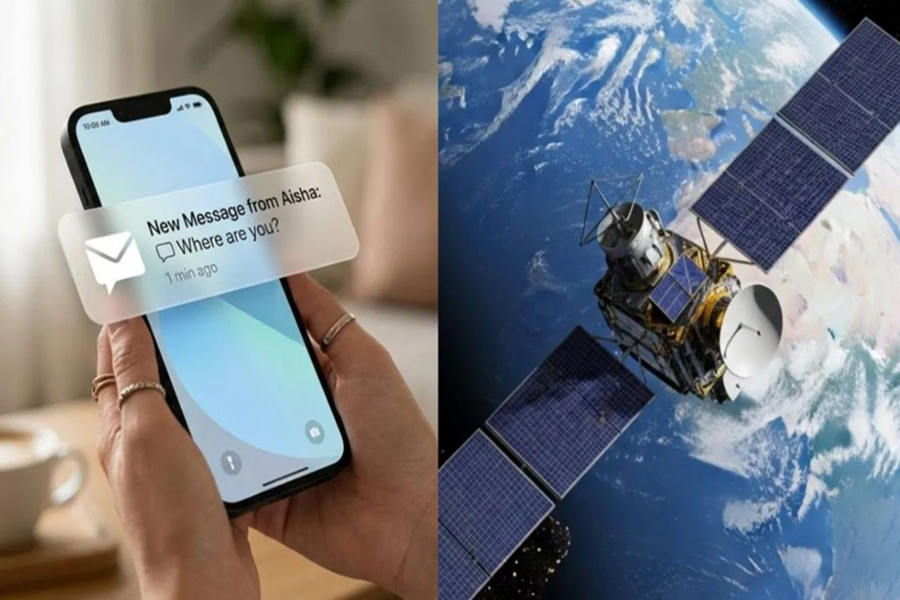
The world of smartphones is now entering a new and exciting era. The day is not far off when issues like poor network coverage or "no signal" will become relics of the past. According to a recent report by the renowned research firm Counterpoint Research,' smartphones equipped with satellite connectivity are rapidly gaining ground in the market. It is estimated that by 2030, 46 percent (nearly half) of all smartphones sold globally will feature 'Direct-to-Satellite' (NTN-capable) connectivity.
However, initially, this feature will primarily operate within companies' own proprietary networks, as it will take some time for a common global standard (such as 3GPP NTN) to be fully established.
**Apple Paved the Way; Now, Multiple Brands Join the Race**
The credit for pioneering this technology goes to Apple. In 2022, with the launch of the iPhone 14, Apple stunned the world by introducing the Satellite SOS feature. To enable this, Apple partnered with the satellite company 'Globalstar.' Interestingly, the e-commerce giant Amazon recently acquired Globalstar, thereby opening up a vast new market for Amazon in the realm of 'Connectivity-as-a-Service.'
Following Apple's lead, the Chinese company Huawei introduced this feature in its smartphones in 2023. Today, the landscape has evolved to a point where more than 10 major smartphone brands—including Samsung, Google, Xiaomi, OPPO, and Vivo—are offering satellite connectivity in select models.
**Who Leads the Pack?**
Soumen Mandal, a Principal Analyst at Counterpoint, states that when it comes to selling smartphones with satellite connectivity, Apple remains the dominant player. Meanwhile, within the Android ecosystem, Samsung is currently leading the charge. Apple, Huawei, and Google are pursuing a strategy of utilizing their own proprietary satellite networks. Conversely, Samsung and other Chinese brands are adopting a common standard known as 3GPP NTN, aiming to make this technology widely and easily accessible to everyone in the future.
**Why is this feature limited to expensive phones?**
Currently, satellite calling capabilities are predominantly found only in ultra-premium (expensive) smartphones. The primary reason for this is that, for the time being, the application of this technology is restricted solely to sending emergency messages (SOS). Experts believe that until a "killer use case"—such as standard voice calling or internet access—emerges for this technology, the general public will not prioritize it. While the arrival of 3GPP Release 18 is expected to expand its presence within the premium smartphone segment, its introduction into budget-friendly, mid-range devices will likely only become feasible following the release of 3GPP Release 19.
**The U.S. Takes the Lead; The World Waits**
At present, the United States stands at the forefront of satellite connectivity. Major U.S. telecom operators—such as T-Mobile, which has partnered with SpaceX, and AT&T, which has teamed up with AST Mobile—have signed significant agreements in this domain. However, telecom companies in other major markets, such as Europe and China, are currently showing no urgency to roll out this technology.
Disclaimer: This content has been sourced and edited from Amar Ujala. While we have made modifications for clarity and presentation, the original content belongs to its respective authors and website. We do not claim ownership of the content.
